Category Archives: ProfessionalLearning

Breadcrumbs and Ripples

The 2015 WRDSB learning carousel day focused on  Innovative Change  was a great day of learning and connecting for me. I was impressed with the quality and quantity of the sharing sessions and loved the energy in the room.  As a reflection,  I wanted to share a few things that resonated with me by bringing together ideas from two conversations.

Each year, we have been purposeful about initiating targeted new projects to model change, inform our collective practice and leverage opportunities to share and role model.  Some of our projects from the last few years are captured in this whiteboard ‘clip’.
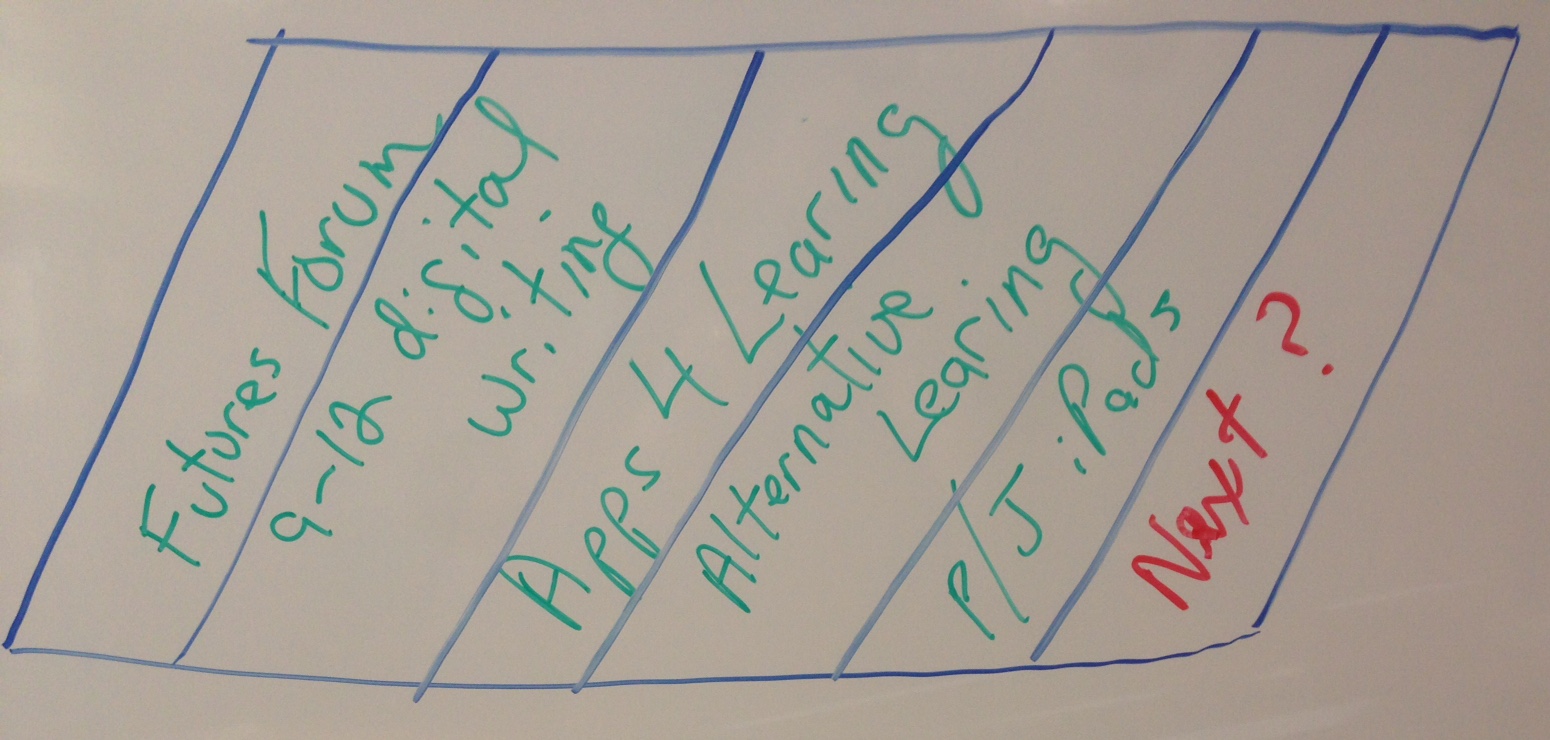
TELT-01

Along this journey, we have learned some important items or “breadcrumbs” as I like to call them,  that should be applied to new projects and scaling up strategies as we move our innovative change agenda forward.

Some of our breadcrumbs include:

  • learning IS messy. We need to accept this and continue to play in this space.
  • co-learning between teachers, and teachers & students is a really important element.  It is OK to fail.
  • shifting writing from paper to digital spaces makes a difference
  • student voice and choice are motivators in the learning process
  • using technology as an enabler creates new possibilities  to be explored in the context of the C’s and the  SAMR model.  Think about boundless and joyful learning.

breadcrumbs

In my view, as we look at a path forward, each of us has to own our piece of the collective through our own actions.  I like the question,  what is your next?  Creating a culture where:

  • conversations of change and identifying entry points are ongoing and natural
  • we celebrate small steps forward with joy and encouragement
  • the process of nudge, encourage, give/have  permission and expect is openly explored
  • we continue to be intentional and
  • we share our experiences in open and  easy to access ways

are all important elements in sustaining the synergy and  energy of forward movement.

ripple effect

Join the move to  innovative change and add to the ripple effect.  Learn, connect, reflect and share.

~Mark

Related Resources

The storify of the days twitter stream.

The ongoing twitter discussion at  #wrdsbchange.

The  Innovative Change  blog.

EdCampHam – sharing the learning

Hats off to the organizers of the  Ed Camp Hamilton  event – great turn day, great turn out and awesome conversations.  I really enjoyed the positive energy of a professional learning event where people chose to attend and brought their opens minds – wonderful!!!

I wanted to share a few resources from the event so that the learning and ideas continue.

The twitter stream is captured online via  Storify.

Archives from the live streaming are now up on YouTube.  Enjoy these deep conversations:

Math

The Ins and Outs of blogging with students

Collaborative Inquiry


Monitor the Twitter stream at #edcampham

Keep the learning going!

~Mark

Learn Virtually at Ed Camp Hamilton

On Saturday April 18th I will be sharing my learning at Ed Camp Hamilton  via the Twitter Stream at #edcampham. I will also be live streaming some sessions at [here] (view with free account).

Will you join in?

~Mark

edcamp-attending

uLead: Engagement Take 2

In the uLead 2015 Monday afternoon keynote,  Andy Hargreaves spent some time exploring the idea of student engagement. He closed by asking us to do some deep thinking about the notion of engagement.   What does it mean in our K-12 context?  I felt compelled to comment on the challenge and explore this for myself.

stop the press

This is my second go at writing this blog post.  Wait!  Maybe I am engaged with this task.  Aha!!!  Here we go with a clean slate, or whatever you call that in bloggers land – a clean screen or a clean digital writing space perhaps?

I am thinking that perhaps instead of getting stuck on some formal or historic definition of engagement, I am simply going to consider it in this learning context as being “in the active learning & participating  zone”.  My way of considering this will be to consider a number of factors as they relate to the person I know best — me.

I know I can be engaged when alone or with others.  A good example for me is music. I might be practicing a new piece of solo music or perhaps rehearsing with the members of my quintet.  I should be totally engaged during a performance situation.  Perhaps focus vs distractedness is an element of this too.  Level of readiness or willingness also plays into this.

IMG_0100

I know that I can be engaged with or without technology. For those of you that know me, I’ll bet the “yah right” thoughts are  flowing through your mind.  So yes, there a lots of ways I engage with and through technology: learning something new, solving a problem, collaborating, reading, discussing, searching, researching … arranging a piece of music, writing a blog post 🙂 …  and on the list goes.  It might be the technology itself – learning to use a GoPro camera or a Myo wrist band, or the technology might simply be the means to get to another process such as writing, composing, arranging or creating.

MYO

I enjoy a great conversation too: something new, something deep or maybe just a new context.  I like variety – these conversations could happen F2F, on a walk, over the phone, or online.

I know the potential level of participation and/or newness plays a role.  I am sure we can all think of a scenario or two when you simply want to opt out or not be there … the KMN situations.

Timing is a factor for me.  I am in tune with my high and low  energy  times. I might be more or less engaged depending on my energy level.  Balance is in the mix too.  I know when I need my introvert time – recharge time. In some ways this is a powerful force within me – a must have.  I know that I will not engage well in an extroverted situation when I am in introvert recharge mode.  Simple:  overruled,  not happening.

As I think through this, I am realizing what engagement isn’t. I don’t think engagement is a one size fits all “thing”. There is no magic formula that applies to all people in all situations.

cookiecutters

So,  put those big paint brushes and cookie cutter ideas away.  There are no everyone should  do this, stop that, use this, don’t use this etc. solutions.  Engagement is a complicated recipe that has many variables.

Perhaps the secret is building our skills as learning chefs by being aware of the ingredients and knowing how to create that perfect recipe with the ingredients on hand.

Develop skills in reading people as individuals and groups, consider readiness and trust in trying something new, sense the energy level, learn to maximize participation, ask great questions, poke at what comes next, what if, I wonder … know your learners.

Clearly,  this is a complex topic. I know I have much more to learn about this topic.  Help me learn by sharing a comment or insight here,  send me a link to your blog post about this or consider connecting on social media.  Whatever you do, on your own terms:

engage

~Mark


uLead15 Keynote reflections

The kickoff to the uLead 2015 conference was spectacular: over 800 educators at a great venue with Simon Breakspear and Abdul Chohan keynoting.

Simon focused on 3 keys for critical change:

  • Design Learning Futures
  • Embrace Radical Collaboration and
  • NEVER stop learning.

I am keen to reflect on this framework and see what else I can learn about the approach.

Now, how many times have we heard the “never stop learning” or “life long learners” messaging.  The giant  BUT  is you HAVE to LIVE it – lip service doesn’t make the grade.  Not only can we never stop learning, but we have to take things to the next level:  connected learning, a commitment to sharing and making your thinking visible.

Are you up for the challenge?

I really enjoyed hearing Abdul’s story and appreciated the learnings he shared.  Some personal highlights include:

  • theories of action do not equal a well understood vision
  • technology allows us to do things we just could not do before – in all walks of life.  Why resist this in education?
  • go beyond substitution to redefine (#SAMR thinking)
  • leading change: build community, secure accountability, manage process, develop the people and secure with vision
  • Simple, reliable and equitable technology is ESSENTIAL
  • increasing planned coincidences
  • take it global
  • the challenge of taking the complex and making it simple

EasyButton

The highlighting of the easy button approach to technology really resonates with me. Complexity drives people away which means the flow between F2F, online, and digital resources is broken … the chance to do something that was not previously possible (#SAMR) is gone or at least unlikely.  Simplicity, reliability, equitable access and sufficient bandwidth are requirements.  I think this aligns with the ideas of Digital Inclusion.

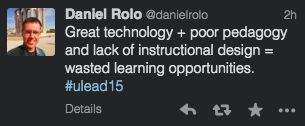
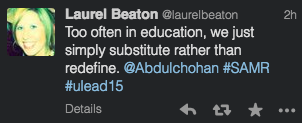
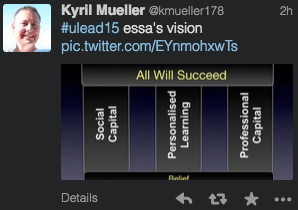
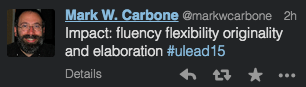
Finally, a few tweets to give you a flavour of the learning and sharing. Check out the full stream at  #ulead15.

u01

u02

u03

u04

u05

u06

u07

u08

u09

and … Abdul’s closing challenge.

u10

~Mark

Publishing Makes a Difference

I recently had an opportunity to enjoy a site visit to John Mahood PS,  a WRDSB  K-5 school to see a their technology use in action.

Under the leadership of principal Tracy Tait, the staff has been working hard over the last 3 years to explore new effective ways to utilize technology to enable student learning in new ways, change and improve practice and share their successes.

The traditional lab at the school has been dismantled and the desktops have been redistributed throughout the school.  The mobile technology (iPads and Chromebooks) within the school has been allocated so that each classroom has a minimum of 6 to 8 devices to share among the students.  The lab space is now used as a “tech lounge” – more of a flexible creative work space.

In a site walk through, Tracy commented that she expects staff to integrate mobile technology into the learning environment as part of their daily practice.  I enjoyed observing a couple of classes during silent reading time and seeing that student had a choice in both what they read and HOW they read it: paper based, via iPads or Chromebooks. Talk about a great example of student voice and choice!

The school focus on choice for students is making a noticeable difference.  Several staff commented about technology options providing choice and independence for students.  In some cases, the use of technology created benefits in socialization between students both in and out of class.  In conversation, it was noted that technology use  improves the focus on learning which in turn impacts behaviour in a positive way. In some cases, the use of technology removes frustration when paper and pencil based tasks create an obstacle for students.  The result is increased  participation through differentiated approaches.

This video captures some of the observations and thinking of students and staff at the school.

[youtube http://youtu.be/eEDd5oOwI4k]

Ethan’s Story

Kyle’s Story

Samuel’s Story

Note: The video and story presentations are published with permission.

~Mark

Purposeful Connecting

As I was reviewing materials for some upcoming presentation, I was struck by the insightfulness Silvana Hoxha shared in the interview I did with her in preparation for an OSSEMOOC submission to the K12 Online Conference.

I am confident that you will find Silvana’s message inspiring. Grab a comfy chair and enjoy the message she has to share.

Related Resources

Connected Learners Need Connected Leaders – an Ontario Perspective. (K12 Online Conference Submission)

TEDx Talk by Mark W. Carbone & Donna Miller Fry
(TEDxKitchenerED: Connected Learners Need Connected Leaders)

~Mark

Virtual Sharing with ADSB

I experienced a wonderful virtual learning opportunity this week with some fantastic educators from ADSB.  Donna Fry, who was leading the learning sessions on site, invited me to provide a kick off presentation to their day.  My task was to ignite some change thinking by linking the areas of technology enabled learning, technology change and bringing collaboration into eLearning.

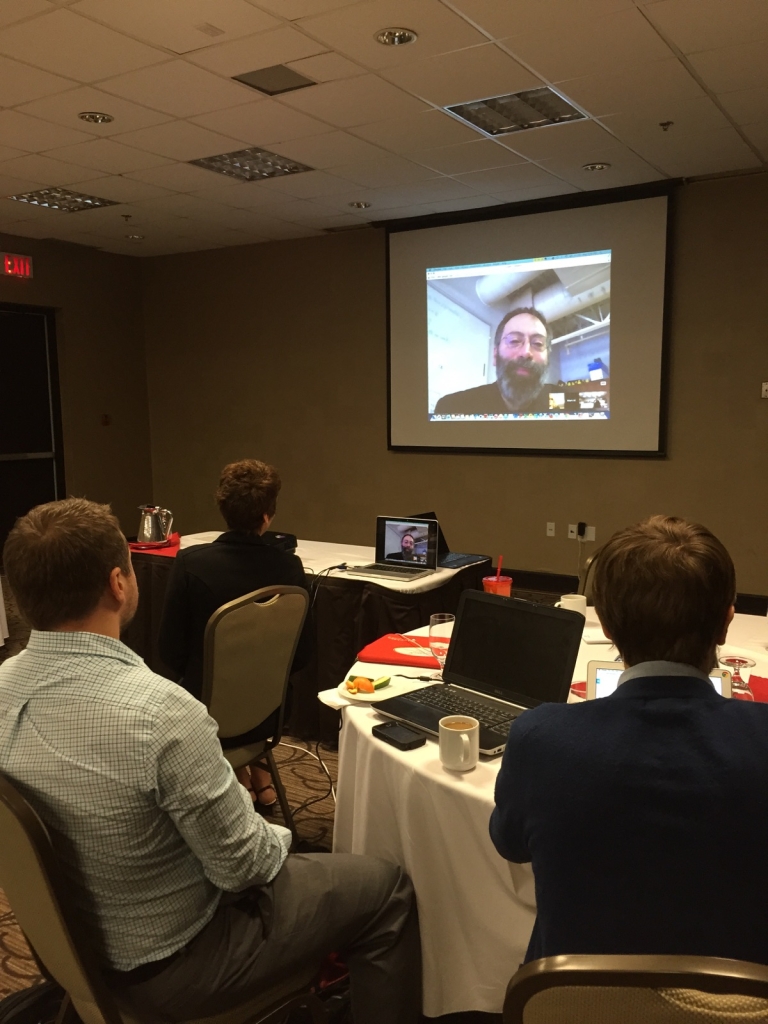
virtual keynote

virtualkeynotescreen

I loved the idea of doing a virtual keynote – what a perfect way to “walk the talk” in terms of connected learning and modelling what we need our students to do.

While there are a variety of tools one could use for this type of activity, we settled on Google Hangouts (GHO) for our session.


Of course, the technology all worked flawlessly <big grin!> – a good demonstration of technology creating a natural flow of sharing.


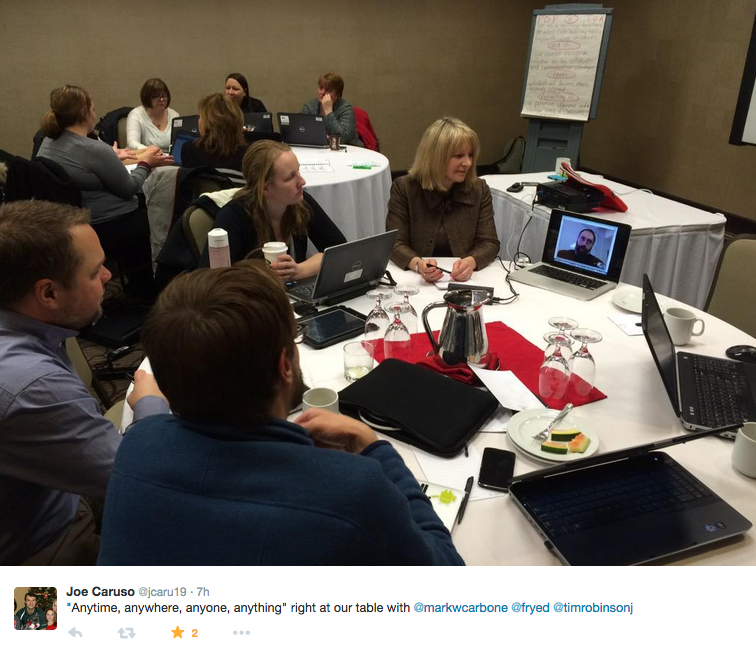
I really enjoyed being able to participate in a timed table talk opportunity following my presentation as Donna kindly relocated me from the “big screen” to the table.

I was certainly struck by the power of this. We collectively decided that this was a virtual F2F learning session.

ADSB_table_talk

Linking back to the theme of the day and my task with the opening kick off, I could envision a day when virtual F2F learning opportunities are normalized into  learning environments.  I look forward to learning with these educators as they develop their connecting and collaborating strategies.

~Mark

Resources:

Learn more about the background of the Futures Forum Project.

On the ground with Futures Forum.

SAMR examples from OSAPAC.

SAMR as a growth model

SAMR on scoop.it

Leveraging the Room

Last week I had the opportunity to attend an OASBO session where the main topic was succession planning.  The discussion started with considering communication processes in a simply way:  transmitters and receivers.

Now, move this idea to a mentor/coaching relationship between two people.  We were asked to divide ourselves into groups of three to tackle the task of listing attributes you would want to have in your mentor/coach.

crowd_source

         Image via www.socialbrite.org

I decided to see what would happen if we crowd sourced answers to this question. I popped the question out onto twitter hoping that some of my PLN would spot the request and take a moment to respond. The plan worked great as I received a number of responses during the work time allotted.

By happenstance our group was chosen to report back first.  One of my colleagues reported back on our strategy.  I wished I had recorded the reaction in the room as our approach was described (gasp, shock, what?, we didn’t ‘do the work’, you can’t do that). The guest presenter went with the situation as he was quite interested in our approach.

what they said 2

          Image via: chesapeakeadd.com

Here are the PLN responses to the question:  What makes a good mentor/coach?

  • engagement
  • vision
  • empathy
  • credibility
  • respect for the people they lead
  • active listener
  • humility
  • courage
  • geniousness
  • openness
  • accessible
  • transparent (honest, no hidden agendas)
  • relationship builder

People were impressed with the quality of thoughtful responses of the  PLN generated answers.  Additional responses from the session members included knowledge, flexible, sympathy, empathy and show confidence in others.

The facilitator added

  • being a sounding board (note importance of just listening … (you don’t always need an answer)
  • an objective view: a fresh set of eyes and
  • accountability in process

All in all a great list of important qualities for a mentor or coach to have.  Plus, it was a great impromptu demonstration of leveraging yourPLN.

Many thanks to PLN members   @EdDoadt,   @KentManning,  @ispgrew,  @alanacallan,   @mstayica,   @sheilashauf,  @fryed,  @jp_payeur,  @heidi_hobson and  @LAndriessen  for taking time to respond and contribute to a great learning experience.

~Mark

Thinking About Professional Learning

Reblog from  OSSEMOOC.

If you were not able to join us live this evening,  the session recording is now available [here].  A summary of some of the thinking we shared, and some of the questions that arose from the discussion are captured below.  Please feel free to continue the conversation in the comments.

I’m not sure we answered any of the questions we used as provocations this evening, but the discussion was rich, and it led to more questions.

We began with this question:

“How does a shift occur from a mindset where learning is provided to a culture where learning is sought?”

This applies to students and teachers.  It’s a big shift!  But we are seeing a critical mass now believing that this must go forward.  Consider this link shared this evening: http://mltsfilm.org/

Or, consider this story about China telling its students to quit school: http://zhaolearning.com/2015/01/22/china-encourages-college-students-to-suspend-study-and-become-entrepreneurs-and-innovators/ .

Raghava KK spoke eloquently on this very topic last weekend at #Educon.

Agency, or ownership of learning, is a powerful concept when we consider both student and adult/educator learning.

We know that parents need to be involved in the shift.  They are products of a system built in the 1800’s, but it is the system they trust.  How do we bring them into the conversation of what education needs to look like in the year 2015?  How do we address their concerns about “preparation for high school” and “preparation for university”?

Is the inertia of higher education a brick wall preventing change? Is the focus on marks as the filter for higher education opportunity stifling learning?

What is the importance and impact of “tradition” on the work we are doing in trying to change to a culture of learning?

Student teachers exist in the higher education system.  How does this affect their thinking about what education can be?

We hear university professors complain that students don’t have the critical thinking skills they expect, yet the entry filter into university is a two digit number that may have nothing to do with critical thinking skills.

Will our elementary students in Ontario today be the drivers of change?  Will they stand up for quality opportunities for inquiry over memorization and test taking?  Will they resist a system that forces them to memorize answers instead of encouraging them to ask questions?

How much curiosity will they be able to retain?

How can we disrupt the thinking around professional learning.  Do we need a new name for PD days?  What might that look like?

PL (Professional Learning) Day? SD (Self-Directed) Day? PLC Day?

Do you believe that all educator professional learning should be directed by what knowledge and skills the data indicate that students need to succeed (i.e., that all professional learning is based on student learning needs)?

Can professional learning be based on the passions of the educator?

Are you working in an environment where your colleagues challenge your practice to make you think deeply about what you are doing?

Are we valuing professional capital (Fullan and Hargreaves) enough?  Sal Khan says that the nations who will be strong in the future are those who have nurtured innovation and creativity among their people, as we shift from and industrial to an information society (http://mltsfilm.org/).

Do you think that “Professional Development” creates a culture of learned helplessness? Have we taught educators to wait for someone to teach them?

Have we done the same for our students?

Is this the only PD really needed: “The opportunity to learn where to find something when we need to learn about it”?

If we want kids to explore and learn, why would we sit back and wait for someone to teach us?

Should schools create a culture of teacher-learner agency?

(From Wikipedia, “In the social sciences, agency is the capacity of individuals to act independently and to make their own free choices”.)

We’d love to hear your thinking about this.  Feel free to comment, and please join us live next Tuesday at 8 p.m. EST for more thinking and learning on this topic.  More details will be posted at the OSSEMOOC site.