Category Archives: Leadership Perspective

The Importance of Now and Next

N  O  W
E                     
X
T

Last fall I can remember sitting in a Starbucks with Donna Fry working on our  OSSEMOOC  project, and talking passionately about the importance of being “present” – living life in the moment and explicitly doing the best thing possible in that moment:  listen, understand, suggest, advise, coach, act …  you get the picture.   I don’t recall specifically how we got onto the topic, but the importance of the conversation stayed with me.  This is a choice,  a way of living, a way to interact with people.   That is the “now”.

StarbucksLogo

In his recent address to Microsoft employees on the 40th anniversary of  the company, Bill Gates restated his views on the importance of making  “the power of technology accessible to everyone, connect people to each other and make personal computing available everywhere.” 

And then, there it was – a very powerful quote:  “What matters most is what we do next”  he wrote. Let that sink in:  What matters most is what we do next.

Lets take a moment to frame the importance of now & next in terms of our GAFE Summit experience this weekend.

Clock-now

Be in the moment – learn, experiment, play, document,  ask and savour the joy of learning.
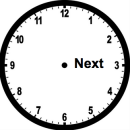
Clock-next

What will you do to

  • keep a new connection
  • document your learning
  • share your reflections
  • change your practice
  • make your learning visible and/or
  • nurture those around you?

It is up to you.  What is your  NEXT?

~Mark

Resources:   Read Bill Gates email address to Microsoft employees email address.


uLead15 Keynote reflections

The kickoff to the uLead 2015 conference was spectacular: over 800 educators at a great venue with Simon Breakspear and Abdul Chohan keynoting.

Simon focused on 3 keys for critical change:

  • Design Learning Futures
  • Embrace Radical Collaboration and
  • NEVER stop learning.

I am keen to reflect on this framework and see what else I can learn about the approach.

Now, how many times have we heard the “never stop learning” or “life long learners” messaging.  The giant  BUT  is you HAVE to LIVE it – lip service doesn’t make the grade.  Not only can we never stop learning, but we have to take things to the next level:  connected learning, a commitment to sharing and making your thinking visible.

Are you up for the challenge?

I really enjoyed hearing Abdul’s story and appreciated the learnings he shared.  Some personal highlights include:

  • theories of action do not equal a well understood vision
  • technology allows us to do things we just could not do before – in all walks of life.  Why resist this in education?
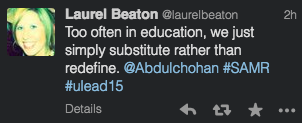
  • go beyond substitution to redefine (#SAMR thinking)
  • leading change: build community, secure accountability, manage process, develop the people and secure with vision
  • Simple, reliable and equitable technology is ESSENTIAL
  • increasing planned coincidences
  • take it global
  • the challenge of taking the complex and making it simple

EasyButton

The highlighting of the easy button approach to technology really resonates with me. Complexity drives people away which means the flow between F2F, online, and digital resources is broken … the chance to do something that was not previously possible (#SAMR) is gone or at least unlikely.  Simplicity, reliability, equitable access and sufficient bandwidth are requirements.  I think this aligns with the ideas of Digital Inclusion.

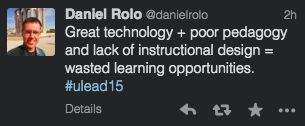
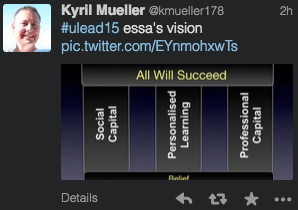
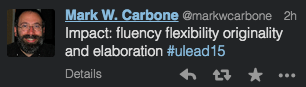
Finally, a few tweets to give you a flavour of the learning and sharing. Check out the full stream at  #ulead15.

u01

u02

u03

u04

u05

u06

u07

u08

u09

and … Abdul’s closing challenge.

u10

~Mark

Virtual Sharing with ADSB

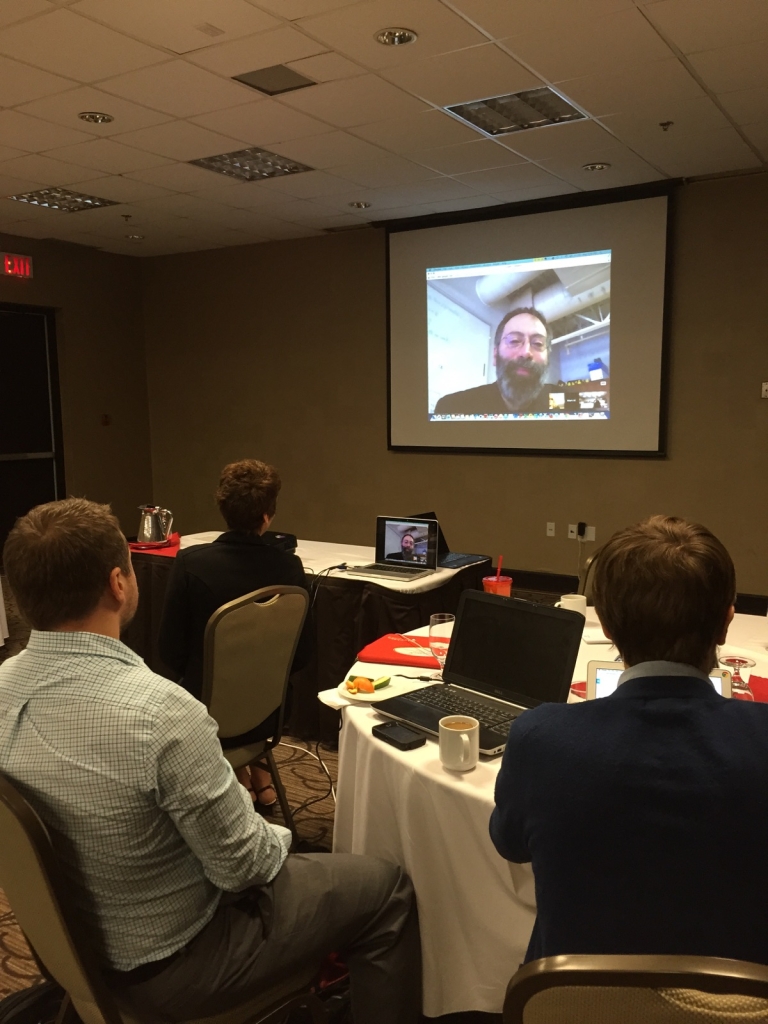
I experienced a wonderful virtual learning opportunity this week with some fantastic educators from ADSB.  Donna Fry, who was leading the learning sessions on site, invited me to provide a kick off presentation to their day.  My task was to ignite some change thinking by linking the areas of technology enabled learning, technology change and bringing collaboration into eLearning.

virtual keynote

virtualkeynotescreen

I loved the idea of doing a virtual keynote – what a perfect way to “walk the talk” in terms of connected learning and modelling what we need our students to do.

While there are a variety of tools one could use for this type of activity, we settled on Google Hangouts (GHO) for our session.


Of course, the technology all worked flawlessly <big grin!> – a good demonstration of technology creating a natural flow of sharing.


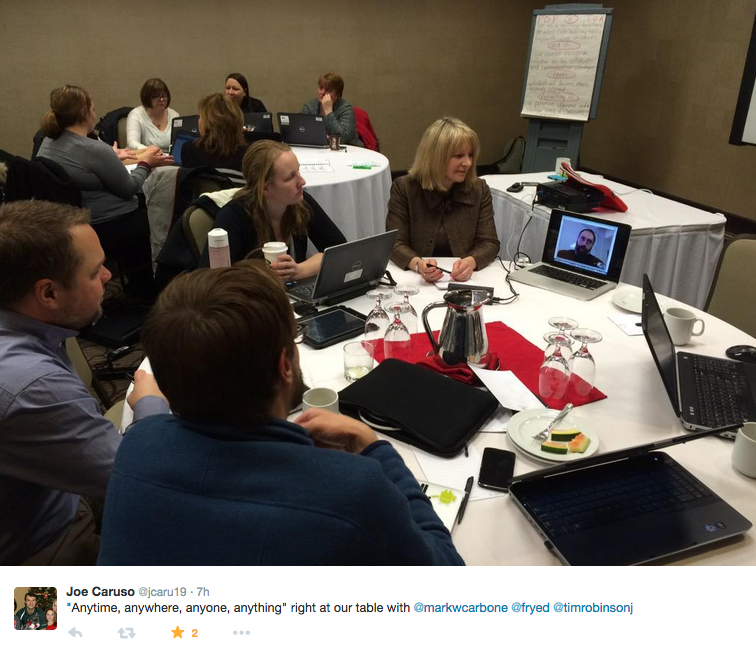
I really enjoyed being able to participate in a timed table talk opportunity following my presentation as Donna kindly relocated me from the “big screen” to the table.

I was certainly struck by the power of this. We collectively decided that this was a virtual F2F learning session.

ADSB_table_talk

Linking back to the theme of the day and my task with the opening kick off, I could envision a day when virtual F2F learning opportunities are normalized into  learning environments.  I look forward to learning with these educators as they develop their connecting and collaborating strategies.

~Mark

Resources:

Learn more about the background of the Futures Forum Project.

On the ground with Futures Forum.

SAMR examples from OSAPAC.

SAMR as a growth model

SAMR on scoop.it

Leveraging the Room

Last week I had the opportunity to attend an OASBO session where the main topic was succession planning.  The discussion started with considering communication processes in a simply way:  transmitters and receivers.

Now, move this idea to a mentor/coaching relationship between two people.  We were asked to divide ourselves into groups of three to tackle the task of listing attributes you would want to have in your mentor/coach.

crowd_source

         Image via www.socialbrite.org

I decided to see what would happen if we crowd sourced answers to this question. I popped the question out onto twitter hoping that some of my PLN would spot the request and take a moment to respond. The plan worked great as I received a number of responses during the work time allotted.

By happenstance our group was chosen to report back first.  One of my colleagues reported back on our strategy.  I wished I had recorded the reaction in the room as our approach was described (gasp, shock, what?, we didn’t ‘do the work’, you can’t do that). The guest presenter went with the situation as he was quite interested in our approach.

what they said 2

          Image via: chesapeakeadd.com

Here are the PLN responses to the question:  What makes a good mentor/coach?

  • engagement
  • vision
  • empathy
  • credibility
  • respect for the people they lead
  • active listener
  • humility
  • courage
  • geniousness
  • openness
  • accessible
  • transparent (honest, no hidden agendas)
  • relationship builder

People were impressed with the quality of thoughtful responses of the  PLN generated answers.  Additional responses from the session members included knowledge, flexible, sympathy, empathy and show confidence in others.

The facilitator added

  • being a sounding board (note importance of just listening … (you don’t always need an answer)
  • an objective view: a fresh set of eyes and
  • accountability in process

All in all a great list of important qualities for a mentor or coach to have.  Plus, it was a great impromptu demonstration of leveraging yourPLN.

Many thanks to PLN members   @EdDoadt,   @KentManning,  @ispgrew,  @alanacallan,   @mstayica,   @sheilashauf,  @fryed,  @jp_payeur,  @heidi_hobson and  @LAndriessen  for taking time to respond and contribute to a great learning experience.

~Mark

One Word for 2015

I must admit I was intrigued by this tweet when I saw it, and I have been mulling over the notion of picking ‘a word’ to focus my 2015 efforts.

OneWordTweet

In considering this, I recognized that actually getting possible choices down to just one word would indeed be a challenge. I began to think about short phases, pairs of words with dashes or underscores linking them to one.  Well,  you-get- the_ picture.

Knowing this was the open mic discussion topic for OSSEMOOC tonight, I had settled on “model” as my word.  I think it is important to model what you seek.  Some key elements on my list include:

  • connected leading & learning
  • listening
  • seeking understanding and
  • problem solving to name a few.

This morning at our system leaders meeting we watched this TED Talk by Onora O’Neill

to kick off a discussion about deepening our understanding of trust. This topic seemed to solidify my choice to model.  Add trust to the list.

I have settled on and shared my word: “model”.   What is your word? Please share!

OneWordGraphic

~Mark

Is This Enough?

Happy 2015.  I hope this year is a great year for you personally and professionally.

Over the last couple of weeks, I noticed this graphic popping up in a variety of tweets and retweets.

Is this enough

I am not sure why, but this image stayed with me.  While there are exemplary practices listed for sure,  it struck me that this message is incomplete.

In my view the key elements missing are connected learning and  leading, effective use of digital tools and resources or making your thinking visible.

In 2015, I don’t think these elements can be left out of the educational equation.

Please share your thoughts in a comment or connect with me on twitter.

~Mark


Celebrating Future-Ready at WRDSB

I have been a longtime believer in a self directed job embedded approach to staff development.  For several years I have had the privilege of working with a dedicated team in IT Services  at the Waterloo Region District School Board to design and deliver staff development programs fitting this ideal.

Last fall I participated in the 2013 Connected Educator Month activities which included an opportunity to complete an interview and submit documentation about our CATC Camp and CATC connections programs along with information about the WRDSB Futures Forum Program.

Celebrate

I am honoured and thrilled that  our WRDSB submission been selected  as a part of the Future Ready program as an international case study and is published on the US government Tech Ed website as a one of six case studies selected.

OET_logo

A special announcement was shared with over 12,000 US based school superintendents.

Learn more about the Future Ready program.

The case studies, including our WRDSB submission  are online here.

View the Future Ready professional learning toolkit.

I want to acknowledge the team of Rebecca Rouse, Harry Niezen and recent retirees Ron Millar and Anita Brooks-Kirkland for their insightful and collaborative work with me in on our ITS staff development program.  I also appreciate the on going support and collaborative work of Mary Sue Meredith and Ken Whytock.

~Mark

CMA: Connecting more dots

Yesterday I had a chance to hear Simon Breakspear (@simonbreakspear) deliver his “Learning Redesigned” presentation. I thought the dive into deeper learning for all, and HOW was brilliant and thought provoking.

I have shared a simplified sketch of few key elements of the CMA model from my notability musings.

CMA

I am really interested in what Simon identified as three key aspects of change:  start small,  move fast, and  iterate frequently. Clearly, these are aspects of change that big organizations such as K12 institutions do not excel at.   As I was reflecting on his message over the day, I got to thinking about other connections within the K12 structure.

I don’t see this insight limited to learning and instructional practice. IT departments need to operate in this way too.  I can envision many benefits of striking more quickly with technology change and implementation – especially with the ever increasing rate of digital change.  The rapid iteration notion would apply to developing support models, tweaking networks for optimum performance and perhaps dynamic agile assignment of people resources to deal with trending needs re help-desk support models etc.

I wonder if the real quest is for instructional change & digital change to be working through this process at the same time for a more harmonious, rapid and positive change.

I love the AMPLIFY element of Simon’s model. There is no replacement for nurturing others, starting conversations and sharing your thinking and learning. PERIOD.  As part of the go forward process, in my view it is critical that we, yes we – all of us, take the time to share our experiences in ways that are findable, sharable and provide forums for comments and questions: blogs, videos, chats etc. – we must leverage the learnings from the journeys we each experience.

~Mark

Quest 2014: Innovative Practices

Last week I had the privilege of participating on a panel discussion at the YRDSB’s Quest conference  with Lewis Morgulis (DCDSB) and Russ Coles (YRDSB).  The panel was  moderated by Margaret Roberts (YRDSB).  I appreciate that, with permission,  we were able to livestream and record the session to offer a virtual learning opportunity to other interested educators.

Quest2014_logo

The panel discussion was centred around four guiding questions:

  • What is innovation in a K-12 context?
  • Share an example where innovation has been successfully implemented?
  • What were the elements that made your example successful?
  • What were the challenges?

Watch the panel session.

Following the panel discussion, participants engaged in table discussion guided by the question and statement  set below.

  • What does innovation look like, sound like, feel like?
  • share personal examples
  • How do you engage staff that are resistant to change?
  • How do you build a culture where change is accepted and embraced?
  • Identify barriers and potential solutions

Participants also added comments, ideas and questions to a Today’s Meeting back channel.  I have shared three quotes that resonated with me below.

Russ: thinking outside the box while living in the box

Mary-Anne: innovation starts when we stop accepting the status quo

Donna Miller Fry: (virtually from TBay)  Innovation requires a willingness to be distrubed by M. Wheatley

Do you find these quotes & ideas intriguing?   Check out the full session transcript  [here]  from the Todays Meet  collaboration space.

The closing comment spoke for itself:  As a result of your learning today, what would you do to start to implement this in your own context?

Please share your innovation ideas!

~Mark

Virtual Learning via Quest

This week I have the opportunity to participate at the annual York Region DSB Quest conference on a panel discussion. Our topic is promoting innovative practices.   I have received permission to livestream the panel session Thursday November 20th 2:15-3:45 p.m. EST  to allow for virtual learning opportunities.

The live video stream event will be listed  [here].  (Note: free account needed for viewing) .  There  is a Today’s meet back channel available  at Promoting Innovative Practice.

Session details:

Quest2014-1

Quest2014B06-2

Additional information about the  Quest Conference.
Follow the Quest twitter stream.

I hope you can join us.

~Mark