Category Archives: 21st century learning

Forward Thinking with Jamie Weir

At semester turn around I had a great opportunity to connect with WRDSB teacher Jamie Reaburn-Weir.  After some conversation about student voice, choice and assessment strategies, she kindly agreed to capture the conversation for wider sharing.

Enjoy Jamie’s forward thinking insights in this video.

I look forward to following along the journey where Jamie is leading her classes.

Follow Jamie on Twitter: Jamie Weir
Read Jamie’s Blog.

~Mark

Publishing Makes a Difference

I recently had an opportunity to enjoy a site visit to John Mahood PS,  a WRDSB  K-5 school to see a their technology use in action.

Under the leadership of principal Tracy Tait, the staff has been working hard over the last 3 years to explore new effective ways to utilize technology to enable student learning in new ways, change and improve practice and share their successes.

The traditional lab at the school has been dismantled and the desktops have been redistributed throughout the school.  The mobile technology (iPads and Chromebooks) within the school has been allocated so that each classroom has a minimum of 6 to 8 devices to share among the students.  The lab space is now used as a “tech lounge” – more of a flexible creative work space.

In a site walk through, Tracy commented that she expects staff to integrate mobile technology into the learning environment as part of their daily practice.  I enjoyed observing a couple of classes during silent reading time and seeing that student had a choice in both what they read and HOW they read it: paper based, via iPads or Chromebooks. Talk about a great example of student voice and choice!

The school focus on choice for students is making a noticeable difference.  Several staff commented about technology options providing choice and independence for students.  In some cases, the use of technology created benefits in socialization between students both in and out of class.  In conversation, it was noted that technology use  improves the focus on learning which in turn impacts behaviour in a positive way. In some cases, the use of technology removes frustration when paper and pencil based tasks create an obstacle for students.  The result is increased  participation through differentiated approaches.

This video captures some of the observations and thinking of students and staff at the school.

[youtube http://youtu.be/eEDd5oOwI4k]

Ethan’s Story

Kyle’s Story

Samuel’s Story

Note: The video and story presentations are published with permission.

~Mark

Is This Enough?

Happy 2015.  I hope this year is a great year for you personally and professionally.

Over the last couple of weeks, I noticed this graphic popping up in a variety of tweets and retweets.

Is this enough

I am not sure why, but this image stayed with me.  While there are exemplary practices listed for sure,  it struck me that this message is incomplete.

In my view the key elements missing are connected learning and  leading, effective use of digital tools and resources or making your thinking visible.

In 2015, I don’t think these elements can be left out of the educational equation.

Please share your thoughts in a comment or connect with me on twitter.

~Mark


Celebrating Future-Ready at WRDSB

I have been a longtime believer in a self directed job embedded approach to staff development.  For several years I have had the privilege of working with a dedicated team in IT Services  at the Waterloo Region District School Board to design and deliver staff development programs fitting this ideal.

Last fall I participated in the 2013 Connected Educator Month activities which included an opportunity to complete an interview and submit documentation about our CATC Camp and CATC connections programs along with information about the WRDSB Futures Forum Program.

Celebrate

I am honoured and thrilled that  our WRDSB submission been selected  as a part of the Future Ready program as an international case study and is published on the US government Tech Ed website as a one of six case studies selected.

OET_logo

A special announcement was shared with over 12,000 US based school superintendents.

Learn more about the Future Ready program.

The case studies, including our WRDSB submission  are online here.

View the Future Ready professional learning toolkit.

I want to acknowledge the team of Rebecca Rouse, Harry Niezen and recent retirees Ron Millar and Anita Brooks-Kirkland for their insightful and collaborative work with me in on our ITS staff development program.  I also appreciate the on going support and collaborative work of Mary Sue Meredith and Ken Whytock.

~Mark

Virtual Learning via Quest

This week I have the opportunity to participate at the annual York Region DSB Quest conference on a panel discussion. Our topic is promoting innovative practices.   I have received permission to livestream the panel session Thursday November 20th 2:15-3:45 p.m. EST  to allow for virtual learning opportunities.

The live video stream event will be listed  [here].  (Note: free account needed for viewing) .  There  is a Today’s meet back channel available  at Promoting Innovative Practice.

Session details:

Quest2014-1

Quest2014B06-2

Additional information about the  Quest Conference.
Follow the Quest twitter stream.

I hope you can join us.

~Mark


Scaling factors at ON21cLearn

Today I am attending the Ontario 21C Learning Journey event hosted by the Ministry of Education.  As we consider the path forward with professional growth, change of practice and technology enabled learning, and scaling, important points to are:

adoption vs adaption


and

context&culture

Happy reflecting.

Follow the twitter discussion at #ON21cLearn

~Mark

Just in time I.T. Support

One of the highlights of last week for me  was kicking off  our Tuesday ITS teams meetings.  The room was filled with great people, energy, enthusiasm and anticipation.   We kicked off our meeting with a “state of the universe” with our Google Apps (GAFE) environment.

ONgafesummitIn the big picture – all good:  things are working well,  great adoption during our first year,  synergy for change,  excitement about Google Classroom … and the list goes on.

We started to talk about goals for this year  which led to discussion about the need to further develop our support model.  Sounds easy.   Seems traditional.   We want users to feel well supported and offer timely assistance as needed.

HD_login

Then it happened, THE  disruptive question:  Where is this all going?  Then more questions:  On what timeline?  What can we stop doing?   How do we improve ‘this’?  How do we solve ‘that’?

The  broad strokes answer is we are going to the cloud where we have anytime  anywhere access,  device agnostic functionality and no dependancy on any particular  OS.  At what rate?  With what feature set?  With what issues?  — the bottom line is no one  really  knows.  Things are changing more rapidly than ever before  — and certainly faster than traditional support mechanisms can be designed, learned,  documented,  workshopped and  people can be ready to answer help desk tickets with tiered support levels can be put in place.  In my view,  this journey is much more like building the plane while you are  flying it.   Support in this rapidly changing state might mean best effort or we are researching — a far cry from the comfort of a more traditional and methodical approach.

Finally someone stated “but we haven’t functioned or learned in this ‘just in time’ mode before.”  BINGO! – it is new and and feels uncomfortable,  really uncomfortable.  IT staff are supposed to know all the answers.   Yet, I believe  being in this is the new fluid “technology existence”  is the new norm.

I emphasized a few key points to help the conversation end in a good place.  The bottom line:  the smartest person in the room IS the room.  This type of scenario is a great chance for an IT department to play, learn together, collaborate and share — ultimately put themselves and their learning out there to give students and staff the opportunity to use the latest tools to support learning.
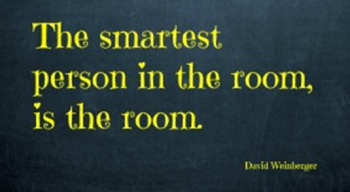
The Smartest Person in the Room

     Image from: chdairiesdiary.wordpress.com

I hope that our user community appreciates the balance of risk taking and just in time learning to offer great technology enabled learning environments.

~Mark


Sharing your Learning: Collaboration

This year, WRDSB  teachers  Alison Bullock  and  Andrew Bieronski  ran a very successful cross curricular and cross panel collaborative project with grade 4 and grade 10 students.

moviephoto

Full project details may be read [here].   A “quick peek” overview of the  project  is included below as a point of reference.

The Collaborating

The grade 10 students will provide mentorship to the grade 4 students as they research, plan and write the scripts needed for the audio guided tour files.  Students will be collaborating through the WRDSB Google Apps for Educators  (GAFE) environment. The role of the grade 10 students will be related to their civics and English courses.

All students, in both grades,  will share about their experiences in this collaborative learning project through their blogs.   Blogging platforms may include Google, WordPress or Weebly.

As part of the professional learning with this project, Alison and Andrew met with me for a live streamed interview to share their learning and reflections on collaboration, student voice, engagement and professional practice.

formula

~Mark


UnGoogleable Questions

Today’s post is a reblog from my original “picture and post” on OSSEMOOC.

Part of my weekly routine is to check out the Twitter  #cdnedchat hashtag stream.  I have learned that there is always something interesting to check out.

The words “UnGoogleable Questions”  in this post seemed to  jump right out at me.   While Google is a great tool that provides almost instantaneous access to limitless information,  it is important to pause and recognize that this is just the beginning in the context of a learning journey.

Ungoogleable Questions

What does the notion of “UnGoogleable Questions” mean to you in terms of asking,  inquiry, probing and going deeper with learning?  How might this impact your professional practice?

Resource: Link to Nancy’s full  blog post.

Ask great questions!

~Mark

Digital Citizenship meets SAMR

Setting aside the debate of whether “digital citizenship” should just be “citizenship”,  I think there continues to be a need for  focus on the digital aspect of citizenship as people learn the in and outs of our rapidly evolving digital world.

DC_Web_cube

I enjoyed an opportunity to have an in depth conversation with the WRDSB student senate and trustee  Kathi Smith  last night on this very topic.  The discussion was lively, and a number of important points were made through the evening.

In the end, we landed on digital citizenship (or D.C. as we ended up abbreviating it):

  • is not a “check box” or single event
  • be  embraced and lived
  • must be relevant
  • role modelled by staff and students
  • experienced with real life tools and contexts

There was agreement that action is needed to continue to raise awareness among students in terms of managing your digital profile, understanding what online information about you is actually ‘out there’  and understanding the impact of your choices and actions.

I look forward to meeting with next year’s senate members to explore options to bring the ideas and action items identified into play.

On the drive home,  I was wondering what approaches to teaching, coaching,  mentoring and role modelling digital citizenship would look like if you applied the 4 stages of the SAMR model.   Hmmm.

SAMRgraphic

There it is:  Digital Citizenship meets the SAMR model.

What do you think this might look like?   Wonder with me and share your ideas.

~Mark