Category Archives: Technology Enabled Learning

Mobile Learning with OSSEMOOC

Last night I enjoyed the mobile learning session presented by  Rob De Lorenzo  as part of the  OSSEMOOC  professional learning series.

mobile_learning_RDL

After the session I went the the chat transcript and picked out a few phrases that resonated with me.  They are:

  • it is so important that community creates the learning
  • the “any’s” — anytime, anywhere, anyone, anything learning
  • love that idea – learning languages on social media.
  • The need for administrators to be involved in the process is critical.
  • technology empowerment of teachers is critical to reach our tech hungry students
  • The computer lab is an artifact. We’ve moved beyond the need for it.
  • Wifi is a game changer.
  • No need for uniform platform anymore – different tools for different tasks
  • let them bring the devices they are comfortable with.
  • You choose the device that will best let you do that”
  • No tech can replace carefully thought out lessons and teaching strategies!
  • mobile productivity

Which phrase(s) resonate with you? Why?

invitation

Now, an invitation, or perhaps a challenge depending on your viewpoint.  Share your thoughts by leaving a comment on this post or consider writing a blog of your own to share your thinking.  If you choose to blog,  please share a link to your post.

Additional Resources
Listen to the  archived recording of  Mobile Learning .

~Mark

Connected Learning: A Virtual EdCamp Experience

Why not make your Saturday a great opportunity to learn.  Would you like to learn from where ever you are?   You just need an internet connection.

EdCampWR is happening Saturday Feb. 22 2014 at Ryerson PS.  I will be attending in person and sharing my experience through  video broadcasting of sessions  and interviews.

Here is how you can learn virtually.

Learn more about  Ed Camp Waterloo.

Sign up for a free account to access the video stream here.

Where to watch:  click here.

Follow the  Twitter conversation

Make it a great learning day!

~Mark

SAMR: Fuelling a growth mindset

The SAMR model has taken the technology enabled learning world by storm. Based on long term thorough research the model offers a new strategy to look at the relationship of technology and learning. The model describes four stages of using technology to support student learning as summarized in the chart below.

SAMRgraphic

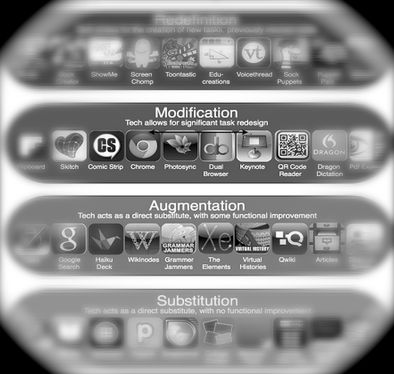
Let me say up front that I am a big believer in the SAMR research and methodology. You can read my other SAMR related blog posts  here.  However, I am concerned about the circulation of SAMR charts that slot apps and web tools to a stage on the SAMR chart.

SAMR_apps_chart_blur

The SAMR model is based on the notion of using technology to support learning in ways to deepen learning through opportunities not previously possible – that is, a change in practice.  To my way of thinking, the SAMR framework needs to be internalized in one’s thinking so that you independently examine your lesson, practice, approach etc.  It is NOT about just picking an app from the ‘R’ level and assuming “that is it”.

I think SAMR is a lens, a way of thinking about self improvement.  It is a journey of reflection and getting to that better technology enabled learning place of practice consistently.  As learning contexts change, reflection through the SAMR lens is necessary to keep one’s practice sharp.

Technology is changing at a torrid pace.  New web based tools and apps are born every minute.  Each choice of technology, app and use MUST factor in the context of the learning at hand and the needs of the students.  Recognize that a learning moment is simply that – a moment in time, and worthy of professional reflection. Tomorrow, there will be new hardware, new apps and new web tools.  The SAMR model will see us through these changes by helping us focus on best practice, reflection and a moving through a personal journey.  Sometimes, being at an ‘S’ level might be just the right place to be – part of the journey.

Take the SAMR challenge today.  Become familiar with the model and how it relates to learning and excellent instructional practice. Examine new possibilities for technology enabled learning.  Challenge yourself.  Reflect.  Share what you experience and learn. Internalize it – make SAMR part of who you are!

~Mark

Educon2.6 Reflections

educon26header

Once again the annual  Educon  event was an amazing learning experience.  I decided to share a couple of  learning points by bringing a few reflection points through this video.

On a another note, it was great to have a opportunity to try out Google Glasses too!!!

mwc&googleglasses

Happy pondering and learning.

Related Resources

Learning at Educon by @fryed
Follow the #educon Twitter channel

 ~Mark

Reflecting on Openness

Educon 2.6 got off to a great start tonight with the panel discussion on creating a more open and transparent world. As anticipated, the excellent panel presented a variety of views and thoughtful insights. I thought I would share a few points in an effort to encourage you to reflect on some of the points raised in the discussion.

  • Define openness.  What does this mean?   What are the different contexts?
  • Learners or students?
  • Valuing connnectedness
  • badges rather than marks/grades/pass. What might this mean for  future employers? higher ed?
  • MOOCs – making them really work and not continuing old patterns
  • vulnerability
  • technology to enable learning – it is all about HOW we use it

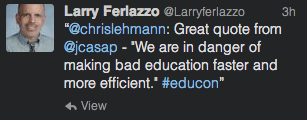
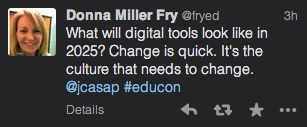
I have selected a few tweets from the 100’s that were posted that connect to these points.

E1

E2

E3

E4

E5

E6

E7

E8

E9

E10

Will your reflections lead to change? renewed commitment to “the cause”? improved practice? attention to nurturing those around you? a more open approach? It is your journey. Make it worthy of the best student learning possible.

~Mark

Setting the Stage for Digital Inclusion

I am always amazed at how time to reflect changes what eventually ends up in a blog post.  This post is a great example of this notion as I originally thought I might write about these topics in different posts, but now I  think the ideas are more powerful together.

I had the privilege of attending and presenting at the  1:1 Computing Conference  this fall with  Ed Doadt.  It was great to meet so many passionate educators at the event. Two ideas from this conference really struck me.

First, I was amazed at the high number of schools/districts that were declaring “singular”  IT strategies: we use ONLY iOS or win 7/8 or  chromebooks or BYOD devices.  This is an all in approach with no flexibility or notion that different devices have different strengths/weaknesses, that students will have varying comfort levels with different devices, that technology will continue to develop and change at a torrid pace never experienced before or that a variety of devices might be a better fit to support learning.  I feel strongly that our approach at  WRDSB  to use and support a variety of devices  to support learning will yield better results than a singular strategy approach.

Secondly, I was really taken by the keynote presentation by  Alicia Banuelos   outlining the powerful state of digital inclusion – a community approach to full wifi coverage for the San Luis community in Argentina – schools and community, access for all students and community members. The work to build access for all is based on the idea that those without access will have less opportunity to: learn, work, develop networks (people connections) and lead productive lives.  A very powerful idea indeed.  Since hearing this presentation and meeting Alicia, I have been reflecting on what this would mean in an Ontario context.

ontario-map1

A few months ago, the Ontario K12 IT Leaders authored the  Manifesto for 21C Learning  document outlining the need for a powerful Ontario provincial network (meaning internet & WAN) to support not only K12 needs, but an infrastructure that would create opportunities for learning, working, business and innovation with an eye to need, scalability and sustainability – digital inclusion  for Ontario residents.

I typically listen to  Craig Norris  on  CBC KW  on my drive into work. On a recent show, Craig was hosting an interview about business investments in the area of transportation between Toronto and the KW area and how that would be beneficial to facilitate business opportunities in the technology area. While listening to the show, I couldn’t help but think about the opportunities that would come from investing in an Ontario network. Now, one can not deny the initial large investment (some estimates of over $2B have been estimated) that would be involved to truly achieve a state of  digital inclusion of this magnitude. Yet, this seems like such an important need, how can we afford to avoid tackling it?

fibreoptic_cable1

I believe a high speed provincial network an achievable goal, and that the money is around, but you must  THINK  differently.  The money would need redirecting. Consider the annual profit margins in the banking and financial sectors.  Perhaps a pension plan (teachers?) investment could be part of the solution.  Strategic partnerships.  JUST  BE  CREATIVE.

Achieving this goal would:

  • recognize this as a critical need,  rather than an  item on a political agenda
  • be for all Ontario citizens and
  • be affordable.

I believe achieving this is about collective will,  and not “what if”.   What does a future Ontario look like to you?

~Mark

RCAC13 Chromebook Workshop Resources

RCAC_logo

Presenters:

Mark W. Carbone
Ron Millar
Andrew Bieronski

Resources:

Presentation  Slide Deck
Chromebook  Internet Treasure Hunt
Twitter Stream via Storify.  Thank you Doug Peterson.

~Mark

CEA Presentation Resources

CEA1to1-2

Social Media in the Classroom and School Community

CEA International 1:1 Computing Conference

Slide Deck

Contact info
Ed Doadt
Mark W. Carbone

Videos

Corbett Ball:  Change Perspective

Joe Cvetish on  Blogging

Jane Mitchinson-Schwartz on  Google Docs

Aaron: student voice

Andrew: student voice

Teacher  Andrew Bieronski

Teacher  Gavin Albrecht

Additional Resources:

Waterloo Region District School Board  Responsible Use Procedure

 WRDSB  Digital Literacies Pathway

Q & A from the  Today’s Meet back channel:

Facebook training around privacy, security and appropriate use of groups and teacher fan pages was provided through after school workshops, online workshops via Adobe Connect at a variety of times after school and evening, as well as site based workshops arranged through our instructional technology consultants.

Edmodo  is also used by many teachers.

Internet radio re-broadcasts of the session, advertised on Twitter and G+, will be available via QueST Radio 1-24 .

~Mark & Ed

A Visit to New Dundee PS

Nurturing the Classroom Community

On a recent visit to  New Dundee PS,  I had the pleasure of meeting with  Ms. Andrea Michelutti, Principal and teacher  Scott McKenzie.  Their plan for using technology is well aligned with our Board  student achievement plan.  I noted in our conversation that both  spoke enthusiastically about how the seamless use of technology in the learning environment has produced a positive attitude in students, increased engagement and improved literacy.  As the school’s new iPads arrive, all classes will have the use of 5 to 10 devices so that all learning spaces have access to technology and can use it as a natural part of the learning environment.

The students in Mr. McKenzie’s class are using a combination of Board owned mobile technology and personally owned devices. Given the variety of devices used, Mr. McKenzie has wisely chosen to take a device  agnostic approach by using writing and collaboration tools that easily cross platforms such as Google docs, Evernote and a variety of Chrome browser extensions.  Students were coached on responsibilities and appropriate use to prepare them for this flexible learning environment.  As their new iPads arrive,  all classes will have the use of 5 to 10 devices so that all learning spaces have access to technology and can use it as a natural part of the learning environment.

Teacher based observations include:

  • students leverage voice capabilities by speaking to the computer, minimizes typing and spelling challenges
  • students used computer based read alouds
  • careful font choice and size can positively impacts student reading abilities
  • technology facilitates options for students to self select their approach to learning
  • students are typically confident with technology, particularly when they use a personal device they are familiar with

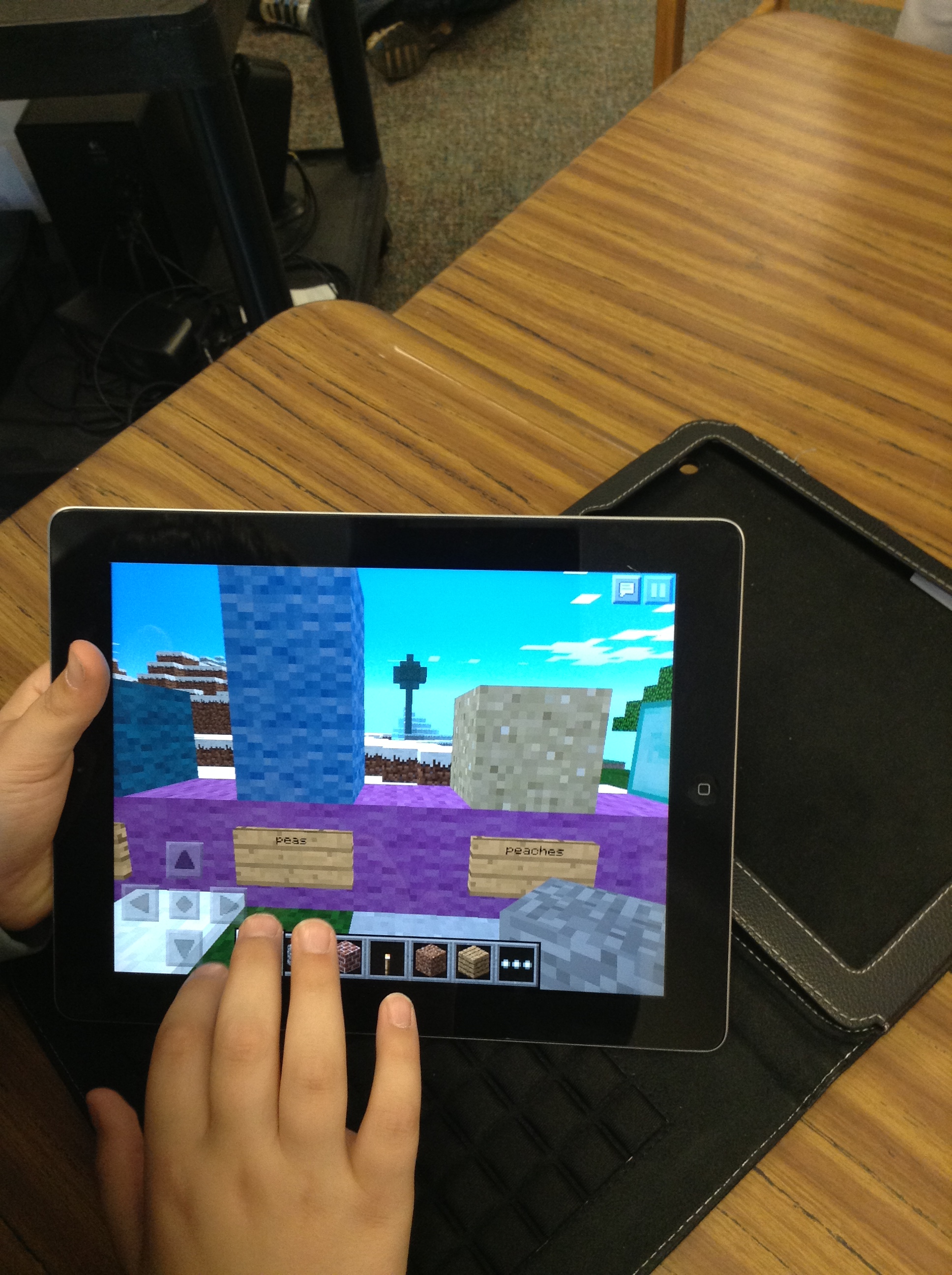
On a classroom visit, I noted the students were working independently and making their own choices concerning when to use technology, when not too and what application to use for their learning task. There is definitely a culture of risk taking and an explorer approach evident in the classroom.   Some students were demonstrating graphing tasks in Minecraft, while others were  focused on collaborative writing tasks.  The class is also leveraging digital newsletters and blogging as a way to share information with the community while reducing paper usage.

iPads in Action

NDPS4

NDPS1

NDPS5

NDPS6

Related Resources

Follow New Dundee Public School on Twitter
Teacher Scott McKenzie’s blog
Kindergarten class sharing

~Mark

21C Round Table Panel 20131029

21Cpanel

I had the privilege of participating on the Ministry of Education 21C Round Table Discussion panel this week along with Dany Dias,  Grade 7 and 8 teacher at Le Sommet High School in Hawkesbury;  Mark Melnyk,  Head of History at Markville Secondary School in Markham, Ontario;  Catherine Montreuil,  Director of Education, Bruce-Grey Catholic District School Board and Sharon Moss, Principal of Leadership Development, YRDSB.

Each panel member was provided a question focusing on a particular aspect of 21C learning to respond to.  I wanted to extend a thank you to the other panel members as I appreciated hearing their perspectives and learning from them.  I have included a copy of my question and resopnse for the session.

My Panel Question

“Our external research team reports on findings such as technology’s role in providing opportunities for cross-curricular learning in manageable and efficient ways, together with a move toward systems thinking by school districts. Curriculum Services Canada (CSC) notes that a number of school boards reported that changing the operational structure in some areas was valuable, such as establishing working relations between IT and curriculum. Please tell us about how the Waterloo Region District School Board has approached the alignment of resources and departmental coordination in order to create the supporting conditions for an innovation such as Futures Forum to become embedded system-wide. What are the benefits for students that inform and motivate such changes?”   We would also be interested in insights connecting  with ‘digital citizenship and literacies,’ and/or ‘learning culture shifts,’ 

My Response

We are fortunate to live at such an exciting time.  The rate of change is rapid, opportunities are abundant and the possibilities for education exciting. Technology is a powerful element and enabler for learning when skillfully and effectively used with best instructional and assessment practices. Technology breaks down time & space challenges and really lets you dig into the notion of “the anys” – anytime, anywhere, anyone, anything access and engagement.  When I reflect on my various experiences, technology has the greatest impact when focused on the C’s or hooks as I sometimes refer to them:  communicate, collaborate, create, critical questions & thinking and (digital) citizenship/character development.  From a technology point of view, the reality is that the actual devices used, are only the devices of the time, and will continue to change and evolve at an amazing rate, so keeping the focus on learning, assessment and best practice is very important.

I believe a second area of importance is fostering a culture of risk taking and providing entry points for staff to shift their practice and “jump in” is critical to scaling across systems. At any moment in time, we all have access to using the same technology tools. It doesn’t matter whether you are 3 or 60, we can all use the tools available. In today’s terms, that includes a variety of web 2.0 and social media tools.

I have also found that studying change models such as SAMR which defines levels of technology use as substitution, augmentation, modification and redefinition.  At the redefinition level, technology is used to enable learning that was not possible before.

SAMRgraphic

The TPack model is also helpful as we continue to learn and consider change processes.

TPack

With specific reference to the Waterloo Region District School Board, I want to begin by acknowledging my colleagues here today:  Mark Harper and Kim Keena.  The work we have been doing on an ongoing basis is a team approach.  It is important that we vision, implement, problem solve and celebrate together.  We have created a number of forums for us to work together.  I attend the Learning Services Leaders chaired by Mark Harper.  I am responsible for our Technology Steering Committee. Mark, Kim (along with others) participate this this forum.   Mark also leads a Digital Learning Steering Committee which brings together key staff representing a variety of stakeholders within our organization. These forums provide an ongoing avenue to share thinking, ask questions, consider resources and supports, gather feedback and  address issues.

The roots of our Futures Forum Project (FFP) go back 6 or 7 years, to a time when we were outwardly exploring the notion of 21C learning and what the classroom of the future looked like with staff, students and community partners such as Communitech.  We also enrolled in a year long program at  Powerful Learning Practice  (PLP) in order to immerse ourselves in a year long job embedded PD experience to put ourselves squarely in the role of the learner as part of our professional learning.  What we now have as the Futures Forum Project  is the implementation of our action research project from the PLP experience.  Centrally, we were able to stand united to visibly support the idea of taking risks, breaking traditional moulds of delivering instruction and exploring different avenues (timetabling, staffing, technology use).

Core elements of the Futures Forum Project include:  a cross curricular approach with grade 10 English, Careers and Civics taught by one teacher across a 2 period block of time. Classes at each site are timetabled in a common manner (all mornings or all afternoons) to facilitate collaboration between staff and students.  Specific strategies used to deliver this program include:

– blogging for writing, journaling, creating, commenting, peer review

– cross school novel studies where students choose a novel to study with one of the FFP teachers. Interactions occur through a variety of collaboration tools such as Adobe Connect licensed through  OSAPAC.

– collaborative research and content creation to produce online web publications

– Ted Talk Fridays – teachers select a common Ted Talk to watch, students then share learnings, questions and comments through a cross school twitter chat

This approach to teaching and learning provides  ongoing opportunity to engage in digital literacies and digital citizenship. In a situation such as this, digital citizenship is something front and centre as you live it & role model it on an ongoing basis each day. To me, this is how we need to live our lives, making good digital choices on a continuous basis.  As we become more “Googleable” we should be aware of, and manage our digital legacy.

The FFP has been scaled at a manageable  rate over the last 4 years, with careful consideration being given to sustaining and scaling the various supports  required.  The project started with approximately 1 teacher in approximately half of our  secondary sites, then expended to most sites, then to multiple sections and now we are seeing spinoff impact within each site.  This strategy has given the new approach visibility at each site which is proving beneficial.

It is important to continue gathering information and data to inform the process.  We have completed student, teacher, administrator and parent surveys, conducted hundreds of individual and focus group interviews through an independent critical friend partner.  Results have shown that this approach does make a difference and a statistically significant difference in many cases.  Additionally, teachers continue to meet regularly to share and reflect on best practices and needs.

Going forward, we continue to talk about  scaling the system from a strategic point of view considering our current state, defining our desired future state and determining the best path forward while factoring in areas of emphasis & focus, sustainability, supports and professional learning needs.

Related Resources

WRDSB Futures Forum Project
WRDSB Futures Forum Program wins award
The SAMR Model
ON21cLearn Twitter Stream via Storify
TED: Ideas Worth Spreading

~Mark