Category Archives: Social Media

Social Media as a Writing Tool

The other day I happened to catch a segment of The Current CBC broadcast as I was driving between school appointments. The topic was big data based the book Dataclysm, which certainly captivated my interest for a variety of reasons.

Dataclysm book cover

              Image from Amazon.com

I happened to tune in just at the moment the discussion was focused on analyzing data written in social media, Twitter in this case.   While many view social media communications as somewhat inane,  an in depth analysis reveals some interesting facts.

140-1

  • writing tends to be more sophisticated
  • word length is 20% longer
  • lexical density ,  the proportion  of meaning carrying words, is  higher than in many other forms of writing (email, magazines etc.  – perhaps opposite to what you would think)
  • with a limitation on the number of characters per message or post, 140 in this case,  people learn to improve word choices
  • in turn,  this improves editing skills

In the interview,  Christian commented that this type of analysis can and has been repeated.   This is not an isolated ‘one time’ look at this area.

When one considers the writing benefits summarized here,  I believe there is a strong case to incorporate  the social media writing medium in the school system.   Of course there are natural connections to digital citizenship, engagement, real world audiences etc.

140-2

As a classroom educator,  if you are already doing this, keep going!  If not,  consider giving it a try with an age appropriate system, a collaborative document with simulated limits  or even  offline.

Related Resources

Listen to the  CBC Podcast  with Christian Rudder on Dataclysm

Book:  Dataclysm  by Christian Rudder

Have a comment?   Please share.

~Mark
Meet the Teacher Night Tech Slam

At this point in my life I find myself with one university graduate and one in first year and on the way.  It has certainly been a long time since I attended an elementary school meet the teacher night.

In a  recent summer conversation with WRDSB teacher  Alison Bullock,  my interest in the parent  aspect of  school year startup was rekindled.  Alison was enthusiastically sharing about her plans to provide parents attending with a fast paced “tech slam” – a quick tour through many of the different online services students would be using in their learning journey with her.  I approached Alison about attending meet the teacher night,  and I was thrilled that she readily agreed.

On parent night evening, I arrived at portable 4 to find an energized room of parents and students.  Students were eagerly leading parents to their seating area.

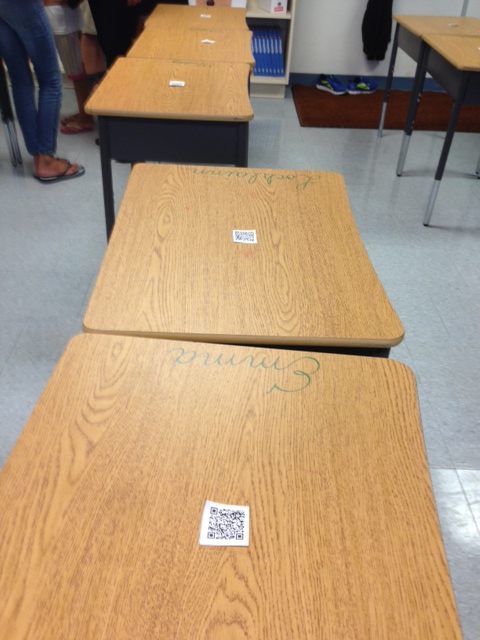
QRdesk

On the top of each desk was a  QR Code  that linked to a personalized welcome video for each parent.  Students were visibly excited to show their parent(s) how to access the video and have them watch it.

Now it was time for the tech slam.

Wow – actioned packed, filled with key learning statements and clearly highlighted  the connected learner robust technology enabled approach to be used in the classroom.

Casual conversation with parents afterwords showed excitement and interest  about the  approach to learning their child would participate in.

If I had elementary school aged children,  this is the type of classroom learning experience I would want them to have.

Related Resources:

Follow Alison’s class on Twitter: ESTP4.

~Mark

Important Voices

Today started with a great conversation over breakfast.  I was sitting with Harry Niezen,  Donna Fry and  George Couros.  The question on the table was who are the big names to follow in education these days?

social_interactions     Photo from http://goo.gl/EG8KAi

After some healthy discussion, of a few of the traditional big names the conversation drifted to a new perspective. Why do we need to focus on the “big names”?   Many educators are bloggers. These educators are openly sharing ideas, reflections, visions and questions.

Why would we pay attention to one perspective?  Why not read, share, comment and reflect on the viewpoints of active connected educators who are putting their thinking ‘out there’ for everyone to access?

Where do you stand?  The one (or few) or the many?

Share your comments here or connect on Twitter.

~Mark

Related Resources

OSSEMOOC
Ontario Bloggers via @dougpete

Sharing your Learning: Collaboration

This year, WRDSB  teachers  Alison Bullock  and  Andrew Bieronski  ran a very successful cross curricular and cross panel collaborative project with grade 4 and grade 10 students.

moviephoto

Full project details may be read [here].   A “quick peek” overview of the  project  is included below as a point of reference.

The Collaborating

The grade 10 students will provide mentorship to the grade 4 students as they research, plan and write the scripts needed for the audio guided tour files.  Students will be collaborating through the WRDSB Google Apps for Educators  (GAFE) environment. The role of the grade 10 students will be related to their civics and English courses.

All students, in both grades,  will share about their experiences in this collaborative learning project through their blogs.   Blogging platforms may include Google, WordPress or Weebly.

As part of the professional learning with this project, Alison and Andrew met with me for a live streamed interview to share their learning and reflections on collaboration, student voice, engagement and professional practice.

formula

~Mark


Celebrate and Share with Twitter

June is always a busy month in education, but last night a number of WRDSB staff found time to participate in a year end Twitter Chat to celebrate successes in the 13/14 school year.

twitter-birds

I was struck by the richness of the discussion, and the level of openness.   You can share in the learning by reviewing the  Storified capture of the live chat  [here].

I look forward to continuing the sharing of our learnings through these chats next year.

~Mark

Connected Learning with Grade 3s

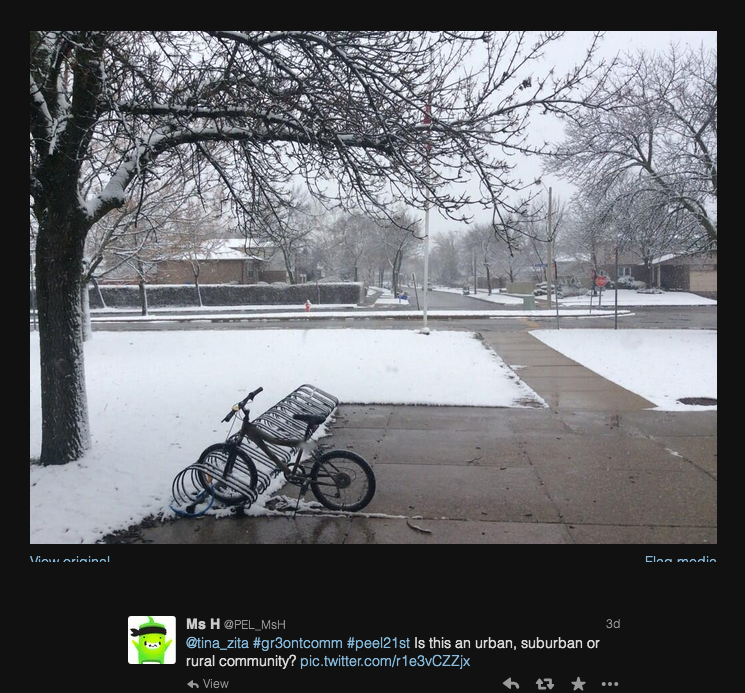
Last week I became aware of an interesting approach to learning about Ontario communities with grade 3 classes.  The  idea is  to involve people from around the province to submit picture clues about the community they live in.  The clues are shared with the students, and student responses are tweeted (posted) back through a class or teacher based Twitter account.

The project takes on another level of connectedness by using a hashtag (Twitter conversation label)  to collect all of the tweets on this topic into a searchable stream which can be viewed [ here].  What a GREAT way to bring a personal and connected context to the classroom.

I enjoyed an afternoon walk this weekend to take a few pictures to participate this week.  I wonder how many clues it might take the students to guess where I live.

Here are some sample tweets from last week.

WhereAmI 1

possible answer

WhereAmI 2

This will be a great week in the connected learning world.

~Mark

London PNC: Digging into change

Last Thursday (April 10, 2014) I had the pleasure of attending the meeting of the London MISA PNC group  to serve on a panel discussion with

L-PNCpanel

Joe Sisco of the WECDSB did a nice job hosting the event and moderating the panel discussion.  My role on the panel was to share some ideas concerning technology planning.

My response:

I enjoyed the variety of  questions the panel addressed.  Two conversations really stood out for me.  First,  some excellent dialog around the notions  of professional sharing:

and secondly, examining comfort with change:

In a rather timely fashion, this tweet from  Donna Fry  was posted just two days later while she was participating as a virtual learner by following the Twitter conversations of  Edcamp SWO  and  Edcamp London  which ran on Saturday April 12th.  I think the tweet captures the essence of the panel discussions in a nice concise way.

LivingInBeta

~Mark

Related Resources: sound clips in a local format

Clip 1:

Clip 2:

Clip 3:


Leveraging the Lull

I had a chance to chat with  Brandon Grasley  at the end of the  OTRK12 conference  following the  OSSEMOOC  “Getting Connected” session.  Somehow we got onto the topic of new social media users adapting to the “fire hose” information flow of services such as Twitter.

You can’t get caught up in reading endless material.  One must become comfortable with jumping in and out as time permits.   Information can be tailored to your interests by using dashboards such as tweetdeck to follow topics of interest.

I decided to put the  “jump in”  theory to test, so one morning this week I looked at my twitter dashboard to see what could be noted in just a couple of minutes.

SUCCESS !!!

… an insightful blog post

JBalen

… a digital citizen/digital literacy tip

LynHilt

… and a PD opportunity

M-EdCamp

Excellent results for just a couple of minutes of reading I would say. Here are a few ways to “jump in” that work for me.

– breakfast & twitter – I enjoy an interesting read to start the day
– tea & twitter?
– a few minutes between meetings
– lunch break
– waiting in the car to pick up your kids
– standing in lineups

Well, you get the picture.  Jump in when you can and leverage on the go connected learning .

~Mark

Focus on Beginners: What do you Need to Start Connecting?

Donna Miller Fry's avatarOSSEMOOC

As we have travelled throughout the province this week, we have heard loud and clear that we need an easier entry point for our education leaders to start the connecting process.

Last Tuesday, connected leaders met to discuss how they became connected leaders – the catalyst that got them started.  Here are some of the things we learned.  Which of these do you need?  Which of these can you bring to a leader you know to help them connect?

1. TIME!  When can we possibly find the time to connect?

http://www.flickr.com/photos/76818399@N00/4536146692/

Educators are busy.  Nobody disputes that!  But could connecting actually make your life easier?  YES IT CAN!  You can pose a question on Twitter 24/7 and get an answer in minutes.  We have heard many stories with this theme.

Learn to make time.  Start with 15 minutes each day.  Some of us do “Tea and Twitter”,  some of us start…

View original post 441 more words

On or Off Line: a Perspective

I happened to come across  Aviva’s  post yesterday, titled
online-offline-where-to-draw-the-line.  Aviva makes that point that “students need a safe place to make mistakes, and I don’t know that social media provides this safe place.”  Check out  the comments from some of the readers  [here].

We do live in interesting times for sure.  Perhaps this is all a lesson in media literacy (& life).   From my perspective,  there are a few important points in the mix.

In my view blogs are indeed a social media tool.  In today’s world, you DO have a voice through a variety of social media tools.  One’s actions in a social media environment have reach and impact.  This begs responsible and ethical use: do good, ask good questions, ‘poke’ at things in a respectful manner.   It is likely safe to say that not all real life experiences  will have these characteristics, and from this perspective,  Aviva’s blog post raises a great point when considering the learning environment.

blog

In response to Aviva’s post,  Doug Peterson wrote a great blog post this morning  called  Learning about Social Media  in which he  makes a strong case for using blogs as an excellent entry point into this world.  I certainly support Doug’s view that blogs are indeed an excellent starting point.  I also think that  the K12 educational experience needs to move beyond this.  Our  students live in a world where new online tools and platforms are ‘born’ all the time and having some appropriate experiences  in new arenas is also important.  I like the idea of gradual release of responsibility (age appropriate), and I am excited about the positive experiences I am seeing WRDSB students having within programs such as the Futures Forum Project (FFP).

I don’t think one can underestimate the power of positive role modelling.  Do you see this as an opportunity for educators? or perhaps a responsibility?  Either way, social media is here to stay.  Reach, impact, connections, relationship building and establishing trust are all important aspects of this digital world in which we live, and important areas to develop in young people.

Great topic.  Please weigh in.  I welcome your thoughts on this discussion.  Leave a comment or connect in some other way.

~Mark