All posts by markwcarbone

I have 36 years experience in K-12 education. I have been fortunate to work in many different roles including teacher, department head, ICT consultant, IT Manager and CIO. Personal interests include performing in the Venturi Winds woodwind quintet, the Cambridge Symphony and the KW Community Orchestra as well as composing and arranging music. Connect, Learn, Reflect & Share - make a difference today!

TPACK meets the knowledge domains

Last night I came across this article via Zite:   3 Knowledge Domains For The 21st Century Student.  I was rather intrigued by this way of looking at 21C learning, and have linked to the main graphic.

Many of you will no doubt be familiar with TPACK.

TPack

Image credit http://tpack.org/

Points for reflection:  

  • How do these ideas fit together?
  • Does the 3 domain chart replace part of the TPACK chart?
  • If yes, how?

Happy pondering!  Please share your ideas.

~Mark

ISTE13 BoF reflections

One of the sessions I attended at the ISTE13 conference was a Birds of a Feather discussion.  The original discussion topic was advertised was chromebooks.  When the actual event happened, the chromebooks topic was replaced by a more general discussion on mobile devices in K-12 learning environments.  There were about 8 people at the table, mainly representing independent schools as it turned out.

What really surprised me was the nature of the conversation put forward by most of the participants.  From most participants, the discussion centered around being a “one device school”.  The key question that emerged was:  “How might one go about choosing between the variety of available options: windows netbooks and tablets, android tablets, iPads and chromebooks.”

It seems to me that different tools have different strengths, and that there would be value to having a variety of options available. Besides, at the rate of change with technology,  it would be challenging to set a particular long term direction at this point in time that you could stick to.  Perhaps the key idea is to focus on learning with technology, and leveraging new possibilities rather than focusing on the device itself.  No matter what the device mix is now, things will change.  I believe investing in the infrastructure to support the needs of students and staff in todays 21C learning environment with a variety options including BYOD is the best way forward.

An invitation:  I am curious to know your view.  Please share your thoughts in a comment or tweet.

~Mark

Related Resources

Blog Post:  What’s in a device

CASA13 Presentation Resources

CASA Conference 2013 Presentation Resources

Conference Theme: Theme: Pedagogy to Technology: Hardware to Headwear

Our presentation  : Leveraging the use of Social Media Tools in your School Community — the use of social media tools in the Waterloo Region District School Board as things are now,  the journey and the challenges.

Video Samples from our CASA2013 presentation:

Haley   (Student)
Aaron   (Student)
Andrew  (Student)
Andrew Bieronski  (Teacher)
Kevin Donkers  (Teacher)
Kathi Smith  (Trustee)

additional video resources 

Twitter  (Teacher)
Facebook (Teacher)
Edmodo  (Teacher)
Student Perspective  (Students)
Principal Perspective (Bill Lemon)

Q&A from Today’s Meet backchannel

Information regarding the WRDSB iPad approach

Related Resources

Canadian Association of School Administrators  (CASA)  conference.

WRDSB  Responsible Use Procedure  (RUP)

Social Media Drive By (Blog post)

Quest Radio 1-24  Programming Info  – watch here for announcements regarding additional rebroadcasts of this session.

Join a live broadcast or rebroadcast  on Quest Radio 1-24.

Mark W. Carbone  and  Ed Doadt

~Mark and Ed

ISTE13 session notes

Once again, ISTE was a great conference with wonderful learning opportunities. Today I am sharing some of my session “quick notes”,  taken on the  fly  during the sessions, as links to Evernote documents.  Additional ISTE13  reflections will be shared later.

1. Migrating to a Google Environment

2. Google Tools on iOS

3. Flipped, Curated and Mobile

4. Coaching for Education Transformation


~Mark

Nurturing Your First Followers

During May,  the Waterloo Region District School Board  held a Digital Learning Symposium involving central staff, teachers, students and guests from the Ontario Ministry of Education and community. The intent of the day, was to bring staff and students together to dig deeper into what is working and what is needed as next steps forward. While the day was a huge success with great interaction and discussion within the various stakeholder groups, there is one aspect of this that I have continued to mull over:   Capacity building, and nurturing first followers.

WRDSB teacher, Scott Kemp, selected this “Starting a Movement” video to show as part of the final session discussion kickoff for the day.

On route to ISTE13, I had some great conversations about this idea with Rebecca Rouse  and  Susan Watt .   While the notion of nurturing first followers could be applied to many situations, we were looking at this from a technology enabled learning perspective.

By the numbers: From a strictly numbers point of view, you could think about: one helps another, two help four, four help eight , 8 > 16 > 32 > 64 > 128 > 256 > 512 > 1024 > 2048 … done. Lets say you already have 100 or so “lead nuturers”, then getting to “done” might only be 4 years (or defined time periods). More aggressively, one might start with one helps 3, 3 help 9, 9 > 27 > 27 > 81 > 243 > 729 >  2187 … done. With the same 100 or so “lead nuturers”, then getting to “done” might only be 3 years (or defined time periods).

These kind of progressive numbers are encouraging when thinking about rolling out a change process. But, there is more to it than just the numbers. In our conversations, we identified a number of critical components to consider in the mix.

  • PD should be a graduated continuum just like learning for students
  • professional practice should provide opportunities to align with the plan, act, assess, reflect learning cycle
  • people need varying amounts of time to reach the ‘ready to mentor’ stage
  • at what point could someone properly nuture a “first follower” in a way that produces the desired learnings, results and in turn prepares the first follower to, in  turn, nuture their own first follower with the needed outcome?
  • many of the components identified are all variables in the mix
  • moving along the technology continuum is, at least at this point in time, optional.

While this process is clearly not just amount the numbers, the thought does stimulate some intrigue and excitement about moving things through the system.  Digging deeply into understanding the nurturing of first followers may well be the key to success. To me, there are some key aspects to achieve.

  • Time is needed to shift thinking.
  • The use of technology needs to considered by default in the planning process. We need to arrive at a point where teachers will internalize the asking of the “how might technology support student learning in ‘this’ situation” without external prompting, noting that need will vary.
  • When this answer is ‘yes’, teachers must  know the framework in which technology should be appropriately used to align with and meet Board/District/system goals. In my context, this means technology enabled learning that aligns with our chosen 5 high yield instructional strategies, the C’s (create, communicate, collaborate, critical questioning, citizenship) and TPack.
  • We continue to promote learning of appropriate technology use for all staff
  • Best practices in the area of technology enabled learning are openly shared
  • Recognition that is is NOT about a particular type of device or application. It is about the best way to support learning and engagement.

An invitation:  What do you think is most important to nurturing a first follower of yours?  Share your thoughts!  Please leave a comment, or send a tweet or email.

Related resources
Digital Learning Symposium Tweet Summary
URL to Starting a Movement

Suggested Reading 
Crossing the Chasm

~Mark

Jenni van Rees: Blogging with primary students

Meet Jenni van Rees.

JVR

After a casual conversation at  Ed Camp Hamilton,  and some email correspondence, I arranged to do an interview with  WRDSB  teacher Jenni van Rees to further explore her work in blogging with her grade one students. The interview was initially done live on the internet on QueST Radio 1-24 .   The audio recording is now available as a resource to this blog post, and will also be rebroadcast on QueST Radio 1-24.  Watch radio.markwcarbone.ca , Twitter and G+ for announcements.

Guiding Questions for the Interview

1. Introductions

2. Professional technology interests

3. What drove your interest in getting your students online and blogging?

4. Administrative support?

5. What did you do in the area of communications with parents?

6. Describe/share how this has worked, benefits to students,

7. Did anything surprise you? anything unexpected happen?

8. How did you prepare the students in the area of digital citizenship?

9. Based on the results, will you continue to encorporate blogging as part of your instructional practice?

10. Closing comments.

Jenni provided excellent insights into these interview questions.  Hear her thoughts on professional learning, role modelling, real world audience, digital citizenship and PLNs in the  QueST Radio 1-24 broadcast recording .

Related Resources

Jenni’s class website

Jenni’s student blogging site

Jenni’s professional blog: Thinking about Teaching.

Collaborating with Division 18 in B.C.

Follow Jenni on Twitter

Follow Jenni’s on class on Twitter

Kathy Cassidy’s Connected from the Start: Global Learning in the Primary Grades

Happy learning.

~Mark

Blogging with primary students

Today (Wed. May 29th, 2013)  I will be interviewing  Waterloo Region District School Board  teacher  Jenni van Rees  at 4:30 (EDT).

Our discussion topic:  blogging with primary students.

Catch the live broadcast by visiting the   QueST Radio 1-24   website.   I will also be writing an upcoming blog post featuring Jenni’s work in this area.

~Mark

Resources for Compass For Success Presentation

 Slide Show

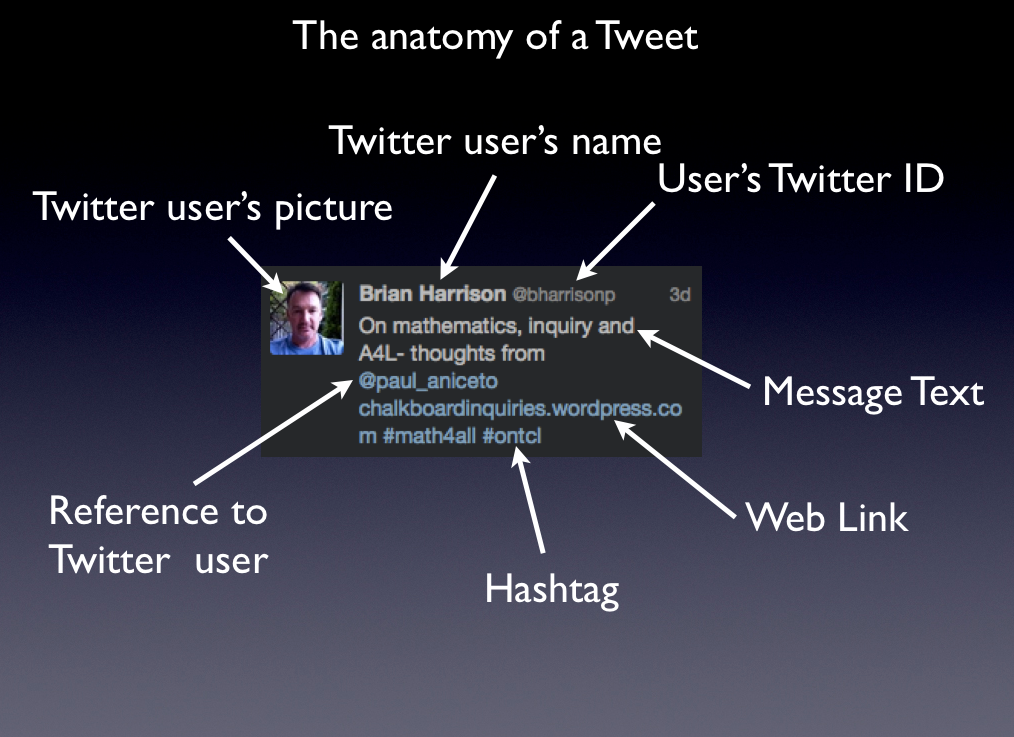
Tweet Anatomy

Digital Footprint 

My Digital Footprint by George Couros
Your Digital Footprint by Diana Graber

Twitter Resources

Twitter Guide Book by Mashable
Twitter Basics (pdf)
Twitter 101 (pdf)
Twitter Essentials
Leveraging Your Twitter Experience

~Mark

TEDx Youth at HHSS

Last week I happened to come across this tweet.

AB-tweet

This sounded interesting, so  I took action, visited the website and reserved a ticket.

AB-ticket

I meet teacher Andrew Bieronski at the door.

AndrewB

The Program:

I was very impressed with the TEDx Youth event that Andrew and his class put together.   The program featured a number of speakers well balanced with male/female and a variety of ages.  In addition to the tradition voice based presentations, the speakers used different approaches to presenting including music, dance, video and poetry.  I particularly enjoyed the slam dunk poetry session with a good message about bullying and a personal presentation about dealing with diabetes.

I was struck by one common element over the evening.  All of the presenters were obviously passionate about what they were doing, and their topics of choice.  All of the presenters were awesome in their own way, and  had an important message to share out to a broader audience.

Congratulations to all presenters, and to the class who that took on the task of organizing the evening.  I understand that a similar event may in the works for next year, so I will be watching for details!

Thanks for a great evening at Huron Heights Secondary School.

~Mark

Maxing your Twitter Experience

I have been enjoying an extended conversation with Jane Mitchinson regarding the process of participating in social media. The conversation has wandered between conversations over coffee, to Twitter, to connecting face to face at Ed Camp Hamilton and back online, most recently in the comments section of my  Ed Camp Hamilton  post. Now that is a great example of keeping the learning going and leveraging different tools.

The last comment, raises a number of points and questions about whether or not Twitter becomes in echo chamber.  While I do understand that concept, and have seen it happen, there is also the idea of reach – communication reach through social media tools. Reach, and the notion of the 6 degrees of separation make explain some of this.  None the less, there are some solid points to consider when navigating this space.

  1. Given the number of your followers, and the number you follow, how do you best get traction in important conversations?
  2. Although Twitter arguably represents only a ‘slice of society’ what strategies yield the best diversity for enriching your experience
  3. Engagement styles:  depth vs skimming – how do you keep your learning rich? and your contributions worthwhile?
  4. Finally, I believe it is important to contribute by contributing content through blogging etc.  and asking good questions.  I wonder what percentage of Twitter users are also actively contributing?

Please join this conversation.  How are you maximizing your Twitter experience?

~Mark