Category Archives: TEL

EOIT2014 resources and reflections

I enjoyed my recent opportunity to present a session on ever changing EdTech world in K12  education at EOIT2014.  Three points from the various conversations over the day captured my attention.

Limestone DSB,  CIO Wayne Toms described how becoming active on Twitter has “changed his  approach to PD forever”.   He emphasized the importance of having access to a stream of current information and thinking to shape one’s perspective underscoring the importance of connected learning.

If fact,  this coming weekend,  two Ontario based EdCamps  are happening on May 10th as per the  “Tweet captures” below.  Connected learners can participate by following  #edcampsault  and  #edcampisland.

connected_learning

EdCampSault

IT  leaders  Ron Plaizier and James Proulx  openly discussed the challenges of “all the moving pieces” – technology changing at a rate much faster than classroom practices shift and support models can be adapted.  There are no easy answers. The best strategy is to bring people together for conversation and time to play in this “change space”.  Agreed!

The third conversation focused on a notion I would call the  software “power” gap – the difference in capability when comparing a desktop application version against the corresponding web version.  This power gap differential exists in many applications.  In my view, the critical piece of this puzzle is at the intersection of  desktop > mobile, local > cloud and minimal NEEDed functionality vs extra features.  One “crystal ball” question is how long might it take to reach the ideal cloud based offering of a particular application?

I also wanted to share of few highlights from the back channel related to “What is the most important aspect of your work?”

TodaysMeetParticipants stated:

EOIT-1

EOIT-2

EOIT-3

EOIT-4

EOIT-5

Related Resources

View  presentation  file

Twitter chat for  #EOIT2014

Blog articles related to the  Futures Forum  project.

Blog articles on the  SAMR  model.

Scoop.it articles on  SAMR

~Mark


WRDSB Twitter Sharing 20140428

Many thanks to the participants in our  #edwrdsb  Twitter chat tonight. You can see the chat at  Storify.

The open sharing and exchange of ideas was AWESOME.  Here are a few comments that resonated with me.

T-A28-1 T-A28-2 T-A28-3 T-A28-4 T-A28-5 T-A28-6 T-A28-7 T-A28-8 T-A28-9 T-A28-10 T-A28-11 T-A28-12 T-A28-13

I am already looking forward to our next Twitter sharing session.

~Mark

Connected Learning with Grade 3s

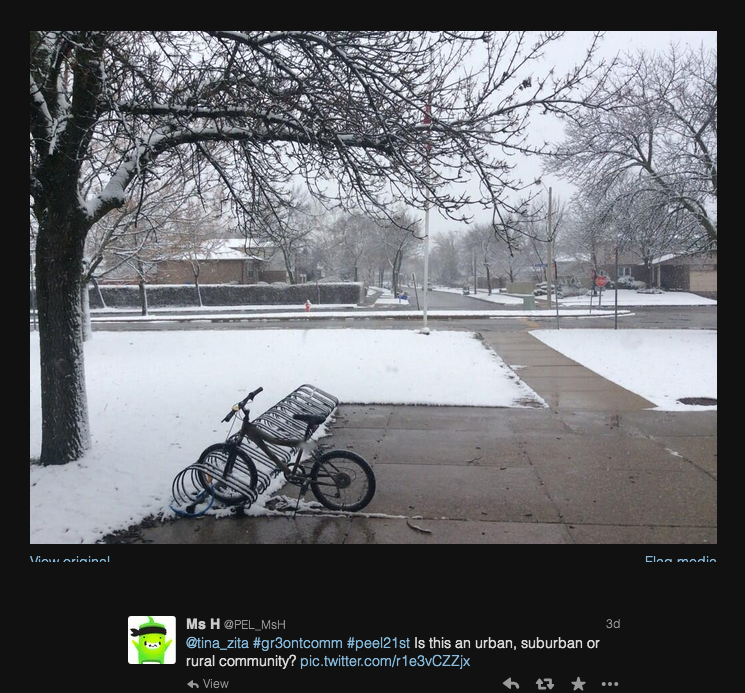
Last week I became aware of an interesting approach to learning about Ontario communities with grade 3 classes.  The  idea is  to involve people from around the province to submit picture clues about the community they live in.  The clues are shared with the students, and student responses are tweeted (posted) back through a class or teacher based Twitter account.

The project takes on another level of connectedness by using a hashtag (Twitter conversation label)  to collect all of the tweets on this topic into a searchable stream which can be viewed [ here].  What a GREAT way to bring a personal and connected context to the classroom.

I enjoyed an afternoon walk this weekend to take a few pictures to participate this week.  I wonder how many clues it might take the students to guess where I live.

Here are some sample tweets from last week.

WhereAmI 1

possible answer

WhereAmI 2

This will be a great week in the connected learning world.

~Mark

How many apps?

This point from the Twitter stream of  EdCampSWO resonates with me.

NoAppAddict

How thoughtful are you about choosing apps for use with your students?

Do you choose apps that support the “C’s” in a technology enabled learning environment:  Communicate, Collaborate, Create, Citizenship, Critical Questioning/Answering?   Perhaps your app choices facilitate inquiry or project based learning.

Where do you stand on app selection?  How many is too many?  What do you use as app selection criteria? I would be interested to know your ideas on this.  Please comment or get in touch via  @markwcarbone  on Twitter or  +markwcarbone  on  Google +.

~Mark

The Power of AB squared

After hearing about this intriguing classroom collaboration project at  EdCampWR, I was delighted to meet with  elementary teacher  Alison Bullock  to learn more about this cross panel collaborative project with secondary teacher  Andrew Bieronski.

The  Learning Framework

The project framework is based on the new  Ontario social studies curriculum.  Alison’s grade 4 French immersion students will be partnered with Andrew’s grade 10 students.  The grade 10’s will be mentoring with grade four students as they progress through a summative project which requires students:

      • create a physical structure of a museum artifact
      • produce audio guided tours in both English and French
      • generate a QR code linking to the audio files and
      • share about learning process

The Collaborating

The grade 10 students will provide mentorship to the grade 4 students as they research, plan and write the scripts needed for the audio guided tour files.  Students will be collaborating through the WRDSB Google Apps for Educators  (GAFE) environment. The role of the grade 10 students will be related to their civics and English courses.

All students, in both grades,  will share about their experiences in this collaborative learning project through their blogs.   Blogging platforms may include Google, WordPress or Weebly. 

Bringing it all Together

As a conclusion to this learning process, the class museum will be created in the physical space in library, where  all students connect for a grand finale.  Projects will be displayed and the students of both classes involved will meet face to face. 

This project is just getting underway.  I look forward to following along this learning journey.

Note on the Title:  I thought is was interesting that the two teachers involved in this project have the same initials. Given their interest in technology enabled learning and passions for forward thinking, I thought the notion of  

formula

was quite appropriate 🙂

~Mark

Connected Learning: A Virtual EdCamp Experience

Why not make your Saturday a great opportunity to learn.  Would you like to learn from where ever you are?   You just need an internet connection.

EdCampWR is happening Saturday Feb. 22 2014 at Ryerson PS.  I will be attending in person and sharing my experience through  video broadcasting of sessions  and interviews.

Here is how you can learn virtually.

Learn more about  Ed Camp Waterloo.

Sign up for a free account to access the video stream here.

Where to watch:  click here.

Follow the  Twitter conversation

Make it a great learning day!

~Mark

OSAPAC Software: A SAMR Perspective

Classroom educators working in publicly funded Ontario schools have access to a wide variety of provincially licensed software and digital resources. Full listings are at the OSAPAC web site.

The SAMR model describes four stages of using technology to support student learning as summarized in the chart below.

SAMRgraphic

The SAMR model provides a well researched framework for planning and reflecting on the use of technology to enable new possibilities to support student learning.  To this end, the OSAPAC committee is currently running a project to gather examples of using the  SAMR approach specifically with OSAPAC licensed titles. Click  [here]  to learn about the details.  I hope you will consider being involved in this project.

~Mark

Relate Resources

A list of my SAMR blog posts.

SAMR: Fuelling a growth mindset

The SAMR model has taken the technology enabled learning world by storm. Based on long term thorough research the model offers a new strategy to look at the relationship of technology and learning. The model describes four stages of using technology to support student learning as summarized in the chart below.

SAMRgraphic

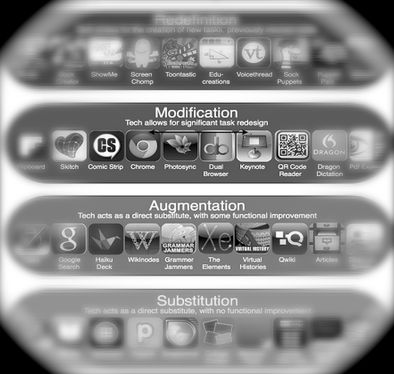
Let me say up front that I am a big believer in the SAMR research and methodology. You can read my other SAMR related blog posts  here.  However, I am concerned about the circulation of SAMR charts that slot apps and web tools to a stage on the SAMR chart.

SAMR_apps_chart_blur

The SAMR model is based on the notion of using technology to support learning in ways to deepen learning through opportunities not previously possible – that is, a change in practice.  To my way of thinking, the SAMR framework needs to be internalized in one’s thinking so that you independently examine your lesson, practice, approach etc.  It is NOT about just picking an app from the ‘R’ level and assuming “that is it”.

I think SAMR is a lens, a way of thinking about self improvement.  It is a journey of reflection and getting to that better technology enabled learning place of practice consistently.  As learning contexts change, reflection through the SAMR lens is necessary to keep one’s practice sharp.

Technology is changing at a torrid pace.  New web based tools and apps are born every minute.  Each choice of technology, app and use MUST factor in the context of the learning at hand and the needs of the students.  Recognize that a learning moment is simply that – a moment in time, and worthy of professional reflection. Tomorrow, there will be new hardware, new apps and new web tools.  The SAMR model will see us through these changes by helping us focus on best practice, reflection and a moving through a personal journey.  Sometimes, being at an ‘S’ level might be just the right place to be – part of the journey.

Take the SAMR challenge today.  Become familiar with the model and how it relates to learning and excellent instructional practice. Examine new possibilities for technology enabled learning.  Challenge yourself.  Reflect.  Share what you experience and learn. Internalize it – make SAMR part of who you are!

~Mark

Reflecting on Openness

Educon 2.6 got off to a great start tonight with the panel discussion on creating a more open and transparent world. As anticipated, the excellent panel presented a variety of views and thoughtful insights. I thought I would share a few points in an effort to encourage you to reflect on some of the points raised in the discussion.

  • Define openness.  What does this mean?   What are the different contexts?
  • Learners or students?
  • Valuing connnectedness
  • badges rather than marks/grades/pass. What might this mean for  future employers? higher ed?
  • MOOCs – making them really work and not continuing old patterns
  • vulnerability
  • technology to enable learning – it is all about HOW we use it

I have selected a few tweets from the 100’s that were posted that connect to these points.

E1

E2

E3

E4

E5

E6

E7

E8

E9

E10

Will your reflections lead to change? renewed commitment to “the cause”? improved practice? attention to nurturing those around you? a more open approach? It is your journey. Make it worthy of the best student learning possible.

~Mark

Setting the Stage for Digital Inclusion

I am always amazed at how time to reflect changes what eventually ends up in a blog post.  This post is a great example of this notion as I originally thought I might write about these topics in different posts, but now I  think the ideas are more powerful together.

I had the privilege of attending and presenting at the  1:1 Computing Conference  this fall with  Ed Doadt.  It was great to meet so many passionate educators at the event. Two ideas from this conference really struck me.

First, I was amazed at the high number of schools/districts that were declaring “singular”  IT strategies: we use ONLY iOS or win 7/8 or  chromebooks or BYOD devices.  This is an all in approach with no flexibility or notion that different devices have different strengths/weaknesses, that students will have varying comfort levels with different devices, that technology will continue to develop and change at a torrid pace never experienced before or that a variety of devices might be a better fit to support learning.  I feel strongly that our approach at  WRDSB  to use and support a variety of devices  to support learning will yield better results than a singular strategy approach.

Secondly, I was really taken by the keynote presentation by  Alicia Banuelos   outlining the powerful state of digital inclusion – a community approach to full wifi coverage for the San Luis community in Argentina – schools and community, access for all students and community members. The work to build access for all is based on the idea that those without access will have less opportunity to: learn, work, develop networks (people connections) and lead productive lives.  A very powerful idea indeed.  Since hearing this presentation and meeting Alicia, I have been reflecting on what this would mean in an Ontario context.

ontario-map1

A few months ago, the Ontario K12 IT Leaders authored the  Manifesto for 21C Learning  document outlining the need for a powerful Ontario provincial network (meaning internet & WAN) to support not only K12 needs, but an infrastructure that would create opportunities for learning, working, business and innovation with an eye to need, scalability and sustainability – digital inclusion  for Ontario residents.

I typically listen to  Craig Norris  on  CBC KW  on my drive into work. On a recent show, Craig was hosting an interview about business investments in the area of transportation between Toronto and the KW area and how that would be beneficial to facilitate business opportunities in the technology area. While listening to the show, I couldn’t help but think about the opportunities that would come from investing in an Ontario network. Now, one can not deny the initial large investment (some estimates of over $2B have been estimated) that would be involved to truly achieve a state of  digital inclusion of this magnitude. Yet, this seems like such an important need, how can we afford to avoid tackling it?

fibreoptic_cable1

I believe a high speed provincial network an achievable goal, and that the money is around, but you must  THINK  differently.  The money would need redirecting. Consider the annual profit margins in the banking and financial sectors.  Perhaps a pension plan (teachers?) investment could be part of the solution.  Strategic partnerships.  JUST  BE  CREATIVE.

Achieving this goal would:

  • recognize this as a critical need,  rather than an  item on a political agenda
  • be for all Ontario citizens and
  • be affordable.

I believe achieving this is about collective will,  and not “what if”.   What does a future Ontario look like to you?

~Mark