Category Archives: ProfessionalLearning

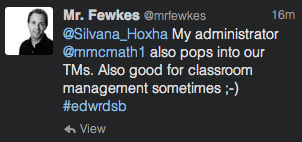
Tweet as Prompts

When I saw this tweet this morning, it reminded of a recent conversation with  Rod Lucier  where the point of discussion centred around the ideas that:

a) all positions have leadership components and
b) perhaps the best leadership position is the one you are in.

Using this tweet as a prompt, I think it is time worthy to reflect on the leadership traits described here.

Leadership-Fullan

What changes will you make to your practice?

~Mark

Note: Cross posted to OSSEMOOC

Digital Learning Carousel Reflections

I had the pleasure of attending the  WRDSB  Digital Learning Carousel event today along with 400 educators and students from our Board. The event provided opportunity to share our collective insights around digital learning,  changing practice and planning next steps forward for our organization.  The carousel sessions I attended included online novel studies, innovative practices with math, inquiry approaches and the Futures Forum program.

Three aspects of the day really struck me.  The positive feedback on the interest in using Google Apps for Educators (GAFE) and the high rate of adoption on our roll out was awesome.  Secondly, I was intrigued to hear some of the educators sharing the benefits of enough technology to support small group instruction over a 1:1 approach. The ‘just enough’ model allows technology to be used as a learning support as needed while fostering opportunities for interaction, conversation and sharing.   A 1:1 approach can result in students being self focused or isolated. This feedback validates our decision to roll out our iPad program in a way that avoided convenient the “portable lab pack” allocation. Finally, so many discussions touched on the idea of the right mobile tool for the learning, teaching or assessment task at hand. I felt proud that our  IT department is deploying and supporting iPads,  Chromebooks and Windows mobile devices to support learning at WRDSB.

carousel

My Session Highlights

The online novel study group talked extensively about taking a proactive approach to digital citizenship before moving into online activities. Their approach included googling yourself to find out what is actually online, reputation management, managing your digital presence and building relationships. Tools used in this program included Google Apps for Educators, Today’s meet, blogging, skype and collaborative web page designs.  An impressive approach indeed!

In the math innovative practices session, I noted that educators were really digging into teaching collaboration skills. What does collaboration look like, sound like, feel like? “Look fors” would include accountable talk, building on the ideas of others to highlight two attributes. Digital tools used in this program included Explain Everything, GAFE, GeoBoard, Notability and iMotion.

The inquiry stream focused on the relationship of two key elements:

1.  What do students need to learn and what do I need to learn as a teacher?
2.  If I do this as a teacher, then students …

The final session featured the Futures Forum program, which I am very familiar with due to my involvement with the program. Presenters emphasized the importance of a growth mindset for both staff and students. The approach used this year involving SparKW really engaged the students in a meaningful way.

Clearly,  all of the presenters I saw today demonstrated a high level of professionalism and a growth mind set. Thank you for sharing your learnings!

~Mark

Connect2014 Reflections

The day I spent at  Connect2014  last week was very valuable. I really enjoyed reconnecting F2F with so many online colleagues at  Dean Shareski’s  session where he lead a two hour in depth discussion on the topic of connected learning.

The discussion was rich as educators shared personal stories of making connections, the impact of the connections in terms of learning, sharing, collaboration and changed practice – talk about POWERFUL!!!

One idea that captured my interest from the session was the idea of recording a learning or change and attributing the connection that “made it happen”.  Attendees joined forces to illustrate the power of helping people with professional learning this video which was produced that day during our time together.


Learn, connect, reflect and share !!!

~Mark

EOIT2014 resources and reflections

I enjoyed my recent opportunity to present a session on ever changing EdTech world in K12  education at EOIT2014.  Three points from the various conversations over the day captured my attention.

Limestone DSB,  CIO Wayne Toms described how becoming active on Twitter has “changed his  approach to PD forever”.   He emphasized the importance of having access to a stream of current information and thinking to shape one’s perspective underscoring the importance of connected learning.

If fact,  this coming weekend,  two Ontario based EdCamps  are happening on May 10th as per the  “Tweet captures” below.  Connected learners can participate by following  #edcampsault  and  #edcampisland.

connected_learning

EdCampSault

IT  leaders  Ron Plaizier and James Proulx  openly discussed the challenges of “all the moving pieces” – technology changing at a rate much faster than classroom practices shift and support models can be adapted.  There are no easy answers. The best strategy is to bring people together for conversation and time to play in this “change space”.  Agreed!

The third conversation focused on a notion I would call the  software “power” gap – the difference in capability when comparing a desktop application version against the corresponding web version.  This power gap differential exists in many applications.  In my view, the critical piece of this puzzle is at the intersection of  desktop > mobile, local > cloud and minimal NEEDed functionality vs extra features.  One “crystal ball” question is how long might it take to reach the ideal cloud based offering of a particular application?

I also wanted to share of few highlights from the back channel related to “What is the most important aspect of your work?”

TodaysMeetParticipants stated:

EOIT-1

EOIT-2

EOIT-3

EOIT-4

EOIT-5

Related Resources

View  presentation  file

Twitter chat for  #EOIT2014

Blog articles related to the  Futures Forum  project.

Blog articles on the  SAMR  model.

Scoop.it articles on  SAMR

~Mark


Reflections on a Collaborative Blogging Project

It was a pleasure for me  to co-author today’s blog post  with  Donna Miller Fry.   In this post,  we share our amazing experiences with the  OSSEMOOC:  30 days of learning in Ontario collaborative blogging  project.

Enjoy reading our reflections  [here].

~Mark

WRDSB Twitter Sharing 20140428

Many thanks to the participants in our  #edwrdsb  Twitter chat tonight. You can see the chat at  Storify.

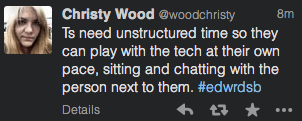
The open sharing and exchange of ideas was AWESOME.  Here are a few comments that resonated with me.

T-A28-1 T-A28-2 T-A28-3 T-A28-4 T-A28-5 T-A28-6 T-A28-7 T-A28-8 T-A28-9 T-A28-10 T-A28-11 T-A28-12 T-A28-13

I am already looking forward to our next Twitter sharing session.

~Mark

London PNC: Digging into change

Last Thursday (April 10, 2014) I had the pleasure of attending the meeting of the London MISA PNC group  to serve on a panel discussion with

L-PNCpanel

Joe Sisco of the WECDSB did a nice job hosting the event and moderating the panel discussion.  My role on the panel was to share some ideas concerning technology planning.

My response:

I enjoyed the variety of  questions the panel addressed.  Two conversations really stood out for me.  First,  some excellent dialog around the notions  of professional sharing:

and secondly, examining comfort with change:

In a rather timely fashion, this tweet from  Donna Fry  was posted just two days later while she was participating as a virtual learner by following the Twitter conversations of  Edcamp SWO  and  Edcamp London  which ran on Saturday April 12th.  I think the tweet captures the essence of the panel discussions in a nice concise way.

LivingInBeta

~Mark

Related Resources: sound clips in a local format

Clip 1:

Clip 2:

Clip 3:


Your Voice in Connected Learning Professional Practice

Note: My article for today is cross posted from OSSEMOOC: Day 1 of 30 days of learning.

I recently enjoyed a family trip to China in the context of  “the journey home”  for my adopted daughter.   The trip in of itself was simply amazing. I enjoyed going back, seeing the changes and once again experiencing the culture in such an amazing and historic country.

wall

Given the 1997 timing of my first trip we essentially survived on landline calling cards as public internet access and early versions of email were just springing up around the globe.  On this 2014 trip, of course the internet as matured and there are many amazing and often free collaborative tools available,  so in that sense the trip felt less isolated.

At the same time,  I had a chance to experience the “internet culture” in a much more locked down and filtered government controlled environment.  Tools that we celebrate, use and promote here in North America were simply not available.   Most social media tools were not available including Twitter, Facebook and Google Plus.  Of the Google suite of tools, only gmail and search were available and even these had seemingly limited use.  Gmail seemed to respond very slowly and not all search result  web links were actively available.  I also noted the some, but not all, blogging sites were blocked.  Facetime and Skype worked OK (band width dependent).

The notion of public free wifi as we experience here at locations such as McDonald’s, Tim Horton’s and Starbucks etc. was not wide spread. Yes, the wifi was free but you needed to text your phone number to a service in order to obtain an access code which would be texted back to you.  This is a very different approach to walk in free access for any device culture that is enjoyed in North America.

summer_res

Here in Canada, we are blessed with a very open culture and full access to a wide variety of web tools. The bottom line is YOU have a voice – and a choice of tools to use.  Please do not take take this for granted.  Leverage this privilege! Take time and make time to connect with other educators to develop your network and make your thinking visible by sharing your learnings and reflections.  Ask questions,  pose scenarios,  collaborate.  Give yourself a rich experience by starting a blog today!

Related Resources:
Reference 1:  Perspective from the Wall
Reference 2: #OSSEMOOC 30 days of learning

~Mark

SAMSUNG CAMERA PICTURES

OTRK12: Ready to learn and share

The  On the Rise K12  conference is set to go for April 1/2 in Mississauga. There is an awesome lineup of workshops.  Check out the  Tuesday list  and the  Wednesday list.

Donna Fry  and I will be there presenting about the  OSSEMOOC project  and also sharing the learning by live streaming some of the sessions.  Video streams will be available  [here]  and/or   [here]   (you will need to sign up for a free account to watch).  Some audio streams will be available at  QueST Radio 1-14.

Watch the  #otrk12  twitter stream for ‘on the fly’ details of which sessions will be streamed.

Enjoy the learning.  Consider sharing your reflections by submitting an article to the  OSSEMOOC 30 days of learning  project.

OTRK12full

~Mark

Focus on Beginners: What do you Need to Start Connecting?

Donna Miller Fry's avatarOSSEMOOC

As we have travelled throughout the province this week, we have heard loud and clear that we need an easier entry point for our education leaders to start the connecting process.

Last Tuesday, connected leaders met to discuss how they became connected leaders – the catalyst that got them started.  Here are some of the things we learned.  Which of these do you need?  Which of these can you bring to a leader you know to help them connect?

1. TIME!  When can we possibly find the time to connect?

http://www.flickr.com/photos/76818399@N00/4536146692/

Educators are busy.  Nobody disputes that!  But could connecting actually make your life easier?  YES IT CAN!  You can pose a question on Twitter 24/7 and get an answer in minutes.  We have heard many stories with this theme.

Learn to make time.  Start with 15 minutes each day.  Some of us do “Tea and Twitter”,  some of us start…

View original post 441 more words