Category Archives: Leadership Perspective

That! is a blog post

This blog post has been in draft mode since I attended the CASA13 conference in July. Every time I sit down to work on it, I think of another angle, write a bit more,  and things stay in draft mode.  Today, I read  Choose to Write  by  Angela Maiers  via Facebook. I would call that synchronicity given the topic.  So, finally, here we go.

I had the pleasure of seeing presentations at the CASA13 conference by  George Couros  and  Dean Shareski  as well as having personal conversations with them – always interesting and enjoyable.  Dean raised a great point in his  closing keynote. “Is the best PD process as simple as choosing something to learn and blogging about your experience?”  WOW – great question, great insight.

Relating to his Huffington Post article  “Want to create better teachers?” Dean states that ”  The reflective writing has been valuable but definitely the nearly 4,000 comments have been even more of a learning experience. This is the single best professional development experience I’ve had. Dan Meyer, a Mathematics teacher in California writes: … blogging was the cheapest, most risk-free investment I could have made of my personal time into my job.”   I suggest you read the full article here.

Next, I decided that I would gather material related to this topic by watching what my online professional learning network (PLN) was writing about it.  I have selected a variety of blog posts related to the value of online writing that I became aware of over the 2013 summer. Please take a moment to check out the insightful comments they shared about blogging and the learning that resulted from the process.

1.  What’s the big deal about blogs by @ColleenKR.

2.  The Reach of Education Blogging by @SheilaSpeaking

3.  What are you Thinking by @fryed (Donna Miller Fry)

4.  The Benefits of Blogging by @PeterMDeWitt

5.  Challenge: Five things I’ve Learned by @fryed (Donna Miller Fry)

6.  Why My Six Year Olds Blog and Yours Should Too by @KathyCassidy

7.  How Blogging Can Help Reluctant Writers/ by @DRPconsultants (Patricia Fioriello)

Now, coming full circle, the conversations around the value of blogging come to life again with the beginning of another school year.  But, what does it take?  There is a journey for each of us to travel:

  • finding your ‘online voice’
  • being comfortable with who you are online (you must be yourself)
  • settling on your own writing style
  • recognizing that you have experiences and insights to share
  • you never know who you might help

As we settle in for the 13/14 school I challenge you to be observant, look for that opportunity to reflect and share, dig in, find your online voice and BLOG!

Related Resources

Dean Shareski’s blog

George Couros’ blog

Angela Maiers

Letting Go by Stacey Wallwin

and a special thanks to my PLN for their willingness to share through blogging.

~Mark

SAMR: A day with Dr. Puentedura

The last 2 weeks have been filled with amazing opportunities to spend quality time with passionate Ontario educators:  the WRDSB  CATC by the Water annual summer PD session, the  OSAPAC  summer planning session and a full day event focused on the  SAMR  technology integration model — talk about awesome!

The SAMR day was very exciting as the presentation given by Dr. Ruben R. Puentedura, the researcher and author of this model.   The SAMR model defines 4 levels of technology use for learning as described in the diagram below.  The focus of  the day was to look at the SAMR model in the context of many different grade levels and subject disciplines.

SAMRgraphic

Personally, I found the day fascinating.  Dr. Puentedura presented many excellent examples of SAMR within the context of Ontario curriculum.   One example that particularly resonated with me was around the idea of reading.  In terms of the substitute level, one can read on paper or read on a screen, highlight on paper or highlight on the screen etc.  This shift really only serves to set the stage for the A, M and R levels.   The augmentation level might include using an e-reader auto read feature to improve the experience and understanding.  The modification level might include a task redesign such as extracting the highlighted notes and using them in new contexts such as word processing, wikis or in social media contexts such as twitter. The redefinition could include blogging by engaging students in reading circles, providing meaningful comments on other’s work and asking probing questions.  This could be extended for deeper meaning by replacing an essay with a digital video production. Video components would include narrative, images, context etc.  Students could further engage by providing meaningful comments on other videos  and asking probing questions.  Other examples I appreciated centred around social technologies (a range of tools from email to Facebook) and story telling.

The bonus in the day was that Dr. Puentedura  joined our table for lunch – yes!!!  We enjoyed a great free flowing discussion about his research – many contexts, environments and countries.  There is no real way to capture all of the things we talked about in our rich discussion, but here are a few highlights:

  • technology is important in a participatory culture of learning (power to connect and collaborate)
  • 1 : 1 – not absolutely essential but it does make a huge difference, so desirable
  • laptops vs tablets … drum roll … tablets

The day was truly amazing, and I couldn’t help but leave feeling energized and wondering about a practical way to put this into action.

Suggestion for Ontario elementary teachers:   Check out the new  social studies  curriculum document (or choose a curriculum relevant to you) with an eye to technology integration and the SAMR model.  I personally see many possibilities with the included citizenship framework of active participation, identity, structures and attributes.  Some of the possibilities I see are  inquiry based research, writing/blogging, collaboration tools, wikis, digital maps, digital timelines, presenting (posters, videos etc.) and age appropriate social media tools.  Wonder, and ponder.  What possibilities do you see?  Share your great idea(s) by leaving a comment to this blog post.

Related Resources

A  (YouTube)  video introduction  to SAMR by Dr. Ruben R. Puentedura
SAMR  event tweet stream
SAMR resources on  scoop it!
SAMR  presenter notes

Happy learning and integrating.

~Mark

Note: Cross posted to VoicED.ca

CASA13: An important remix

As June came to a close, I eagerly anticipated my attendance at the CASA conference as a good learning opportunity and to present with Ed Doadt on the use of social media in the classroom and school community.   With a conference title of Pedagogy to Technology &  Hardware to Headware  I certainly felt some great learning and networking opportunities would unfold.

I must admit that I was taken aback by the approach taken in the keynote address.  The intent may very well have been to cause people to stop, reflect, and engage in meaningful dialogue about the use of technology to support student learning, but the rather hard nosed approach taken seemed to disengage the audience. Although several key points were made, including:

  • innovation has a high failure rate
  • technology is an expensive and ongoing investment
  • the “light house” approach typically ends up as a moth balled project that went nowhere
  • improvement strategies in education must be based on the best instructional and assessment practices

the message seemed to be stay out of this arena and focus on aspects of education that are already proven by research.  Two important questions emerged from this framework: a) why would we (educators) get into the innovation game in K-12 education where funds are limited?, and b) where is the research that demonstrates technology makes a difference?

The audience reaction was rather subdued and there was a smattering of polite applause.  While a few people offered up examples where technology was making an observable difference in student learning, the comments were essentially shot down based on statements of “lack of research”.  There was a real sense of disconnect in the room. The view presented was polarized relative to current directions and thinking in this area by many.  Audience member and conference presenter  George Couros ended the session with a very important point: learning with technology is significantly different than learning about technology.

I have been reflecting on this scenario since attending the conference trying to sort through the various perspectives that come into play.  First off, I don’t think anyone would debate the 4 bulleted points outlined above. These are known facts that are well researched and documented.  Teaching and learning with technology must be done well, and in the framework of best instructional and assessment practices.  Learning WITH technology IS different:  it is about NEW possibilities. The SAMR model, as described in the diagram below, offers a great way to define stages of development in terms of how well technology may be used to support learning.

SAMRgraphic

Yet, there is this nagging question: why do educators want to move in this direction if it does not make any difference?  So many people I talked to indicate that technology DOES make a difference in how students learn.  Many shared reports that perceptual, observation based, focus group data etc. indeed show differences in this area.

After chatting with several people after the presentation and some personal reflection time, I think there is an important perspective missing:  the timing of the research (assuming that this should be researched at all).

REMIX:  In reality, we are still in the infancy in this area of teaching and learning with technology.  We need to apply the right lens and connect the dots differently. Why? Learning how to use technology effectively in education is NOT wild reckless expensive innovation in my opinion.  It is about doing things differently and exploring new possibilities.  We are not at a point in time where enough teachers use technology effectively in their practice. To me, it would make sense that if one researches and measures the effectiveness of technology  now, the results may indeed be somewhat marginal. Then again, if any educational tool/resource is used ineffectively, research will show that the impact of that tool/resource is marginal.

So Now What?  We need to consider the way in which the term innovate is used in the context of education.  Like it or not, technology is here to stay.  Learning to use it effectively is not reckless innovation or transformation.  We need to learn how to leverage it in the most effective ways possible. This means trying things, and sharing the learnings — blogging about is would be great!  I believe we need to invest in teacher training, close the gap, and raise the bar in the area of technology use. Continuing to gather data and formalizing research is a ‘must do’.  Every educator needs to commit to sharing their learnings and best practices (add another plug for blogging).

Finally, in the keynote, technology was portrayed as the big bad beast:  you were IN or OUT. I strongly believe that we  can not look at this sandbox stage as some definitive point of decision.  We do need to continue leveraging learning WITH technology, exploring new possibilities and sharing.

Perhaps it is time to throw a technology challenge on the table:  eliminate technology from your line of work and personal use for a month  — no corresponding, collaborating, note taking, internet enabled research/fact finding, analysing, exploring, reading, social media, email … well you get the picture.  At the end of the month, reflect on whether or not technology makes a difference to how you work, then share your learnings by commenting on this blog post.

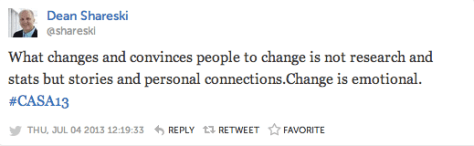
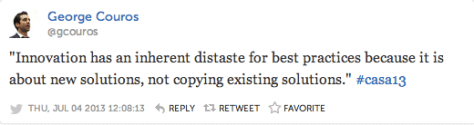
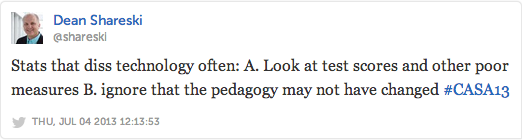
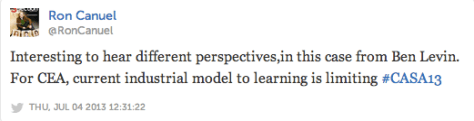
I also wanted to share a few notable quotes from the #CASA13 Twitter stream from this session.

<insert screen caps from storify> 
CASA13-1

CASA13-2

CASA13-3

CASA13-4

CASA13-5

CASA13-6

CASA13-7

Other Resources

SAMR model resources from Scoop.it

Happy reading and reflecting

~Mark

ISTE13 BoF reflections

One of the sessions I attended at the ISTE13 conference was a Birds of a Feather discussion.  The original discussion topic was advertised was chromebooks.  When the actual event happened, the chromebooks topic was replaced by a more general discussion on mobile devices in K-12 learning environments.  There were about 8 people at the table, mainly representing independent schools as it turned out.

What really surprised me was the nature of the conversation put forward by most of the participants.  From most participants, the discussion centered around being a “one device school”.  The key question that emerged was:  “How might one go about choosing between the variety of available options: windows netbooks and tablets, android tablets, iPads and chromebooks.”

It seems to me that different tools have different strengths, and that there would be value to having a variety of options available. Besides, at the rate of change with technology,  it would be challenging to set a particular long term direction at this point in time that you could stick to.  Perhaps the key idea is to focus on learning with technology, and leveraging new possibilities rather than focusing on the device itself.  No matter what the device mix is now, things will change.  I believe investing in the infrastructure to support the needs of students and staff in todays 21C learning environment with a variety options including BYOD is the best way forward.

An invitation:  I am curious to know your view.  Please share your thoughts in a comment or tweet.

~Mark

Related Resources

Blog Post:  What’s in a device

CASA13 Presentation Resources

CASA Conference 2013 Presentation Resources

Conference Theme: Theme: Pedagogy to Technology: Hardware to Headwear

Our presentation  : Leveraging the use of Social Media Tools in your School Community — the use of social media tools in the Waterloo Region District School Board as things are now,  the journey and the challenges.

Video Samples from our CASA2013 presentation:

Haley   (Student)
Aaron   (Student)
Andrew  (Student)
Andrew Bieronski  (Teacher)
Kevin Donkers  (Teacher)
Kathi Smith  (Trustee)

additional video resources 

Twitter  (Teacher)
Facebook (Teacher)
Edmodo  (Teacher)
Student Perspective  (Students)
Principal Perspective (Bill Lemon)

Q&A from Today’s Meet backchannel

Information regarding the WRDSB iPad approach

Related Resources

Canadian Association of School Administrators  (CASA)  conference.

WRDSB  Responsible Use Procedure  (RUP)

Social Media Drive By (Blog post)

Quest Radio 1-24  Programming Info  – watch here for announcements regarding additional rebroadcasts of this session.

Join a live broadcast or rebroadcast  on Quest Radio 1-24.

Mark W. Carbone  and  Ed Doadt

~Mark and Ed

Nurturing Your First Followers

During May,  the Waterloo Region District School Board  held a Digital Learning Symposium involving central staff, teachers, students and guests from the Ontario Ministry of Education and community. The intent of the day, was to bring staff and students together to dig deeper into what is working and what is needed as next steps forward. While the day was a huge success with great interaction and discussion within the various stakeholder groups, there is one aspect of this that I have continued to mull over:   Capacity building, and nurturing first followers.

WRDSB teacher, Scott Kemp, selected this “Starting a Movement” video to show as part of the final session discussion kickoff for the day.

On route to ISTE13, I had some great conversations about this idea with Rebecca Rouse  and  Susan Watt .   While the notion of nurturing first followers could be applied to many situations, we were looking at this from a technology enabled learning perspective.

By the numbers: From a strictly numbers point of view, you could think about: one helps another, two help four, four help eight , 8 > 16 > 32 > 64 > 128 > 256 > 512 > 1024 > 2048 … done. Lets say you already have 100 or so “lead nuturers”, then getting to “done” might only be 4 years (or defined time periods). More aggressively, one might start with one helps 3, 3 help 9, 9 > 27 > 27 > 81 > 243 > 729 >  2187 … done. With the same 100 or so “lead nuturers”, then getting to “done” might only be 3 years (or defined time periods).

These kind of progressive numbers are encouraging when thinking about rolling out a change process. But, there is more to it than just the numbers. In our conversations, we identified a number of critical components to consider in the mix.

  • PD should be a graduated continuum just like learning for students
  • professional practice should provide opportunities to align with the plan, act, assess, reflect learning cycle
  • people need varying amounts of time to reach the ‘ready to mentor’ stage
  • at what point could someone properly nuture a “first follower” in a way that produces the desired learnings, results and in turn prepares the first follower to, in  turn, nuture their own first follower with the needed outcome?
  • many of the components identified are all variables in the mix
  • moving along the technology continuum is, at least at this point in time, optional.

While this process is clearly not just amount the numbers, the thought does stimulate some intrigue and excitement about moving things through the system.  Digging deeply into understanding the nurturing of first followers may well be the key to success. To me, there are some key aspects to achieve.

  • Time is needed to shift thinking.
  • The use of technology needs to considered by default in the planning process. We need to arrive at a point where teachers will internalize the asking of the “how might technology support student learning in ‘this’ situation” without external prompting, noting that need will vary.
  • When this answer is ‘yes’, teachers must  know the framework in which technology should be appropriately used to align with and meet Board/District/system goals. In my context, this means technology enabled learning that aligns with our chosen 5 high yield instructional strategies, the C’s (create, communicate, collaborate, critical questioning, citizenship) and TPack.
  • We continue to promote learning of appropriate technology use for all staff
  • Best practices in the area of technology enabled learning are openly shared
  • Recognition that is is NOT about a particular type of device or application. It is about the best way to support learning and engagement.

An invitation:  What do you think is most important to nurturing a first follower of yours?  Share your thoughts!  Please leave a comment, or send a tweet or email.

Related resources
Digital Learning Symposium Tweet Summary
URL to Starting a Movement

Suggested Reading 
Crossing the Chasm

~Mark

Blogging with primary students

Today (Wed. May 29th, 2013)  I will be interviewing  Waterloo Region District School Board  teacher  Jenni van Rees  at 4:30 (EDT).

Our discussion topic:  blogging with primary students.

Catch the live broadcast by visiting the   QueST Radio 1-24   website.   I will also be writing an upcoming blog post featuring Jenni’s work in this area.

~Mark

Reflections on Ed Camp Hamilton

Saturday May 4th, beautiful sunny weather, no humidity and roughly 150 energized educators at Ancaster Sr. Public School to participate in Ed Camp Hamilton.

edcamp-attending

First, hats off to the organizing committee for planning a great event  — lots of positive energy and opportunity for networking —  take a bow.

I arrived early enough to take advantage of the opportunity to network prior to the official kickoff. It was wonderful to greet friends, meet online acquaintances for the first time and make new connections.

The day followed the traditional ed camp format with a group kickoff to pose questions to form the basis for the days discussion.  The submissions were sorted into groupings and assigned to room locations to facilitate the proceedings of the day.  Each of the discussions I attended was thought provoking:

  •  shift
  • motivating colleagues to change, try new things and take risks when they are reluctant
  • the role of administrators
  • innovation: grass roots, top down, or both
  • what other ingredients are needed for change
  • assessment: do current practices hinder change?
  • the squashing of innovate practice by some of those who fear change and risk taking

Great discussion, no easy answers, nuggets to chew on, things to ponder, take aways to try, ideas to share — awesome!  In addition to the excellent session discussion, three additional conversations are still rattling around in my mind.  One conversation started with Ron Millar and continued with Jenni van Rees  — new ideas for scaling a PD plan for next year.  Hold that thought and perhaps watch for a future blog post.

The second conversation started in the lunch line with Jane Mitchinson and Carlo Fusco, then continued at the lunch table with Ron and Jenni joining us.  We got talking about socialization, the impact of that process and when important conversations become too big and lose focus.  I believe we agreed that one of the hot topics and key elements of change in education right now is the “hot ball” of putting the conditions  of change in place, the shift to technology enabled learning, continued focus on pedagogical improvement and building capacity for change and risk taking. In essence, I believe this synergy  burns brightly because events such as ECOO, the OTRK12 conference,  the Ontario GAFE Summit and this Ed Camp event keep fuelling the flame  for continued learning, sharing and professional reflection.  Sustained energy is SO important right now.

BUT, what happens when the conversations become blurred by the big paint brushes — questions that could take the collective us off our game. Questions that are too big and too general to ever be wrestled to the ground.  Loss of focus would be a major hinderance.  Do people supporting change NOW, have to also be guardians of the focus of the journey?

The third conversation happened after the event – a very engaging conversation with Donna Fry. We talked further about the challenges of creating opportunities for change, and sustaining the energy to keep things going.  Donna has great ideas and big plans for her area — what an amazing educator! I hope I can be a part of the action.

Thanks again to team Ed Camp Hamilton for arranging this successful event.  For those that could not attend, check out the #edcampham twitter stream.  Until the next event, see you online and keep the learning, sharing and reflecting GOING.

Related Resources

Now Thats PD  by  Jane Mitchinson
The revolution will be tweeted … at the Shifting Ideas  blog by Carlo Fusco
Ed Camp Hamilton Reflection by David Fife (www.davidfife.ca)
EdCampHam left me with more questions …. by Karen Wilson

~Mark

Technology Enabled Learning at Millen Woods PS

I recently had a chance to spend some time at Millen Woods PS (link) with principal Gwen McCutcheon and her staff.  The school had a very welcoming atmosphere. There was a definite energy for learning, and yet a calmness at the same time. Impressive!

The visit began with an opportunity to meet with Gwen in her office to discuss some background information and leadership philosophies. Gwen is very interested in how technology can support and enable learning. Gwen states emphatically that she is “NOT a techie”, but has worked hard to establish a culture to leverage the best uses within her school. One of the resources that is shaping Gwen’s thinking is the book Visible Learning. She has noted a few key quotes from the book that really resonated with her, and reads them often. Some of the key points include:

  • teachers need to understand learning through the eyes of the student
  • what works is not just the tool or the structure
  • students learn best when they understand the learning process
  • learning is an:  explicit goal, appropriate challenge or  measuring progress towards meeting a learning goal
  • in this context, effective use of technology makes a difference to student learning
  • technology can add a level of accountability
  • when students explain their thinking, they become their own teachers

Millen Woods P. S. has 60 iPads at this point in time – some from their start up funds 3 years ago, some purchased by the school and 20 from our  central allocation this year.  Principal McCutcheon views iPads as the most versatile piece of equipment in the school. She has been impressed with how well staff have adapted to thinking in a technology enabled framework and using iPads to support small group instruction, rather than taking a 1:1 approach.  She is proud of the way the staff have focused on using technology to enable, support and capture student learning – making student learning visible, exploring critical questions and sharing thinking. Students enjoy the hands on approach and many staff feel that this has increased accountability.  One example of students capturing their work is by using the Explain Everything app.

I enjoyed meeting teacher Stephanie Ringwood and her French immersion class.  I was very impressed with seeing how her students used the iPads to support their learning. Listen to  Stephanie’s perspective  (video) on the shift to using technology in her classroom.

At the time the school opened two years ago, one of the big changes for staff was having the computers dispersed in pods around the school.  While it took some time for all staff to adjust, Gwen feels they have “mad the transformational journey” and see the value in this approach.

As we walked the school, I saw other groups of students working in classrooms, pods and in hallway groups using technology to capture their learning — making movie trailers regarding physical fitness.  I could tell from the way the students interacted with Principal McCutcheon that they were used to seeing her out and about in the school.  I noted that there were some interactive white boards in the school, perhaps in roughly 25% of the classroom.  Gwen feels this number is quite appropriate for the school and that there is no need to have one in every classroom.  I do concur with her views on this as many teachers find it challenging to move past the teacher centered instruction early phases of using them. I also took note of some students working at their literacy skills using electronic books.

As we returned to the office area, the large flat screen TV in the hallway captured my interest.  It is used to display student work the Millen Woods way – students teaching other students and students capturing their learning — AWESOME!

One video example of a student demonstrating their work is evidenced in Roane’s Video (posted with permission).

iPad syncing trays and Mac Mini (side mount) for syncing
iPadtrays

Hallway TV displaying student work
HallTV

Laptop controlling hallway TV
TVsetup

Thank you for sharing your learning journey!

~Mark

OTRK12 Reflections

The month’s On the Rise K12 conference was very worthwhile.  I was impressed with the level of learning, sharing and reflecting. Some of my highlights included:

There was a notable energy during the event which continued right through to the last session.  I attended an identifying barriers and moving forward session. It was quite interesting to listen to the various challenges raised:

    • great admin support, but teachers are resisting change
    • wonderful grass roots energy to change, need more admin support
    • interest and participation in blended learning is growing but bandwidth capacity is an issue
    • need more wifi coverage

All in all, it was a great passionate discussion  by caring educators.  Upon reflection, the things that really resonated with me were:

    • it is critical to continue investment into bandwidth (internal and internet) and stay ahead of the need
    • I believe leveraging access by including BYOD as part of the mix is important
    • the grass roots up/top down needs to become a planned path with expectations and annual goals
    • continue to focus solving problems and sharing solutions

There are 2 more critical pieces to the puzzle in my mind. There are a wealth of teachers who already use many web 2.0 and social media tools as part of their instructional practice in curriculum delivery. I seems to me, a plan is needed to bring this body of ‘casual’ blended learning into the D2L portal used by the Ministry of Education. Part of this plan would address the need for an easy path to connect existing resources used in the casual approach into D2L – a transition, not a do over for teachers.  Secondly, the D2L environment needs to be “lego like”  — easy to snap outside resources into the portal and minimizing the need for custom interfaces or complicated conversions.

Related Resources 

Conference Twitter chat stream
Presentation: The Traditional Classroom by Diana Hughes
Reflections from Donna Fry
Colleen Rose’s Reflection
OTRK12 Part 1 by Ferdinand Krauss
OTRK12 Part 2 by Ferdinand Krauss
Reflections from Brandon Grasley
Conference Site

I look forward to attending next year’s event.

~Mark