Category Archives: Leadership Perspective

RCAC11 Presentation Notes: Facebook 1 year later

RCAC 2011 presentation notes: Facebook – one year later in WRDSB

A special thank you to my presentation guests:

Elaine MacKenzie
Dan Ballantyne
Adrienne Fiander
Shannon Smith

Related Links:

Ontario ConnectEd Leader Consortium
Log into Facebook to see OntCLC on Facebook
OCT Backgrounder
OCT Advisory
OCT Social Media video
Principals and Social Networking Report (2010)
Log into Facebook to see Dan Ballantyne’s Teacher Fan Page
RCAC

~Mark

5 on 5 part 2

I recently enjoyed a second opportunity to participate in an interview process with IT World Canada.  The format is 5 on 5 — 5 questions for 5 people. View the IT strategy 5 on 5  November discussion on innovation.

~Mark

Great CATC conversation

I attended a technology planning meeting tonight with Rebecca RouseCarolyn Graham and the Smithson Public School CATC (computers across the curriculum) team. Reflecting on the meeting, a few thoughts stayed with me:

  • good energy on the team
  • positive outlook towards change
  • technology change is messy right now, and shifting quickly.  Time is needed in the sandbox to play!
  • static vs dynamic use of technology (static = fixed labs etc., dynamic = technology in the student learning space)
  • technology to enable and enhance learning,  not new technology for technology’s sake
  • discussion focused beyond now and short team –> what does the next 3 years look like at the school?
  • increasing access
  • advantages of mobile technology
  • highlighting new learnings at staff meetings

I hope some of the discussion points listed here, might provide guidance to other sites in their planning process.  We look forward to working with the Smithson staff to develop their plan and support them moving forward with their agenda.

~Mark

#OntCL Kickoff

Tonight  the official kickoff for the first Ontario ConnectEd Leaders chat event happened.  Participation was great, and there was an action packed 75 minutes of sharing on tonight’s topic: Why Be a Connected Leader and What to Tweet.

The energy was amazing – great synergy.  I think there is already anticipation of the next  event. Thank you to all participants for a great event.

I have captured a few highlights below.

Additional Resources

Primer of tonight’s #OntCL session from The Principal of Change : What should a networked educational leader tweet about?

The full Twitter Stream of the #OntCL  conversation.

The Ontario ConnectEd Leaders Consortium web site.

~Mark

Pecha Kucha at ECOO 2011

The suite of presentations at ECOO 2011 included a Pecha Kucha session. Pecha Kucha is a presentation style – 20 slides, 20 seconds of speaking time per slide.  Preparing for this was a unique experience, as I am used to presenting in a more free flow approach. I decided to keep my slides as simple as possible  to support the main idea being discussed. My presentation topic was being a change agent.

Main speaking points for each slide are outlined below.

1. “Simple can be harder than complex” is a Steve Jobs quote. Today I
want to honour Steve Jobs with this quote by applying it to my topic
and approach to this presentation. “Simple can be harder than complex”.

2. My favourite Greek letter is DELTA, which represents change.
The topic of my presentation is considerations in being an
effective change agent. Lets ponder some of the important elements
by reflecting on some questions and ideas.

3. The challenge: check out the landscape around you, and have a really
good look, not just a cursory look. What do you REALLY see?
Fear? Avoidance? Fragmentation? Struggle?

4. Reflect on how you can make a difference.
— What path forward will be developed based on your reflections?
— How will you make the best impact possible?
— What actions will you take?
— How will you make a difference?

5. Technology perspective:
— We need strong alignment with authentic student learning.
— research, writing, analysis, problem solving, project based learning,
— critical thinking, expressing thinking in writing or digital storytelling.

Technology must be used in enabling and engaging ways to support
learning – it can’t simply be for the cool factor.

6. Need a plan

— change does not happen randomly in the large scale
— the right building blocks have to be put in place,
— and in the optimum sequence in whatever level you are working at
— decide on your key elements, and focus.

7. sphere of influence
— what are your potential impacts
— how do you position yourself so your actions have maximum impact?
— CONNECT, LEARN, REFLECT, SHARE
— and share in a way that influences your sphere
— commit to what makes a difference

8. study culture (teachers, admin, IT staff, learning support staff)
— leader, follower, bumblebees or samplers, early adopters, resisters
— pause to reflect, what will make a difference in the BIG picture.
— how you can best impact?
— how do you turn these ingredients into a symphony of change?

9. Gaining credibility
— be reflective
— show your actions make a difference
— share your experiences in meaningful ways
— you need to share in ways connected to your sphere of influence

10. Personal growth
— you must outwardly embrace change
— you must demonstrate that you can change as an individual
— you MUST be a learner, but not just any learner
— you need to be a learner in the way we expect our students to learn

11. Role modelling
— talking the talk is simply not good enough
— you have to walk the walk, this is critical in my view
— do it in visible ways
— fundamentally, you must LIVE IT.

12. Be an enabler
— Actively play the role of the enabler
— but do it in the focused way that moves your agenda ahead
— and do it in a way connected to your sphere of influence
— fracturing your focus will not help in the long run

13. Stay the course
— can’t be a weather vain, no matter what the challenge
— champion your strategy
— there is less chance of people buying in if you have a new “best idea” on a regular basis.
— Stay the Course

14. Embrace the end user experience
— the milkshake story by Clayton Christenson
— At McDonald’s, why do people buy milkshakes in the morning?
— Simple — it is all about the end user experience
— commute to work, need something to sustain them, need to
—— consume it with one hand, can’t me messy, avoid frequent bio breaks.
— Now, put the end user context to technology enabled learning

15. scaffold
— as people dip their toe into this new world (Alison’s blog idea)
— feel welcomed and supported
— people need guidance to travel the scaffolded road
— if the goal is to change the broader landscape, then this idea is critical

16. focus
— doing too many things fractures resources and outcomes.
— focus on the things that make a difference,
— a difference now that is a stepping stone to the level needed

17. sustain
— build capacity in ways that impact
— don’t build on false economy
— if something only works because an extraordinary amount of $ or
——- equipment was provided, then the idea is not scalable or sustainable
— build capacity in a sustainable approach

18. pace yourself
— change takes time
— change takes consistency
— don’t burn out, pace yourself to be effective
— Being a change agent requires time and commitment

19. Believe in yourself
— you must, if you don’t others won’t either.
— do your change agent work with conviction
— you can transform
— be part of the educational transformation movement
— join the revolution and help make a difference

20. Tips 🙂
— I like the concept of consistency, maybe a uniform?
It worked for Steve Jobs
Personally, I like wearing black
Oh, and some of that new bullet proof skin might come in handy too!!!


~Mark

Social Media Check

Thanks to a tweet from @trustsocmedia this week, I found out about the  The Doc Zone  feature titled Facebook Follies   . Although I was not able to view the CBC broadcast, the title did capture my interest. Today, I took the time watch the online version of  Facebook Follies .

In my view, the production was very well done.  The realities, cautions, benefits and highlights of using Facebook, and social media tools in general, are all explored through real situations. To me, this speaks to the reasons why students need to be educated through authentic experiences about the use of social media tools, digital citizenship and managing your online profile/digital footprint.

Your online actions live forever. I applaud educators who are making efforts to embrace social media tools, leverage their power , teach and model ethical and responsible use.

~Mark

Ryerson Public School

I recently had an opportunity to participate in a Grand Magazine interview with Peter Berndt, Principal at Ryerson Public School in the Waterloo Region District School Board. The article, linked below, captures the technology focus of the school and highlights the excellent work of the teachers in using technology to support student learning.

Congratulations to Peter and the Ryerson staff for their excellent work with technology and forward thinking about student learning.

This article is posted and linked for viewing purposes only with permission from the publisher. A special thank you to Nancy Silcox for preparing this article for publication.

Ryerson Public School

~Mark

5 on 5

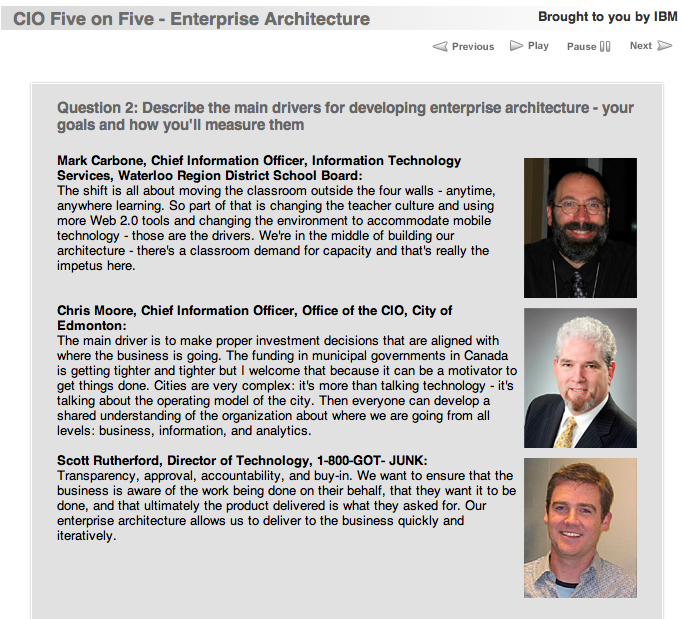
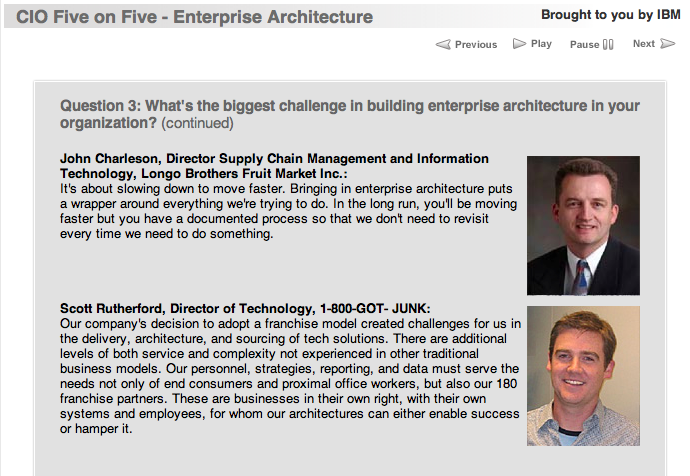
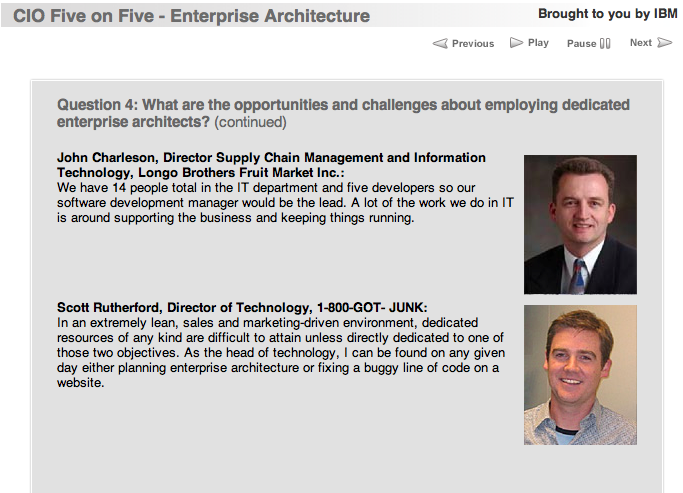
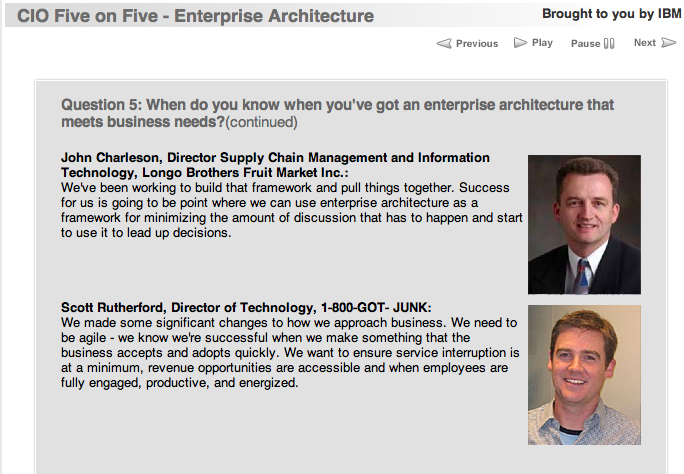
This past summer I had an opportunity to participate in an interview process with IT World Canada.  The format is 5 on 5 — 5 questions for 5 people. The IT strategy 5 on 5 discussion on enterprise architecture development is captured below  (with permission).

 Question 1

Question 2


Question 3


Question 4


Question 5


~Mark

Boot Camp Panel Reflections

Earlier this week, I had a wonderful opportunity to participate in a PLP Boot Camp panel discussion.  I enjoyed hearing the thoughts and key messages of the panel members concerning 21C leadership. I captured a key phrase or two from each panel member and share them here for your reflection and what these might mean for you.

  • awakening to the 21 century
  • embrace change
  • continuous learning
  • unified direction needed
  • observe and learn from the cultures in your organization(s)
  • place yourself in the place of most potential, be open to possibilities
  • tools in service of the learning
  • be open and transparent
  • consider support and release needs
  • sustainability planning is critical
Enjoy reflecting on these leadership thoughts. What actions will you put in place?
~Mark

The OCT Advisory – my view

On Monday April 11th, the long awaited press release of the Ontario College of Teachers (OCT) electronic communication and social media advisory was released. I was attending the OCT live presentation on Tuesday in Toronto, and viewed the advisory print document and watched the video to be well informed for the session.

My initial impression of the print document was that it was a well written, solid framework to guide educators into this new territory. I was very impressed with the video production as it captured a positive spirit for leveraging these new tools within our education system. I did feel that some additional clarification was required in the area of Facebook use, and planned my comments and questions for the live session.

It was interesting to watch the press and media take on the documents and follow the reactions via Twitter. As one would expect, reaction varied widely, tending towards the ‘too cautious’ end of the scale. Tuesday morning, I was able to have a conversation with Chris Vollum, an excellent speaker who has significant experience presenting social media sessions to school and parent audiences across the province and at many WRDSB schools. Chris, who was interviewed as part of the video, had a positive reaction and felt the overall message was positive. I also had a good phone discussion with Jane Mitchinson who has provided extensive leadership in technology and social media use within our Board.

The session was well organized, with the agenda organized as: presentation, table discussion and Q&A.  I captured some of the important highlights and shared them on Twitter:

  • Opening remarks: OK to use social media in responsibly and ethically — key factors: care, trust, integrity and respect
  • The intent of the advisory is to clarify responsibilities while capitalizing on the potential of these tools
  • Social media tools can be appropriate, useful and powerful
  • OCT: ‘off duty’ use of social media tools matters – what does appropriate use look like?
  • Online behavior by teachers should reflect the same professional ethics as used in the school setting
  • Private vs. Professional: onus on members, off duty conduct matters, exercise caution, act professionally at all times
  • The internet is part of a teacher’s off duty realm
  • Any online presence should respect professional integrity, even in the somewhat less formal social media environment
  • Reviewing some examples of professional misconduct -I note that these examples would be inappropriate online or offline
  • Teachers: model good behavior, advocate proper use (digital citizenship) be courteous and professional at all times
  • Facebook – caution re ‘friending’ – but no distinguishing of friend=contact, it is all about the security and privacy settings – education!!
  • My comment: follow the Grandma rule— if you don’t want your Grandma to find out, don’t put it on Facebook
  • You can’t judge social media from outside
  • Board hosted email should be used for communications with parents (not personal email addresses)

The table discussions were interesting. We were given 4 scenario questions to consider. All were great questions  with pros and cons and certainly generated excellent discussion around the different viewpoints — risk factor(s), legal implications, empathy, professional approach.

In some ways, I enjoyed the Q&A best. Many good questions were asked, and gave further indication that there are multiple factors to consider in almost all situations. I did take the opportunity to raise a few points during the discussion:

  • Digital citizenship and character development programs are essential for teachers and students
  • Staff and students need authentic experiences with social media tools in a real world context
  • Your digital footprint represents your online presence – how google-able are you?
  • Your digital legacy is your digital reputation – how will other perceive you and remember you?
  • Social media tools offer many opportunities for connecting, collaborating and sharing – embrace & capitalize
I did ask specific clarification around the ‘teachers should not friend students’ point.  In the Facebook environment, a ‘friend’ is a contact. How any 2 contacts interact is dependent on security and privacy settings, and the relationship — a professional context suitable to the educational environment.  I sited examples where teachers might ‘friend’ students, but have suitably locked down profiles and interact with students in a Facebook group setting.  Panel members who addressed my question indicated that there is no issue with this if it is done properly with appropriate settings and professional conduct. We all recognized and acknowledged  the need for people to know, understand and use appropriate settings (Digital Citizenship).
I took the time to meet the panel members after the session. I appreciate the work done on this document, and the importance of the framework established and congratulate the team that worked on the preparation of this document.
What if I could change one thing? – The one thing that I wish could be changed is the manner in which this was handled by the media. They really grabbed a couple of small pieces of information and cast a giant negative spin on things — so much for fact finding and balanced reporting. Unfortunately, this is all some people will remember.
Next steps: Embrace change! Given the great potential of these tools, it is important that those comfortable in leading, continue to learn and share best practices and experiences. Boards and federations need to make sure Digital Citizenship and Character Development programs and other training supports are in place. Pre-service teacher programs should provide a good grounding in Web 2.0 and social media tools. Teachers need to be familiar and comfortable with these tools before using them with students.
Related Links:

OCT Backgrounder
OCT Advisory
OCT Social Media video
Viewpoint: Pipedreams (blog)
Viewpoint: Off the Record (blog)
Viewpoint: The Clever Sheep (blog)
Viewpoint: Jane Mitchinson (blog)
Viewpoint: People for Education
People for Education’s Online Community

~ Mark