Category Archives: 21st century learning

Digital Citizenship Through Connected Learning

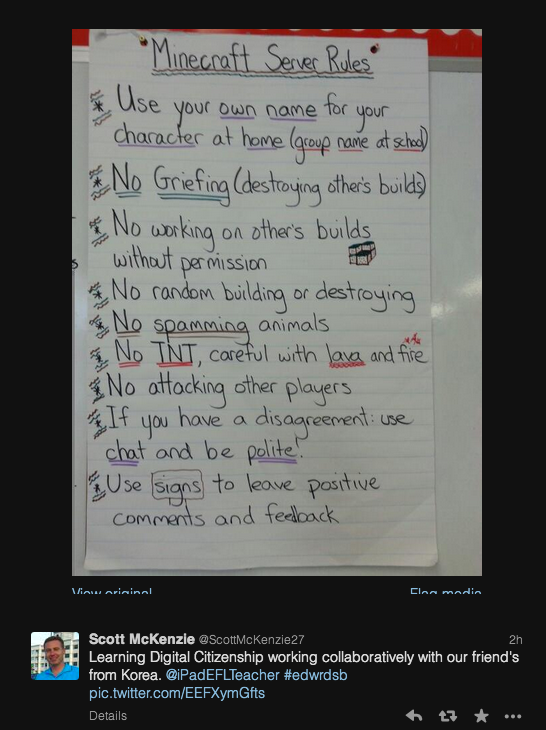
This tweet from  @ScottMcKenzie27  caught my attention this week.

The approach Scott is taking with digital citizenship in his classroom really brings it to life through relationships,  conversation, collaboration and a real world connected learning experience.

screen_cap_1

Thank you for sharing your work and learning openly Scott.

~Mark

Note: Cross post to OSSEMOOC

Digital Learning Carousel Reflections

I had the pleasure of attending the  WRDSB  Digital Learning Carousel event today along with 400 educators and students from our Board. The event provided opportunity to share our collective insights around digital learning,  changing practice and planning next steps forward for our organization.  The carousel sessions I attended included online novel studies, innovative practices with math, inquiry approaches and the Futures Forum program.

Three aspects of the day really struck me.  The positive feedback on the interest in using Google Apps for Educators (GAFE) and the high rate of adoption on our roll out was awesome.  Secondly, I was intrigued to hear some of the educators sharing the benefits of enough technology to support small group instruction over a 1:1 approach. The ‘just enough’ model allows technology to be used as a learning support as needed while fostering opportunities for interaction, conversation and sharing.   A 1:1 approach can result in students being self focused or isolated. This feedback validates our decision to roll out our iPad program in a way that avoided convenient the “portable lab pack” allocation. Finally, so many discussions touched on the idea of the right mobile tool for the learning, teaching or assessment task at hand. I felt proud that our  IT department is deploying and supporting iPads,  Chromebooks and Windows mobile devices to support learning at WRDSB.

carousel

My Session Highlights

The online novel study group talked extensively about taking a proactive approach to digital citizenship before moving into online activities. Their approach included googling yourself to find out what is actually online, reputation management, managing your digital presence and building relationships. Tools used in this program included Google Apps for Educators, Today’s meet, blogging, skype and collaborative web page designs.  An impressive approach indeed!

In the math innovative practices session, I noted that educators were really digging into teaching collaboration skills. What does collaboration look like, sound like, feel like? “Look fors” would include accountable talk, building on the ideas of others to highlight two attributes. Digital tools used in this program included Explain Everything, GAFE, GeoBoard, Notability and iMotion.

The inquiry stream focused on the relationship of two key elements:

1.  What do students need to learn and what do I need to learn as a teacher?
2.  If I do this as a teacher, then students …

The final session featured the Futures Forum program, which I am very familiar with due to my involvement with the program. Presenters emphasized the importance of a growth mindset for both staff and students. The approach used this year involving SparKW really engaged the students in a meaningful way.

Clearly,  all of the presenters I saw today demonstrated a high level of professionalism and a growth mind set. Thank you for sharing your learnings!

~Mark
WRDSB Twitter Sharing 20140428

Many thanks to the participants in our  #edwrdsb  Twitter chat tonight. You can see the chat at  Storify.

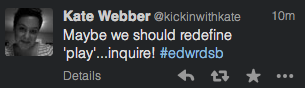
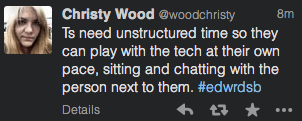
The open sharing and exchange of ideas was AWESOME.  Here are a few comments that resonated with me.

T-A28-1 T-A28-2 T-A28-3 T-A28-4 T-A28-5 T-A28-6 T-A28-7 T-A28-8 T-A28-9 T-A28-10 T-A28-11 T-A28-12 T-A28-13

I am already looking forward to our next Twitter sharing session.

~Mark

Connected Learning with Grade 3s

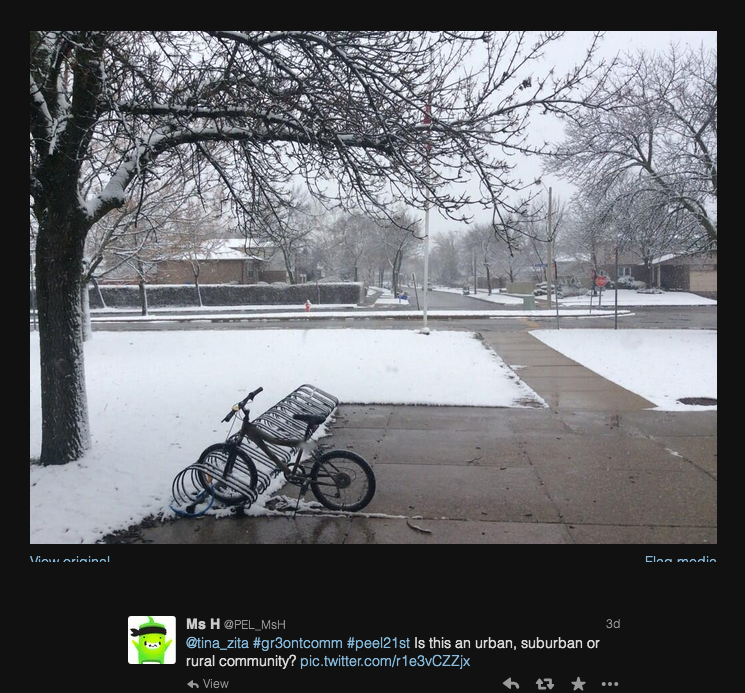
Last week I became aware of an interesting approach to learning about Ontario communities with grade 3 classes.  The  idea is  to involve people from around the province to submit picture clues about the community they live in.  The clues are shared with the students, and student responses are tweeted (posted) back through a class or teacher based Twitter account.

The project takes on another level of connectedness by using a hashtag (Twitter conversation label)  to collect all of the tweets on this topic into a searchable stream which can be viewed [ here].  What a GREAT way to bring a personal and connected context to the classroom.

I enjoyed an afternoon walk this weekend to take a few pictures to participate this week.  I wonder how many clues it might take the students to guess where I live.

Here are some sample tweets from last week.

WhereAmI 1

possible answer

WhereAmI 2

This will be a great week in the connected learning world.

~Mark

How many apps?

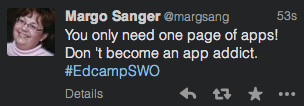
This point from the Twitter stream of  EdCampSWO resonates with me.

NoAppAddict

How thoughtful are you about choosing apps for use with your students?

Do you choose apps that support the “C’s” in a technology enabled learning environment:  Communicate, Collaborate, Create, Citizenship, Critical Questioning/Answering?   Perhaps your app choices facilitate inquiry or project based learning.

Where do you stand on app selection?  How many is too many?  What do you use as app selection criteria? I would be interested to know your ideas on this.  Please comment or get in touch via  @markwcarbone  on Twitter or  +markwcarbone  on  Google +.

~Mark

Shift: hand in or publish

Today’s blog post is a simple question to ponder that came up in an insightful conversation with Ken Whytock.

Rather than ‘handing in’ assignments  today’s students  should:

publish_button

on the web.


Please weigh in.  Share your thoughts by leaving a comment or connect with us via twitter:  @markwcarbone  and  @kenwhytock.

~Mark

Celebrating Excellence

“The Ken Spencer Award for Innovation in Teaching and Learning was established with the generous contribution of Dr. Ken Spencer to recognize and publicize innovative work that is sustainable and has the potential of being taken up by others; to encourage a focus on transformative change in schools; and to provide profile for classroom innovation within school districts, schools, and the media.”

The Waterloo Region District School Board’s Futures Forum Program was recognized for for innovation today at a ceremony hosted at Forest Heights C.I.

Ron Canual, CEO of the Canadian Education Association presenting the aware to Chair Ted Martin.

WRDSB Director John Bryant

Perspective from CEA member  Marty Keast

See the amazing work in these Canadian schools.
The 13-14 Ken Spencer Award finalists

Full press release:   CEA_PR_KSAward_2014

~Mark

London PNC: Digging into change

Last Thursday (April 10, 2014) I had the pleasure of attending the meeting of the London MISA PNC group  to serve on a panel discussion with

L-PNCpanel

Joe Sisco of the WECDSB did a nice job hosting the event and moderating the panel discussion.  My role on the panel was to share some ideas concerning technology planning.

My response:

I enjoyed the variety of  questions the panel addressed.  Two conversations really stood out for me.  First,  some excellent dialog around the notions  of professional sharing:

and secondly, examining comfort with change:

In a rather timely fashion, this tweet from  Donna Fry  was posted just two days later while she was participating as a virtual learner by following the Twitter conversations of  Edcamp SWO  and  Edcamp London  which ran on Saturday April 12th.  I think the tweet captures the essence of the panel discussions in a nice concise way.

LivingInBeta

~Mark

Related Resources: sound clips in a local format

Clip 1:

Clip 2:

Clip 3:


Leveraging the Lull

I had a chance to chat with  Brandon Grasley  at the end of the  OTRK12 conference  following the  OSSEMOOC  “Getting Connected” session.  Somehow we got onto the topic of new social media users adapting to the “fire hose” information flow of services such as Twitter.

You can’t get caught up in reading endless material.  One must become comfortable with jumping in and out as time permits.   Information can be tailored to your interests by using dashboards such as tweetdeck to follow topics of interest.

I decided to put the  “jump in”  theory to test, so one morning this week I looked at my twitter dashboard to see what could be noted in just a couple of minutes.

SUCCESS !!!

… an insightful blog post

JBalen

… a digital citizen/digital literacy tip

LynHilt

… and a PD opportunity

M-EdCamp

Excellent results for just a couple of minutes of reading I would say. Here are a few ways to “jump in” that work for me.

– breakfast & twitter – I enjoy an interesting read to start the day
– tea & twitter?
– a few minutes between meetings
– lunch break
– waiting in the car to pick up your kids
– standing in lineups

Well, you get the picture.  Jump in when you can and leverage on the go connected learning .

~Mark

Igniting the Spark at OTRK12

The  On the Rise K12  conference kicked off with a wonderful keynote by  Stephen Hurley.   Several things Stephen talked about resonated with me from a life perspective.

Your life is a journey,  and it is important to share  YOUR  story.  We all have a story to tell,  and we learn from each other.  Period.   So lets unpack this a bit.

Part of your journey is to discover your passion.  In the end, it is your passions that will drive you forward to learn something new,  ask a new question,  explore a new piece of information,  dialog with a new contact … etc.   Each new ‘node’ on the journey is the impetus for moving to the next.  “Passions NEVER die“. 

I loved hearing Stephen telling his own story about his passion for radio – the discovery, the learnings, the explorations, the successes and how technology was an enabler for him to move forward and pursue his passions further.

I enjoyed Stephen’s exploration and emphasis on the “metaphors we live by”.  Well done.  As educators considering the 3 key engagement elements of social, institutional and intellectual, I encourage you to consider these points:

    • how do we best ignite the curiosity spark to help students find their passion?

SAMSUNG CAMERA PICTURES

    • within our educational context,  what actions do we take to keep student passions alive?

SAMSUNG CAMERA PICTURES

    • how can we be flexible enough to create the path forward for  students to pursue their passion without being in their way?

SAMSUNG CAMERA PICTURES

Many thanks Stephen for prompting more thinking on K12 education. I hope this blog post captures another piece of the educational journey.

Share your comments here, or perhaps in a blog post of your own (include a link please!).

Related Resources
Follow the conference twitter chat:  #OTRK12

~Mark