All posts by markwcarbone

I have 36 years experience in K-12 education. I have been fortunate to work in many different roles including teacher, department head, ICT consultant, IT Manager and CIO. Personal interests include performing in the Venturi Winds woodwind quintet, the Cambridge Symphony and the KW Community Orchestra as well as composing and arranging music. Connect, Learn, Reflect & Share - make a difference today!

Stats: the survey says …

When I got home today the newest publication from the Ontario Teachers College was in the mailbox. I did a quick thumb through and the article that initially caught my eye was the ‘Survey says …’

The article reports on a recent members survey. I noted two points:

1. Usage of social media by teachers is increasing (not really a surprise). Details showed

  • 30.1% connect on Facebook for up to 2 hours per week
  • 32.4 % watch YouTube for a little under an hour/week
  • 50.3% tune into YouTube for as much as 2 hours/week
  • 35.8% use other forms of social media

2. In answer to the question ‘Should the college (OTC) make use of social media tools?’, I found the results very interesting.

  • MySpace 8%
  • LinkedIn 11%
  • Twitter 14%
  • YouTube 20%
  • Facebook 48%

Hmmm. Facebook wins by a landslide. While I am not surprised that members see value in using Facebook as a connecting tool, the margin of choice was surprising to me. I would have also anticipated the Twitter use would have been higher, especially given the extensive education based PLNs members are using effectively.

It is good to see the overall growth in the use of social media tools. Keep those PLN online connections alive. Invite a new person to participate today!

~ Mark
Facebook – new group function in K12

One of my earlier blog posts I made some recommendations for settings for setting up groups for use in the K-12 environment. Since that post, the Facebook group function has changed and I wanted to share what I have learned so far.

The group function is still accessed from the main page in Facebook.

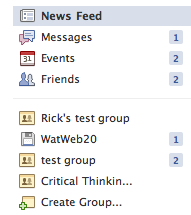
Select the ‘create group’ option.

Next, enter a name for your group, choose an icon from the drop down list and select the type (open, closed or secret). I recommend ‘closed’ for K-12.

Once the group is created, the new ‘header’ is displayed.

Changes include:

  • the ‘post’ area is not visible by default, it must be selected
  • document creation and editing has been added
  • discussion areas within the groups have been removed

Note: groups created prior to this feature change continue to function the way they did.

Group settings are adjusted through the ‘edit’ and ‘settings’ options.

What Else is New?

  • The new group function also provides the option of defining a group mailing list. In my example, I would name the mailing list after the group (watweb20@groups.facebook.com). Messages posted to this addresses are distributed to group members.
  • Only Facebook friends may be added to a group. The email list option to invite group members has been removed.
  • Invited friends are automatically added to the group. The former request/accept process has been removed.
  • Group members can remove themselves from a group, but must request to rejoin as they can not be reinvited
  • The group owner (administrator)  may also remove group members
  • The display of posts has also changed. When a group member posts on a group wall, the post also shows in your personal newsfeed (not wall). Friends in the group will also see the post in their newsfeed. The ability to see posts is also impacted by the ‘top news’ or ‘recent’ setting.

All in all, the new group function will work well for K-12 usage.  I recommend that users set their security and privacy settings appropriate for professional conduct and interaction with students.

Thank you to @rebrouse and @rickbudd for working with me to test and document our learnings.

Happy collaborating in a social networking environment.

~ Mark

Digital Footprint – Reflections

As I reflect about the Digital Footprint concept, I find my thinking about this changing over time. I am gravitating to relating to this notion in two components.

1. The ‘size’ of the digital footprint reflects how much your name is ‘out there’ – fairly easily to search, and shows in a variety of contexts (twitter, blogs, comments etc.) — a frequency factor of sorts.

2. Your digital legacy — the ‘quality’ of the foot print, the lasting impression of who you are, what you stand for and how you contributed to the online environment. What will people think about you based on being ‘googled’ or ‘binged’?

And now a question: What are your thoughts regarding this way of thinking about your digital footprint?

~ Mark

The Training Factor

During the last couple of weeks I have had the opportunity to attend 2 interesting events: our Board’s PLP kickoff session and a K-12 briefing with IBM. In some ways one might think these event would have little in common.  However, in looking at effective teaching and leadership, there was a list of common elements which included: a focus on student needs, learning, collaboration, networking & relationships.

Reflecting upon these events, I found that I was left with one major question.

What would teaching look like today if all faculties of education primarily focused training on

  • building communities, both face to face (i.e. classroom) and online (extension of classroom) and
  • inquiry & research based, collaborative learning and problem solving

as the key strategies to address the various literacies required to today’s student?  Where would we be today?

Just thinking.

~ Mark


Tips and Tricks iPad Resources

Are you looking for some tips and tricks for using your iPad?

Here are a few that I have found in the last month or so that I found to be worthwhile.

1. Free from the iBook store (via the free iBooks app), simply search for iPad

  • iPad User Guide from Apple
  • iPad Starter Guide (Macworld)
  • iPad Publishing Guide (by M. Ashley)

2. Secrets for iPad (app) – free and pay ($0.99) versions

3. iPad for Dummies (by E. Baig & B. LeVitus)

4. iPad Wikis

Enjoy the learning. Make the most of your iPad.

~ Mark

Creating a Facebook group for your K12 class

In my previous blog post, I made reference to a number of strategies to embrace the use of Facebook within the K12 classroom to support learning. One of the most powerful features of Facebook for use in the classroom, is the groups feature.

The process used to setup a Facebook group is straight forward and can be completed in just a minute or two. The steps are:

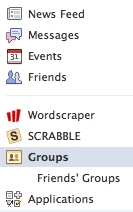
1. Select the Groups link on the left side of your Facebook ‘Home’ page.

2. Click the ‘Create a Group’ button

3. Complete the basic group information.

4. including the category and type information.

5. Click the create groups button to proceed to the group property settings page. I would recommend unchecking the ‘Non-admins can write on the wall’ setting. Unchecking this parameter prevents wall posts leaking out side of the group to Facebook friends of group members.

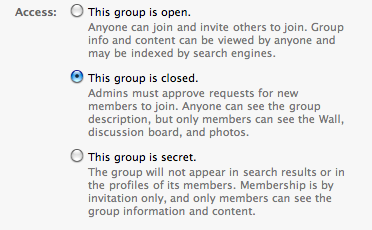
6. The bottom section of the group property settings page governs the visibility and privacy settings for the group.  For K12 purposes, I recommend the closed group setting. This allows the group name to be searched, but keeps the content of the group private to the group membership. With this setup, the group owner can invite members via email addresses and NOT be friends with the members. From the K12 perspective, this allows a teacher to create (own) a group and invite student membership without becoming Facebook friends with the students. In our case, this can be done easily by using our Board generated student email addresses.

Note (20101012): Since researching and experimenting for this blog post, the new groups feature was introduced within the Facebook environment. This feature may impact the functionality described here in terms of the groups members are, or are not, friend relationships. Until this is more clearly understood, I recommend that privacy and security settings are implemented accordingly.

7. Click the ‘Save’ button to activate your settings.

8. Select the ‘invite people to join’ link to send group invites.

Once people accept your group invitation, the collaborating will begin.  Enjoy your Facebook Learning space.

~ Mark

Facebook in the K12 Classroom

Connecting Facebook use to the Classroom

Over the last week, I had a number of opportunities to connect with teachers and have some dialogue about about using Facebook to support learning. Yes, Facebook is a social environment, but it has a huge untapped potential in the areas of engagement, community, sharing, current issues and writing.

I thought I would share this list of activities some of our teachers see as effective uses of Facebook within the learning environment. Many of these are already beginning to happen in our classrooms!

  • conversational writing (French in this case)
  • sharing of poetry writing
  • collaborative math homework support groups – students helping students with teacher support
  • peer review of student created movie trailers
  • short blog style writing posts with opportunity for peer review
  • creating a shared student art gallery
  • discussion of global issues
  • math/science challenge questions
  • use of class groups to provide frequent feedback and positive encouragement (linked to our recent PD session with Dr. D. Reeves)
  • use of teacher fan pages to connect with students re class schedules, homework assignments, test dates etc.
  • school/department pages as another way to connect readers to key events, related news items, promote new library offerings
  • a forum to discuss digital citizenship, online safety and prevention of bullying
  • analyse sample situations in terms of digital citizenship and character development goals

Congratulations to these teachers for their forward thinking about using the power of social media tools in new and powerful ways. I look forward to working with teachers and school Digital Citizenship committee to plan our journey forward.

~ Mark

Adobe Connect – audio update

Further to my earlier blog post regarding my Adobe Connect ‘live teaching’ experience, I wanted to provide an update re my live audio testing sessions. With the help of a test group, we had participants ‘tune in’ from the same building as I was broadcasting, other school sites within our Board network and a couple of off site connections. For all connection types, we were able to improve audio quality.

Before the scheduled session each participant looked after two tasks:

1. check that their flash player was up to date, and complete the update if required and
2. complete this Online Audio Test.

Listeners found the greatest audio clarity when I used the USB Yeti microphone, which I purchased at the Apple store.

We also experimented with web cam settings to determine impact on the audio. With only one camera active, the fast image and slow image settings worked well. The high quality camera setting reduced audio quality (slight choppiness) but not overly disruptive. With multiple cameras active, the slow image setting produced the best overall results.

The test results were validated across the 2 test sessions using different locations and equipment for each session. I feel confident we can proceed with online teaching and our Canada Connections project.

~ Mark

Facebook in K12 – Resources

Links: 2010-09-18  — Facebook in the Classroom


Synthesize the Concepts

Iowa city are now using the social media website inside the classroom

The Science Behind Feeling Good While Social Networking

Ideas for Social Media Guidelines

Social Media Guidelines – More Thoughts

Suggestions: Facebook guidelines for students, parents and schools

ST. CHARLES Community College Facebook Guidelines

Use Facebook to Support School Homework

Note: These resources have also been posted in my ‘Facebook in the Classroom’ user group on Facebook.

~ Mark

Kicking off the 2010-2011 School Year

I enter the 2010-2011 school year with great anticipation and excitement.  Many of the projects that were in major planning stages last year will ‘go live’ this year.

  • Effective today, we have wifi hot spots in each secondary school. These hot spots will allow staff and students to use their own equipment for Internet access.
  • Expanded use of web 2.0 and social media tools to support curriculum delivery. Staff and students now have access to Facebook. Facebook and Twitter, along with other resources will be used to extend school community and support curriculum delivery.
  • By mid month, we will role out email for elementary students. In addition to the secondary role out last April, all students fill have a Board assigned email address to support curriculum and communication needs, and identification in other online environments.  All students will be part of our FirstClass system.
  • Launching our Future Forum project (semester 2), developed as our 2009/2010 PLP project
  • Automated processes now reduce manual work to support account management
  • Redesigned and significantly improved drupal based web sites for our secondary schools
  • Moodle hosted setup to deliver Health and Safety content (launched Sept. 2nd)

Significant projects for this year include:

  • expanded development of our Library Learning Commons (LLC) project
  • a complete rewrite of our Technology Acceptable Use procedure to align with Digital Code of Conduct, Digital Citizenship, and Character Development programs
  • iPads & netbooks in the classroom
  • continued involvement in the PLP program
  • a look at e-book strategies
  • expanding our wireless project
  • building on our Digital Citizenship program

Day one went well. We hit our startup targets and hit the road running. It is going to be a great year!

~ Mark