All posts by markwcarbone

I have 36 years experience in K-12 education. I have been fortunate to work in many different roles including teacher, department head, ICT consultant, IT Manager and CIO. Personal interests include performing in the Venturi Winds woodwind quintet, the Cambridge Symphony and the KW Community Orchestra as well as composing and arranging music. Connect, Learn, Reflect & Share - make a difference today!

Digital Citizenship discussion ‘on air’

Tonight I had the chance to connect with 3 co-workers to try a Google Hangout on Air live session.  Our topic of choice was digital citizenship. Check out our introductory conversation.

While we planned some questions to keep us focused, the discussion was free flow and from the heart.  I hope this is the first of many recorded discussions on this important topic.  Special thanks to Heidi Hobson,  Susan Watt  and  Jeff Brown.

~Mark

Social Media and EQi

This past week I had the privilege of taking an EQi training course with Marcia Hughes  of  Collaborative Growth.   Part way through our first morning of training, we were working our way through a case study when one participant raised an interesting point about whether or not the notion of social media connections played a role in the EQi  coaching process.  A silence fell over the room as people started to ponder.  What a GREAT question.

We really do live in an amazing and unique time.  Never before have we been able to connect with people through so many different communication and collaboration tools, and many of them free! .  Think of the choices:  Skype, Google Hangouts, Facetime, Twitter, Facebook, G+, wikis, Google Docs, MSO365, texting etc. etc.  Social media tools provide people with a means to have an online voice through blogging and other writing tools.  This is a REALLY incredible time.

These tools have ‘reach’ and provide a gateway to connect and collaborate across the globe.  I think it is important to play in this big sandbox to leverage the connections and opportunities – especially for students since this is the world they will work, live and function in.  For those of us who knew the old ‘telephone only’ world and transitioned through email etc. en route to this technology rich world, we may have a better sense of when to connect face to face (F2F) or pick up the phone.  While texting and social media offer so much potential, they may not be the best tools for every situation in our complex world.

I think this speaks directly to the need for digital citizenship and opportunities for students to learn these tools and become skilled them.  In turn,  having opportunities and situations to evaluate and select appropriate tools is an important step in building a confident skill set.  I see all of this connected to building and managing working relationships, so I would cast my vote to YES, social media, online communication and collaboration tools do intersect with relationships and EQi by extension.

What are your thoughts?  How would you vote?  Feel free to add a comment or get in touch via Twitter.

~Mark

CEM13 – Daily Learning List

Check out the GREAT list of online learning opportunities for Connected Educator Month.

CE ToC

(click image to enlarge)

Looking for the toolkits? Look no further, just click here.

~Mark

CE13 – Are you in?

The countdown is on — only 15 days to the official kickoff of Connected Educator Month.  What’s in it for you?  EVERYTHING!  FREE PD!!! Learn more about online connecting tools such as Twitter, starting a blog, collaborating online with wikis and Google Docs and much more. There is an activity per day throughout the month of October. Get a jump start and preview the resources.

Quick Start Info

Visit the  Connected Educator  website.

CE Toolkit

CE district-toolkit

or follow the twitter sharing stream  #CE13

See you online!

~Mark

Fine Tuning the Flip

Do these ideas resonate with you?


CBCquote3

Got your interest?  If you answered yes, yes, yes, then this  CBC podcast  is for you!

~Mark

That! is a blog post

This blog post has been in draft mode since I attended the CASA13 conference in July. Every time I sit down to work on it, I think of another angle, write a bit more,  and things stay in draft mode.  Today, I read  Choose to Write  by  Angela Maiers  via Facebook. I would call that synchronicity given the topic.  So, finally, here we go.

I had the pleasure of seeing presentations at the CASA13 conference by  George Couros  and  Dean Shareski  as well as having personal conversations with them – always interesting and enjoyable.  Dean raised a great point in his  closing keynote. “Is the best PD process as simple as choosing something to learn and blogging about your experience?”  WOW – great question, great insight.

Relating to his Huffington Post article  “Want to create better teachers?” Dean states that ”  The reflective writing has been valuable but definitely the nearly 4,000 comments have been even more of a learning experience. This is the single best professional development experience I’ve had. Dan Meyer, a Mathematics teacher in California writes: … blogging was the cheapest, most risk-free investment I could have made of my personal time into my job.”   I suggest you read the full article here.

Next, I decided that I would gather material related to this topic by watching what my online professional learning network (PLN) was writing about it.  I have selected a variety of blog posts related to the value of online writing that I became aware of over the 2013 summer. Please take a moment to check out the insightful comments they shared about blogging and the learning that resulted from the process.

1.  What’s the big deal about blogs by @ColleenKR.

2.  The Reach of Education Blogging by @SheilaSpeaking

3.  What are you Thinking by @fryed (Donna Miller Fry)

4.  The Benefits of Blogging by @PeterMDeWitt

5.  Challenge: Five things I’ve Learned by @fryed (Donna Miller Fry)

6.  Why My Six Year Olds Blog and Yours Should Too by @KathyCassidy

7.  How Blogging Can Help Reluctant Writers/ by @DRPconsultants (Patricia Fioriello)

Now, coming full circle, the conversations around the value of blogging come to life again with the beginning of another school year.  But, what does it take?  There is a journey for each of us to travel:

  • finding your ‘online voice’
  • being comfortable with who you are online (you must be yourself)
  • settling on your own writing style
  • recognizing that you have experiences and insights to share
  • you never know who you might help

As we settle in for the 13/14 school I challenge you to be observant, look for that opportunity to reflect and share, dig in, find your online voice and BLOG!

Related Resources

Dean Shareski’s blog

George Couros’ blog

Angela Maiers

Letting Go by Stacey Wallwin

and a special thanks to my PLN for their willingness to share through blogging.

~Mark

SAMR: A day with Dr. Puentedura

The last 2 weeks have been filled with amazing opportunities to spend quality time with passionate Ontario educators:  the WRDSB  CATC by the Water annual summer PD session, the  OSAPAC  summer planning session and a full day event focused on the  SAMR  technology integration model — talk about awesome!

The SAMR day was very exciting as the presentation given by Dr. Ruben R. Puentedura, the researcher and author of this model.   The SAMR model defines 4 levels of technology use for learning as described in the diagram below.  The focus of  the day was to look at the SAMR model in the context of many different grade levels and subject disciplines.

SAMRgraphic

Personally, I found the day fascinating.  Dr. Puentedura presented many excellent examples of SAMR within the context of Ontario curriculum.   One example that particularly resonated with me was around the idea of reading.  In terms of the substitute level, one can read on paper or read on a screen, highlight on paper or highlight on the screen etc.  This shift really only serves to set the stage for the A, M and R levels.   The augmentation level might include using an e-reader auto read feature to improve the experience and understanding.  The modification level might include a task redesign such as extracting the highlighted notes and using them in new contexts such as word processing, wikis or in social media contexts such as twitter. The redefinition could include blogging by engaging students in reading circles, providing meaningful comments on other’s work and asking probing questions.  This could be extended for deeper meaning by replacing an essay with a digital video production. Video components would include narrative, images, context etc.  Students could further engage by providing meaningful comments on other videos  and asking probing questions.  Other examples I appreciated centred around social technologies (a range of tools from email to Facebook) and story telling.

The bonus in the day was that Dr. Puentedura  joined our table for lunch – yes!!!  We enjoyed a great free flowing discussion about his research – many contexts, environments and countries.  There is no real way to capture all of the things we talked about in our rich discussion, but here are a few highlights:

  • technology is important in a participatory culture of learning (power to connect and collaborate)
  • 1 : 1 – not absolutely essential but it does make a huge difference, so desirable
  • laptops vs tablets … drum roll … tablets

The day was truly amazing, and I couldn’t help but leave feeling energized and wondering about a practical way to put this into action.

Suggestion for Ontario elementary teachers:   Check out the new  social studies  curriculum document (or choose a curriculum relevant to you) with an eye to technology integration and the SAMR model.  I personally see many possibilities with the included citizenship framework of active participation, identity, structures and attributes.  Some of the possibilities I see are  inquiry based research, writing/blogging, collaboration tools, wikis, digital maps, digital timelines, presenting (posters, videos etc.) and age appropriate social media tools.  Wonder, and ponder.  What possibilities do you see?  Share your great idea(s) by leaving a comment to this blog post.

Related Resources

A  (YouTube)  video introduction  to SAMR by Dr. Ruben R. Puentedura
SAMR  event tweet stream
SAMR resources on  scoop it!
SAMR  presenter notes

Happy learning and integrating.

~Mark

Note: Cross posted to VoicED.ca

Manifesto for 21C Learning

The OASBO ICT  group (K12 IT Managers)  has prepared a document to capture network infrastructure needs to support 21C learning.  Read their thoughts on capacity, scalability and sustainability in a  Manifesto for 21st Century Learning.

~Mark

CASA13: An important remix

As June came to a close, I eagerly anticipated my attendance at the CASA conference as a good learning opportunity and to present with Ed Doadt on the use of social media in the classroom and school community.   With a conference title of Pedagogy to Technology &  Hardware to Headware  I certainly felt some great learning and networking opportunities would unfold.

I must admit that I was taken aback by the approach taken in the keynote address.  The intent may very well have been to cause people to stop, reflect, and engage in meaningful dialogue about the use of technology to support student learning, but the rather hard nosed approach taken seemed to disengage the audience. Although several key points were made, including:

  • innovation has a high failure rate
  • technology is an expensive and ongoing investment
  • the “light house” approach typically ends up as a moth balled project that went nowhere
  • improvement strategies in education must be based on the best instructional and assessment practices

the message seemed to be stay out of this arena and focus on aspects of education that are already proven by research.  Two important questions emerged from this framework: a) why would we (educators) get into the innovation game in K-12 education where funds are limited?, and b) where is the research that demonstrates technology makes a difference?

The audience reaction was rather subdued and there was a smattering of polite applause.  While a few people offered up examples where technology was making an observable difference in student learning, the comments were essentially shot down based on statements of “lack of research”.  There was a real sense of disconnect in the room. The view presented was polarized relative to current directions and thinking in this area by many.  Audience member and conference presenter  George Couros ended the session with a very important point: learning with technology is significantly different than learning about technology.

I have been reflecting on this scenario since attending the conference trying to sort through the various perspectives that come into play.  First off, I don’t think anyone would debate the 4 bulleted points outlined above. These are known facts that are well researched and documented.  Teaching and learning with technology must be done well, and in the framework of best instructional and assessment practices.  Learning WITH technology IS different:  it is about NEW possibilities. The SAMR model, as described in the diagram below, offers a great way to define stages of development in terms of how well technology may be used to support learning.

SAMRgraphic

Yet, there is this nagging question: why do educators want to move in this direction if it does not make any difference?  So many people I talked to indicate that technology DOES make a difference in how students learn.  Many shared reports that perceptual, observation based, focus group data etc. indeed show differences in this area.

After chatting with several people after the presentation and some personal reflection time, I think there is an important perspective missing:  the timing of the research (assuming that this should be researched at all).

REMIX:  In reality, we are still in the infancy in this area of teaching and learning with technology.  We need to apply the right lens and connect the dots differently. Why? Learning how to use technology effectively in education is NOT wild reckless expensive innovation in my opinion.  It is about doing things differently and exploring new possibilities.  We are not at a point in time where enough teachers use technology effectively in their practice. To me, it would make sense that if one researches and measures the effectiveness of technology  now, the results may indeed be somewhat marginal. Then again, if any educational tool/resource is used ineffectively, research will show that the impact of that tool/resource is marginal.

So Now What?  We need to consider the way in which the term innovate is used in the context of education.  Like it or not, technology is here to stay.  Learning to use it effectively is not reckless innovation or transformation.  We need to learn how to leverage it in the most effective ways possible. This means trying things, and sharing the learnings — blogging about is would be great!  I believe we need to invest in teacher training, close the gap, and raise the bar in the area of technology use. Continuing to gather data and formalizing research is a ‘must do’.  Every educator needs to commit to sharing their learnings and best practices (add another plug for blogging).

Finally, in the keynote, technology was portrayed as the big bad beast:  you were IN or OUT. I strongly believe that we  can not look at this sandbox stage as some definitive point of decision.  We do need to continue leveraging learning WITH technology, exploring new possibilities and sharing.

Perhaps it is time to throw a technology challenge on the table:  eliminate technology from your line of work and personal use for a month  — no corresponding, collaborating, note taking, internet enabled research/fact finding, analysing, exploring, reading, social media, email … well you get the picture.  At the end of the month, reflect on whether or not technology makes a difference to how you work, then share your learnings by commenting on this blog post.

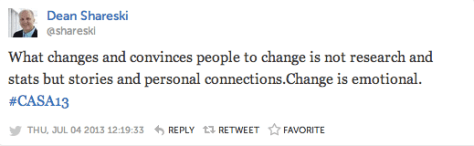
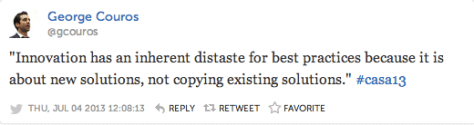
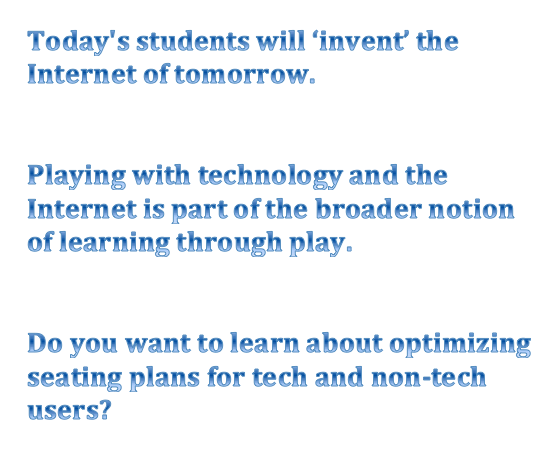
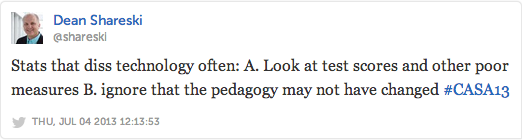
I also wanted to share a few notable quotes from the #CASA13 Twitter stream from this session.

<insert screen caps from storify> 

CASA13-1

CASA13-2

CASA13-3

CASA13-4

CASA13-5

CASA13-6

CASA13-7

Other Resources

SAMR model resources from Scoop.it

Happy reading and reflecting

~Mark

Branding Lesson

In today’s digital world, personal branding is just as important as company and product branding. One needs to consider usernames, public names, pictures and profile management as part of the thinking. I am sure that like many other users, I did not think about this very much when I started my online work years ago. Over time I have recognized the importance of branding and worked to achieve high consistency in this area. I have settled an internet identity, and fortunately, I have managed to obtain my desired user ID on the wide variety of services I use with just a couple of exceptions.

One of the exceptions was on Skype. Once I realized what I wanted to do with branding, I registered a second skype account with my desired username, which was available. This at least held the account until I decided when and how I would either use two accounts, perhaps for different purposes, or migrate to the new account.

… many months go by …

I have been working through an interesting scenario. I registered my new account with a (then) relatively new but rarely used email address. After leaving the skype account dormant, I could not remember the email address used for registration. Skype searching did not yield any clues, and although I could see my registered account I could not change the password without the email address, and in turn I could not ask the folks at Skype to give me access without that email account.

I decided to take a long shot and put in a helpdesk ticket at Skype. As it turned out, the email address I had used was phased out by the host vendor. Even though I did not have the ‘key email address’ Skype staff provided me a series of detailed questions about the account which I was able to answer to verify my identity. Well, today was success day as I finally gained access to the account and now I can move forward with my plans.

Lessons Learned:

1. Use mainstream email addresses when registering for user accounts.
2. Use a ‘keep’ folder for important things like this.

I am writing this blog post as a shout out and thank you to the staff at Skype who were able to help me resolve this scenario. Thank you for having a good identity management process in place.

~Mark