Category Archives: Digital Citizenship

Digital Learning Carousel Reflections

I had the pleasure of attending the  WRDSB  Digital Learning Carousel event today along with 400 educators and students from our Board. The event provided opportunity to share our collective insights around digital learning,  changing practice and planning next steps forward for our organization.  The carousel sessions I attended included online novel studies, innovative practices with math, inquiry approaches and the Futures Forum program.

Three aspects of the day really struck me.  The positive feedback on the interest in using Google Apps for Educators (GAFE) and the high rate of adoption on our roll out was awesome.  Secondly, I was intrigued to hear some of the educators sharing the benefits of enough technology to support small group instruction over a 1:1 approach. The ‘just enough’ model allows technology to be used as a learning support as needed while fostering opportunities for interaction, conversation and sharing.   A 1:1 approach can result in students being self focused or isolated. This feedback validates our decision to roll out our iPad program in a way that avoided convenient the “portable lab pack” allocation. Finally, so many discussions touched on the idea of the right mobile tool for the learning, teaching or assessment task at hand. I felt proud that our  IT department is deploying and supporting iPads,  Chromebooks and Windows mobile devices to support learning at WRDSB.

carousel

My Session Highlights

The online novel study group talked extensively about taking a proactive approach to digital citizenship before moving into online activities. Their approach included googling yourself to find out what is actually online, reputation management, managing your digital presence and building relationships. Tools used in this program included Google Apps for Educators, Today’s meet, blogging, skype and collaborative web page designs.  An impressive approach indeed!

In the math innovative practices session, I noted that educators were really digging into teaching collaboration skills. What does collaboration look like, sound like, feel like? “Look fors” would include accountable talk, building on the ideas of others to highlight two attributes. Digital tools used in this program included Explain Everything, GAFE, GeoBoard, Notability and iMotion.

The inquiry stream focused on the relationship of two key elements:

1.  What do students need to learn and what do I need to learn as a teacher?
2.  If I do this as a teacher, then students …

The final session featured the Futures Forum program, which I am very familiar with due to my involvement with the program. Presenters emphasized the importance of a growth mindset for both staff and students. The approach used this year involving SparKW really engaged the students in a meaningful way.

Clearly,  all of the presenters I saw today demonstrated a high level of professionalism and a growth mind set. Thank you for sharing your learnings!

~Mark

We Need Your Voice

Have your say!!!  

Tonight,  Monday May 26th (8:00 – 9:00 p.m. EDT),   you will have an opportunity to learn more about the  OSAPAC  project on  digital citizenship resources  and provide feedback to the project team.

The  online meeting room  will be open at 7:30 p.m. EDT.  If you are joining us for the first time,   please allow a few extra minutes to allow for the necessary downloads (plugins).

We look forward to connecting with you.  Please pass this invite along.  

~Mark


On or Off Line: a Perspective

I happened to come across  Aviva’s  post yesterday, titled
online-offline-where-to-draw-the-line.  Aviva makes that point that “students need a safe place to make mistakes, and I don’t know that social media provides this safe place.”  Check out  the comments from some of the readers  [here].

We do live in interesting times for sure.  Perhaps this is all a lesson in media literacy (& life).   From my perspective,  there are a few important points in the mix.

In my view blogs are indeed a social media tool.  In today’s world, you DO have a voice through a variety of social media tools.  One’s actions in a social media environment have reach and impact.  This begs responsible and ethical use: do good, ask good questions, ‘poke’ at things in a respectful manner.   It is likely safe to say that not all real life experiences  will have these characteristics, and from this perspective,  Aviva’s blog post raises a great point when considering the learning environment.

blog

In response to Aviva’s post,  Doug Peterson wrote a great blog post this morning  called  Learning about Social Media  in which he  makes a strong case for using blogs as an excellent entry point into this world.  I certainly support Doug’s view that blogs are indeed an excellent starting point.  I also think that  the K12 educational experience needs to move beyond this.  Our  students live in a world where new online tools and platforms are ‘born’ all the time and having some appropriate experiences  in new arenas is also important.  I like the idea of gradual release of responsibility (age appropriate), and I am excited about the positive experiences I am seeing WRDSB students having within programs such as the Futures Forum Project (FFP).

I don’t think one can underestimate the power of positive role modelling.  Do you see this as an opportunity for educators? or perhaps a responsibility?  Either way, social media is here to stay.  Reach, impact, connections, relationship building and establishing trust are all important aspects of this digital world in which we live, and important areas to develop in young people.

Great topic.  Please weigh in.  I welcome your thoughts on this discussion.  Leave a comment or connect in some other way.

~Mark

Digital Citizenship Remix

Over the last few months, I have had the chance to participate in, listen to, and record a variety of discussions on digital citizenship.  In each case, the discussion was rich and though provoking.

On Monday March 3rd,  I am pulling 3 of these discussions together into a ‘remix’ for an internet radio broadcast  6:30 to 8:00  p.m.  EST.

Why not sit down after dinner with a warm cup of coffee or tea, relax and listen to the conversation.

Join the radio broadcast  [here] .

~Mark

QueST Radio 1-24C

CEA Presentation Resources

CEA1to1-2

Social Media in the Classroom and School Community

CEA International 1:1 Computing Conference

Slide Deck

Contact info
Ed Doadt
Mark W. Carbone

Videos

Corbett Ball:  Change Perspective

Joe Cvetish on  Blogging

Jane Mitchinson-Schwartz on  Google Docs

Aaron: student voice

Andrew: student voice

Teacher  Andrew Bieronski

Teacher  Gavin Albrecht

Additional Resources:

Waterloo Region District School Board  Responsible Use Procedure

 WRDSB  Digital Literacies Pathway

Q & A from the  Today’s Meet back channel:

Facebook training around privacy, security and appropriate use of groups and teacher fan pages was provided through after school workshops, online workshops via Adobe Connect at a variety of times after school and evening, as well as site based workshops arranged through our instructional technology consultants.

Edmodo  is also used by many teachers.

Internet radio re-broadcasts of the session, advertised on Twitter and G+, will be available via QueST Radio 1-24 .

~Mark & Ed

Banding Together for THINK

Congratulations to the Waterloo Region Crime Prevention Council for their efforts in partnering with a variety of community partners, including the Waterloo Region District School Board and the Waterloo Catholic District School Board to produce the  T.H.I.N.K.  campaign to promote positive uses of social media within our community for Bullying and Prevention Week (Nov. 18-22, 2013)

THINKgraphic

Related Resources

CTV KW News video clip

Blog post and resource links by WRDSB Technology Support Teacher  Susan Watt:  Think before you …

Follow along on Twitter:   #THINK  and  #bandtogether

~Mark

21C Round Table Panel 20131029

21Cpanel

I had the privilege of participating on the Ministry of Education 21C Round Table Discussion panel this week along with Dany Dias,  Grade 7 and 8 teacher at Le Sommet High School in Hawkesbury;  Mark Melnyk,  Head of History at Markville Secondary School in Markham, Ontario;  Catherine Montreuil,  Director of Education, Bruce-Grey Catholic District School Board and Sharon Moss, Principal of Leadership Development, YRDSB.

Each panel member was provided a question focusing on a particular aspect of 21C learning to respond to.  I wanted to extend a thank you to the other panel members as I appreciated hearing their perspectives and learning from them.  I have included a copy of my question and resopnse for the session.

My Panel Question

“Our external research team reports on findings such as technology’s role in providing opportunities for cross-curricular learning in manageable and efficient ways, together with a move toward systems thinking by school districts. Curriculum Services Canada (CSC) notes that a number of school boards reported that changing the operational structure in some areas was valuable, such as establishing working relations between IT and curriculum. Please tell us about how the Waterloo Region District School Board has approached the alignment of resources and departmental coordination in order to create the supporting conditions for an innovation such as Futures Forum to become embedded system-wide. What are the benefits for students that inform and motivate such changes?”   We would also be interested in insights connecting  with ‘digital citizenship and literacies,’ and/or ‘learning culture shifts,’ 

My Response

We are fortunate to live at such an exciting time.  The rate of change is rapid, opportunities are abundant and the possibilities for education exciting. Technology is a powerful element and enabler for learning when skillfully and effectively used with best instructional and assessment practices. Technology breaks down time & space challenges and really lets you dig into the notion of “the anys” – anytime, anywhere, anyone, anything access and engagement.  When I reflect on my various experiences, technology has the greatest impact when focused on the C’s or hooks as I sometimes refer to them:  communicate, collaborate, create, critical questions & thinking and (digital) citizenship/character development.  From a technology point of view, the reality is that the actual devices used, are only the devices of the time, and will continue to change and evolve at an amazing rate, so keeping the focus on learning, assessment and best practice is very important.

I believe a second area of importance is fostering a culture of risk taking and providing entry points for staff to shift their practice and “jump in” is critical to scaling across systems. At any moment in time, we all have access to using the same technology tools. It doesn’t matter whether you are 3 or 60, we can all use the tools available. In today’s terms, that includes a variety of web 2.0 and social media tools.

I have also found that studying change models such as SAMR which defines levels of technology use as substitution, augmentation, modification and redefinition.  At the redefinition level, technology is used to enable learning that was not possible before.

SAMRgraphic

The TPack model is also helpful as we continue to learn and consider change processes.

TPack

With specific reference to the Waterloo Region District School Board, I want to begin by acknowledging my colleagues here today:  Mark Harper and Kim Keena.  The work we have been doing on an ongoing basis is a team approach.  It is important that we vision, implement, problem solve and celebrate together.  We have created a number of forums for us to work together.  I attend the Learning Services Leaders chaired by Mark Harper.  I am responsible for our Technology Steering Committee. Mark, Kim (along with others) participate this this forum.   Mark also leads a Digital Learning Steering Committee which brings together key staff representing a variety of stakeholders within our organization. These forums provide an ongoing avenue to share thinking, ask questions, consider resources and supports, gather feedback and  address issues.

The roots of our Futures Forum Project (FFP) go back 6 or 7 years, to a time when we were outwardly exploring the notion of 21C learning and what the classroom of the future looked like with staff, students and community partners such as Communitech.  We also enrolled in a year long program at  Powerful Learning Practice  (PLP) in order to immerse ourselves in a year long job embedded PD experience to put ourselves squarely in the role of the learner as part of our professional learning.  What we now have as the Futures Forum Project  is the implementation of our action research project from the PLP experience.  Centrally, we were able to stand united to visibly support the idea of taking risks, breaking traditional moulds of delivering instruction and exploring different avenues (timetabling, staffing, technology use).

Core elements of the Futures Forum Project include:  a cross curricular approach with grade 10 English, Careers and Civics taught by one teacher across a 2 period block of time. Classes at each site are timetabled in a common manner (all mornings or all afternoons) to facilitate collaboration between staff and students.  Specific strategies used to deliver this program include:

– blogging for writing, journaling, creating, commenting, peer review

– cross school novel studies where students choose a novel to study with one of the FFP teachers. Interactions occur through a variety of collaboration tools such as Adobe Connect licensed through  OSAPAC.

– collaborative research and content creation to produce online web publications

– Ted Talk Fridays – teachers select a common Ted Talk to watch, students then share learnings, questions and comments through a cross school twitter chat

This approach to teaching and learning provides  ongoing opportunity to engage in digital literacies and digital citizenship. In a situation such as this, digital citizenship is something front and centre as you live it & role model it on an ongoing basis each day. To me, this is how we need to live our lives, making good digital choices on a continuous basis.  As we become more “Googleable” we should be aware of, and manage our digital legacy.

The FFP has been scaled at a manageable  rate over the last 4 years, with careful consideration being given to sustaining and scaling the various supports  required.  The project started with approximately 1 teacher in approximately half of our  secondary sites, then expended to most sites, then to multiple sections and now we are seeing spinoff impact within each site.  This strategy has given the new approach visibility at each site which is proving beneficial.

It is important to continue gathering information and data to inform the process.  We have completed student, teacher, administrator and parent surveys, conducted hundreds of individual and focus group interviews through an independent critical friend partner.  Results have shown that this approach does make a difference and a statistically significant difference in many cases.  Additionally, teachers continue to meet regularly to share and reflect on best practices and needs.

Going forward, we continue to talk about  scaling the system from a strategic point of view considering our current state, defining our desired future state and determining the best path forward while factoring in areas of emphasis & focus, sustainability, supports and professional learning needs.

Related Resources

WRDSB Futures Forum Project
WRDSB Futures Forum Program wins award
The SAMR Model
ON21cLearn Twitter Stream via Storify
TED: Ideas Worth Spreading

~Mark

Digital Citizenship: A Parent Perspective

Within the context of  Connected Educator’s  month, October 21-25 is digital citizenship week. After recording an earlier Google Hangout session on the topic of  Digital Citizenship  with staff, I thought it would be interesting to record a second hangout to gain a parent perspective on this topic.

Earlier today, I was joined by  Susan Parr, a parent from our school board community and  Chris Vollum, a social media consultant and parent to share some conversation on this topic.  If the notions of  online safety, openness, academic honesty, integrity and social success capture your interest, then this conversation is for you.

Many thanks to Susan and Chris for sharing their time and interest in supporting this important topic.  Until next time …

~Mark

Connecting Students with Google Hangouts

After 2 days of being immersed in conversation about technology enabled learning, focusing on using technology to get to deeper learning, and engage the relationship aspect of the possibilities with George Couros, I was thrilled to hear how WRDSB  teacher Ryan Wettlaufer is using Google Hangouts with his students.

To me, this is a perfect example of the SAMR model.  Ryan has thoughtfully and skillfully created real life opportunities for his students by leveraging his personal learning network (PLN) giving his French language program a whole new meaning.  I was able to connect with Ryan for an interview via Google Hangouts.  Learn about Ryan’s insights in our interview.

Thank you Ryan for taking time to share your leadership and best practices, and a perfect topic for Connected Educators month.

~Mark

Digital Citizenship “Pathway”

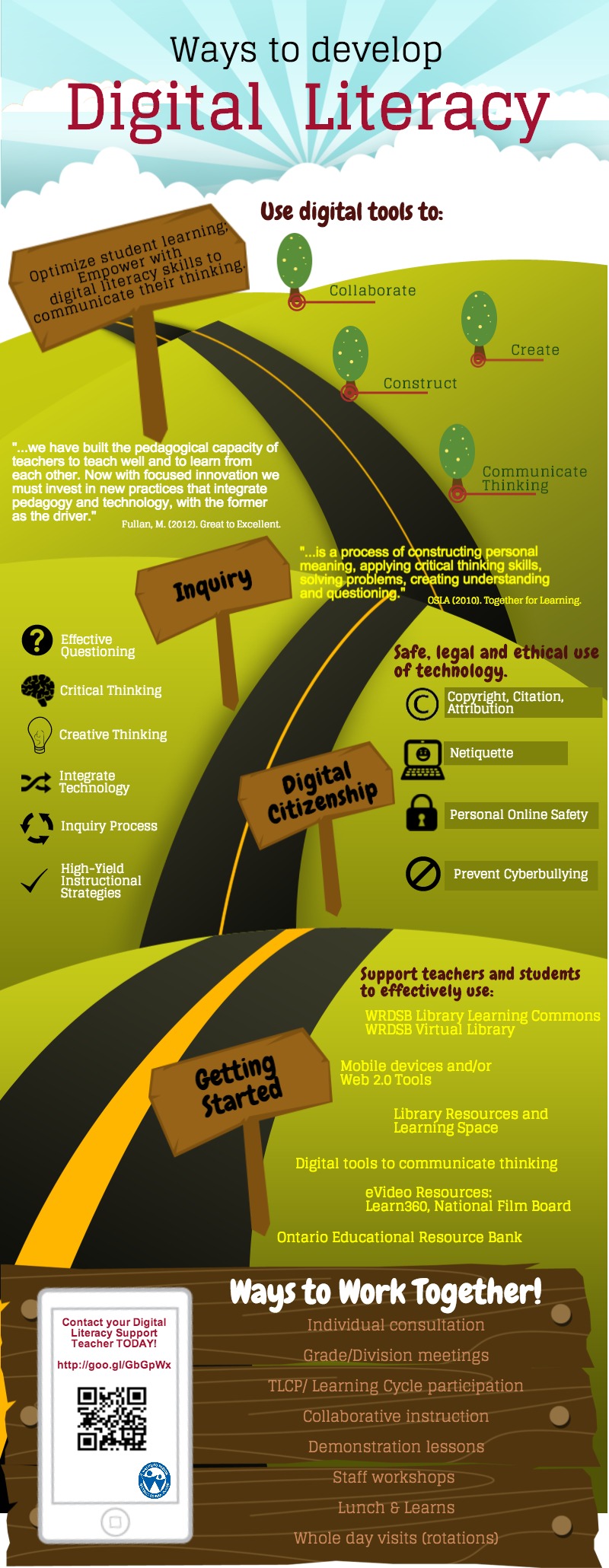
Today I am sharing a framework from WRDSB to consider digital citizenship and literacies in the K12 environment.

DigLit_Oct08

~Mark