Today I am sharing a framework from WRDSB to consider digital citizenship and literacies in the K12 environment.
~Mark
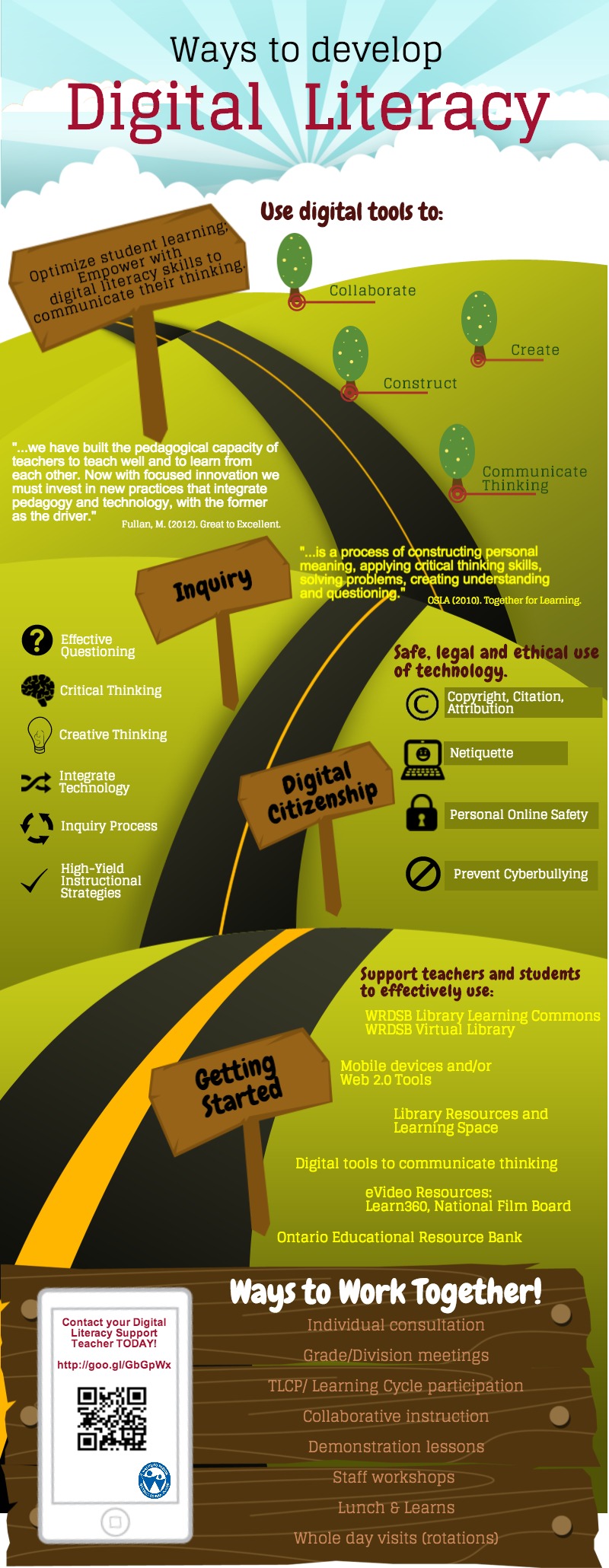
Today I am sharing a framework from WRDSB to consider digital citizenship and literacies in the K12 environment.
~Mark
Yesterday, my morning started with my with my usual routine – a check on the ‘Twitterverse’. There is always something interesting going on there, and this day was no different. I took note of a tweet from Donna Fry announcing her new blog post Changing the Trajectory. I always enjoy reading Donna’s blog as I find her writing thought provoking and insightful.
This article inspired as anticipated, digging into critical aspects of student learning – learning is for ALL, learning is messy and sometimes very messy. Then there were “those words” that REALLY caught my attention: building capacity, personalized learning and towards the end of her article a strong statement of importance of Assessment data + Thinking, collaborating teacher + Technology.
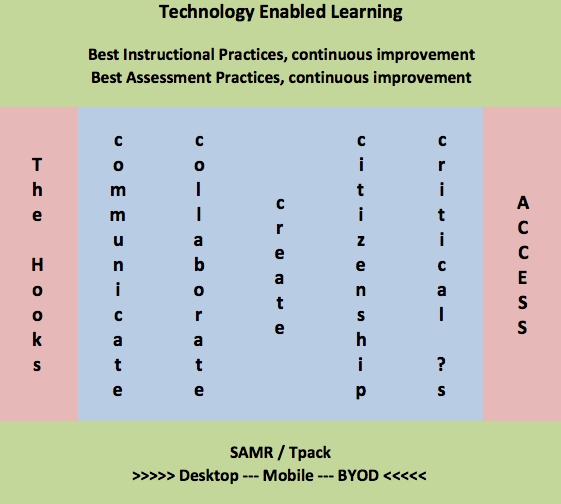
This last statement fit nicely with a diagram I had sketched various of versions of on my office whiteboard. These words capture the essence of what I think of as Technology Enabled Learning (TEL). The journey is all about student learning. The use of technology should not interfere with best instructional and assessment practices. We should not use technology because it is there or perhaps new, but use it in ways that make a difference in the learning.
I am a believer in a thoughtful approach to the use of technology in the learning process and encourage educators to familiarize themselves with both the TPACK model as well as the SAMR model. The C’s, as often described in 21C learning references, provide what I think of as key “hooks” for leveraging the potential of technology for learning. All to often, I think we get caught up in thinking about the hardware …. desktops, operating systems, mobile – laptops, netbooks and tablets. Ah yes, and don’t forget about the bring your own option.
In the end, these devices are well, simply devices. Today, the rate of change in technology is staggering. Devices will come and go, improve, get faster, and have more capabilities. If we are lucky, the price of a device suitable for student learning will continue to drop in price over time. In the spin of the “device of the day”, we do have to learn them and design support models. BUT, we need to be prepared for change as the churn of hardware development and operating system advances will never stand still.
The focus must remain on best instructional and assessment practices and how we use technology to support and enable learning, and not what the technology of the day is. I have attempted to capture a way of connecting these ideas in the diagram below.
I appreciate the timing of Donna’s publication, that she wrote such an insightful article and created an opportunity for me to share how some of my thinking and learning as it links to her learning.
~Mark
Tonight I had the chance to connect with 3 co-workers to try a Google Hangout on Air live session. Our topic of choice was digital citizenship. Check out our introductory conversation.
While we planned some questions to keep us focused, the discussion was free flow and from the heart. I hope this is the first of many recorded discussions on this important topic. Special thanks to Heidi Hobson, Susan Watt and Jeff Brown.
~Mark
This past week I had the privilege of taking an EQi training course with Marcia Hughes of Collaborative Growth. Part way through our first morning of training, we were working our way through a case study when one participant raised an interesting point about whether or not the notion of social media connections played a role in the EQi coaching process. A silence fell over the room as people started to ponder. What a GREAT question.
We really do live in an amazing and unique time. Never before have we been able to connect with people through so many different communication and collaboration tools, and many of them free! . Think of the choices: Skype, Google Hangouts, Facetime, Twitter, Facebook, G+, wikis, Google Docs, MSO365, texting etc. etc. Social media tools provide people with a means to have an online voice through blogging and other writing tools. This is a REALLY incredible time.
These tools have ‘reach’ and provide a gateway to connect and collaborate across the globe. I think it is important to play in this big sandbox to leverage the connections and opportunities – especially for students since this is the world they will work, live and function in. For those of us who knew the old ‘telephone only’ world and transitioned through email etc. en route to this technology rich world, we may have a better sense of when to connect face to face (F2F) or pick up the phone. While texting and social media offer so much potential, they may not be the best tools for every situation in our complex world.
I think this speaks directly to the need for digital citizenship and opportunities for students to learn these tools and become skilled them. In turn, having opportunities and situations to evaluate and select appropriate tools is an important step in building a confident skill set. I see all of this connected to building and managing working relationships, so I would cast my vote to YES, social media, online communication and collaboration tools do intersect with relationships and EQi by extension.
What are your thoughts? How would you vote? Feel free to add a comment or get in touch via Twitter.
~Mark

The countdown is on — only 15 days to the official kickoff of Connected Educator Month. What’s in it for you? EVERYTHING! FREE PD!!! Learn more about online connecting tools such as Twitter, starting a blog, collaborating online with wikis and Google Docs and much more. There is an activity per day throughout the month of October. Get a jump start and preview the resources.
Visit the Connected Educator website.


or follow the twitter sharing stream #CE13
~Mark
This blog post has been in draft mode since I attended the CASA13 conference in July. Every time I sit down to work on it, I think of another angle, write a bit more, and things stay in draft mode. Today, I read Choose to Write by Angela Maiers via Facebook. I would call that synchronicity given the topic. So, finally, here we go.
I had the pleasure of seeing presentations at the CASA13 conference by George Couros and Dean Shareski as well as having personal conversations with them – always interesting and enjoyable. Dean raised a great point in his closing keynote. “Is the best PD process as simple as choosing something to learn and blogging about your experience?” WOW – great question, great insight.
Relating to his Huffington Post article “Want to create better teachers?” Dean states that ” The reflective writing has been valuable but definitely the nearly 4,000 comments have been even more of a learning experience. This is the single best professional development experience I’ve had. Dan Meyer, a Mathematics teacher in California writes: … blogging was the cheapest, most risk-free investment I could have made of my personal time into my job.” I suggest you read the full article here.
Next, I decided that I would gather material related to this topic by watching what my online professional learning network (PLN) was writing about it. I have selected a variety of blog posts related to the value of online writing that I became aware of over the 2013 summer. Please take a moment to check out the insightful comments they shared about blogging and the learning that resulted from the process.
1. What’s the big deal about blogs by @ColleenKR.
2. The Reach of Education Blogging by @SheilaSpeaking
3. What are you Thinking by @fryed (Donna Miller Fry)
4. The Benefits of Blogging by @PeterMDeWitt
5. Challenge: Five things I’ve Learned by @fryed (Donna Miller Fry)
6. Why My Six Year Olds Blog and Yours Should Too by @KathyCassidy
7. How Blogging Can Help Reluctant Writers/ by @DRPconsultants (Patricia Fioriello)
Now, coming full circle, the conversations around the value of blogging come to life again with the beginning of another school year. But, what does it take? There is a journey for each of us to travel:
As we settle in for the 13/14 school I challenge you to be observant, look for that opportunity to reflect and share, dig in, find your online voice and BLOG!
and a special thanks to my PLN for their willingness to share through blogging.
~Mark
The last 2 weeks have been filled with amazing opportunities to spend quality time with passionate Ontario educators: the WRDSB CATC by the Water annual summer PD session, the OSAPAC summer planning session and a full day event focused on the SAMR technology integration model — talk about awesome!
The SAMR day was very exciting as the presentation given by Dr. Ruben R. Puentedura, the researcher and author of this model. The SAMR model defines 4 levels of technology use for learning as described in the diagram below. The focus of the day was to look at the SAMR model in the context of many different grade levels and subject disciplines.

Personally, I found the day fascinating. Dr. Puentedura presented many excellent examples of SAMR within the context of Ontario curriculum. One example that particularly resonated with me was around the idea of reading. In terms of the substitute level, one can read on paper or read on a screen, highlight on paper or highlight on the screen etc. This shift really only serves to set the stage for the A, M and R levels. The augmentation level might include using an e-reader auto read feature to improve the experience and understanding. The modification level might include a task redesign such as extracting the highlighted notes and using them in new contexts such as word processing, wikis or in social media contexts such as twitter. The redefinition could include blogging by engaging students in reading circles, providing meaningful comments on other’s work and asking probing questions. This could be extended for deeper meaning by replacing an essay with a digital video production. Video components would include narrative, images, context etc. Students could further engage by providing meaningful comments on other videos and asking probing questions. Other examples I appreciated centred around social technologies (a range of tools from email to Facebook) and story telling.
The bonus in the day was that Dr. Puentedura joined our table for lunch – yes!!! We enjoyed a great free flowing discussion about his research – many contexts, environments and countries. There is no real way to capture all of the things we talked about in our rich discussion, but here are a few highlights:
The day was truly amazing, and I couldn’t help but leave feeling energized and wondering about a practical way to put this into action.
Suggestion for Ontario elementary teachers: Check out the new social studies curriculum document (or choose a curriculum relevant to you) with an eye to technology integration and the SAMR model. I personally see many possibilities with the included citizenship framework of active participation, identity, structures and attributes. Some of the possibilities I see are inquiry based research, writing/blogging, collaboration tools, wikis, digital maps, digital timelines, presenting (posters, videos etc.) and age appropriate social media tools. Wonder, and ponder. What possibilities do you see? Share your great idea(s) by leaving a comment to this blog post.
A (YouTube) video introduction to SAMR by Dr. Ruben R. Puentedura
SAMR event tweet stream
SAMR resources on scoop it!
SAMR presenter notes
Happy learning and integrating.
~Mark
Note: Cross posted to VoicED.ca
The OASBO ICT group (K12 IT Managers) has prepared a document to capture network infrastructure needs to support 21C learning. Read their thoughts on capacity, scalability and sustainability in a Manifesto for 21st Century Learning.
~Mark
 ~ Mark's Musings ~ blog.markwcarbone.ca