All posts by markwcarbone

I have 36 years experience in K-12 education. I have been fortunate to work in many different roles including teacher, department head, ICT consultant, IT Manager and CIO. Personal interests include performing in the Venturi Winds woodwind quintet, the Cambridge Symphony and the KW Community Orchestra as well as composing and arranging music. Connect, Learn, Reflect & Share - make a difference today!

Adobe Connect Pro Mobile – first impressions

This week I had an opportunity to ‘kick the tires’ on the Adobe Connect Pro Mobile client. I downloaded the free client to my iPod Touch and iPhone.

Session 1

I started a host session on our Board’s server via my laptop. Next, I logged into the session with my iPhone over the 3G network and via wifi with my iPod Touch. Both mobile devices responded well. Audio transmission from the host session was clear, and the available modes of video, chat and screen share all functioned well. In video mode, you see the image transmitted by the host web cam. Chat mode allows you to read and enter text chat information, the same as you would sitting at a computer. Screen mode displays the image being presented via a screen share at the host end.

Session 2

Later in day, I had a chance to try a more involved session with @dougpete. For this session, Doug hosted a session where we connected 5 users – Doug’s iPhone and iPod Touch, my laptop, iPod Touch and iPhone. Again, performance over both the 3G network and wifi worked well. Doug experimented by showing a powerpoint slide show as well as a graphic calculator. Chat and video modes worked well also.

The 1.0 version of the client is quite functional. Audio level settings needed some adjustment to optimize the session communication clarity. We found using the standard earbud style headphones worked better than the speaker audio.

The only issue we found was there was no voice input on the mobile devices. Documentation referred to toggling mute on/mute off to control the mobile voice access. However, we found the icon (see graphic below – 3rd icon from the right in the top row) to allow access to the controls was not actually visible to use. I am sure this will be corrected in a later version.

Overall, very impressive for a 1.0 version free client. I think this opens up a lot of possibilities for mobile learning.

Related Links

~ Mark

Traveling with your iPod Touch

My daughter will be spending her March Break traveling with a group from her school. We agreed that this makes an ideal time to try some communications and trip updates via her iPod Touch in wifi mode. I am sure she will post on Facebook via the Facebook mobile app and send emails from her MSN or Hotmail accounts. We also wanted to try extending our communications with 2 additional applications.

Earlier this year, I had tried Ping! with @dougpete and @rebrouse. I bought the ‘pro’ version for 99 cents. The Ping! app gives you text messaging between iPhones (cell or wifi modes) and/or iPod Touch units (wifi mode only). I have found the application to work great. This trip will be a great ‘international’ test.

We are also going to try some Skype audio calls. I purchased a set of the iPod earbud headphones with the built in mic. In the photos below, you can see the 3rd marker on the pin connector and the inline microphone.


We have tried some iPod Touch to iPod Touch calls here at home as a test run and everything works great. The grand plan is to use Ping! to set up a call time, then have Skype running at the time of the call. In testing, we discovered that you can stay logged into Skype if you ‘swap out’ to run another app, but in this state you will not be notified of the incoming call.

I am sure she will have a great trip, and I look forward to our iPod based communications. Now, off to check out the wifi availability in the hotels listed on the itinerary.

~ Mark

Reflagging mail in FirstClass mobile

The more I use FirstClass mobile, the more I like it. It is a powerful application, and I am always poking around to explore new features and discover how much of the full desktop client functionality is packed into this app.

One of the features I have always liked about the desktop client is that you can reflag a message from ‘read’ to ‘unread’. I use this technique to track important messages so I don’t lose track of my followups, to do’s and time sensitive items. Initially I could not figure out how to do this in the mobile client. However, I did discover how to do this the other day.

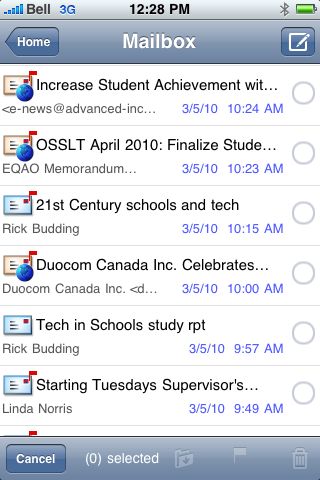
Here is a view from my mailbox. Note the ‘tech in schools study’ message has been read (flag gone).

Now, tap the ‘edit’ button. This will cause the > symbols to change to radio buttons.

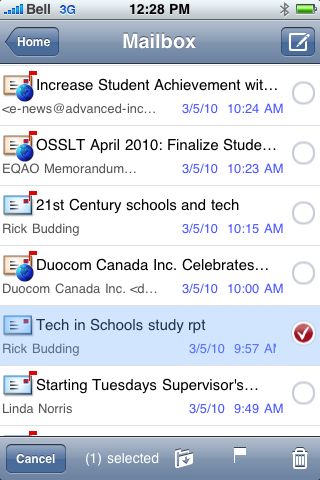
Next, tap the radio buttons to select the message (or multiple messages). A check mark will appear in the radio button to indicate the message has been selected.

Now, tap the flag symbol in the bottom menu bar to restore the mail flag indicator to the message.

Once the flag icon is tapped, the screen returns to the main mailbox view, with the display showing the updated flags.

I hope you enjoy the additional mailbox functionality in the mobile client to help you stay organized.

~ Mark

IT’s about the students – Reflections

As one would expect, many of the Ontario Association of School Board Officials (OASBO) ICT meeting discussions centre around core IT challenges such as work load, work flow, infrastructure, drive imaging, costs, sustainability, integration challenges etc. and the list goes on. These discussions are valuable and critical for learning, planning, and some sense of provincial alignment. Over the course of the last few months, more and more of these discussions cross into the instructional realm. There is an increasing understanding that all of these core IT functions are intertwined with important instructional ICT needs.

This year I had the pleasure and opportunity to contribute to the planning process of the OASBO ICT Winter Workshop. In order to move the collective IT and ICT agendas forward, there is a need for critical understanding of each other’s (traditional IT and instructional ICT) needs. To this end, the decision was made to begin incorporating an ICT instructional strand into the annual winter workshop.

21st Century Classroom – IT’s about the Students!, this year’s workshop was held Feb. 25th, 2010. Mary Jean Gallagher, Chief Student Achievement Officer and Assistant Deputy Minister – Student Achievement Division of the Ontario Ministry of Education delivered the keynote address. I thought the core message of her address was right on the money.

Mary Jean began by reviewing educational goals of  the provincial government and goals the Ministry of Education. She continued by making the point that IT is a strategic part of every thing we do in both the learning and business sides of education. From a philosophical point of view, there are perhaps only two roles in education:  the front lines work of teaching in the classroom and figuring out how to make this happen easier and more effectively.

In IT, our work certainly falls to the second category. The work that has been done to facilitate data driven decision making is absolutely critical as it drives the analysis and planning processes. This work includes assessment data collection, the OnSIS process and reporting. The impressive result of this work is that, based on international standards, Ontario students have collectively made significant gains over the last few years – and yes, Ontario is being noticed in these international circles. It is important to note that these international tests do not have 100% alignment with EQAO testing. As a result, these improvements are not seen as strongly in the EQAO results. The bottom line – this could not happen without the detailed work of IT supporting the process.

On the instructional agenda, student achievement in the 21st century is all about the work we do together: Dream, Inspire, Achieve. Fundamentally, technology must:

  • be embedded in strong instructional practice
  • enable more powerful pedagogy
  • drive changes to instruction and assessment practices

The important question is how do we make this happen?

  • we need to have more events like this one to keep the discussion alive
  • IT personnel need to embrace conversations of change and accommodating needs
  • teachers and ICT need to clearly define their strategic needs
  • IT needs to deliver on the enablers, such as wireless, guest network access (etc.)
  • collectively, we need to establish an approach to funding, sustainability, support and PD/training

The balance of the winter workshop day had at least one ICT session available within each breakout session, and most importantly, provided opportunities to cross fertilize the IT/ICT discussions. Feedback about the format from participants was extremely positive. During the debriefing session at the business meeting the following day, a motion was made to continue with the instructional ICT strand as a key component of future OASBO ICT workshops.

From my point of view, this was a very successful event with an excellent keynote address and forward thinking discussions. I look forward to keeping this discussion going!

~ Mark

Building community at #ABEL

Last Friday I had the pleasure of attending the Mobilizing 21st Centruy Teaching & Learning Leadership Symposium hosted at York University by the ABELearn program. The timetable for the day was:

  • ‘Unleashing the Passion’ Keynote by Sheryl Nussbaum-Beach
  • How Does It Work? – Tools, Strategies and Results – a Carousel of break out sessions
  • ‘Teacher Professional Learning for the 21st century’  Keynote by Ron Owston
  • Dimensions of Change: Leveraging the Wisdom of the Crowd (facilitated discussion and action planning)

During the Carousel of breakout sessions, I chose to attend the discussion titled ‘Building Capacity: A Shared Leadership Approach’. This session was an open round table discussion. A quick round of introductions revealed a diverse group of roles represented including teachers, eLearning leaders, ICT consultants, school administrators and CIOs.

The range of ideas and comments put forward hit the predictable topic list: getting more teachers on board, training, costs, access and funding. While many good points were made, I was quite fascinated by the discussion from one point of view. It was very interesting to see how many people focused on ‘getting something going’ in their own classroom, school or program. This approach certainly does create an energy at the grass roots level and is arguably important in the context of change at the local site level.

However, this approach does not guarantee a coordinated change at the system level. A few of the participants, including me, also spoke in support of the need for a system perspective on planned change as well. Key areas from a system point of view would include setting expectations, a focus on embedded technology use of specific curriculum needs (e.g. non fiction writing), staff development program support and IT support. Once these points were made, the group generally seemed to express agreement that this aspect of moving forward is a key ingredient.

All in all, this was a fantastic learning opportunity. I look forward to reviewing the content, actions and ongoing discussion in session wiki that will be set up.

~ Mark

Tethering with your iPhone

Have you ever needed to access the internet with your laptop when there was no suitable wifi connection?

One solution is to use your iPhone as a wireless modem. Using a smartphone as a wireless modem is called tethering. Setting up this feature with your iPhone is very straight forward.

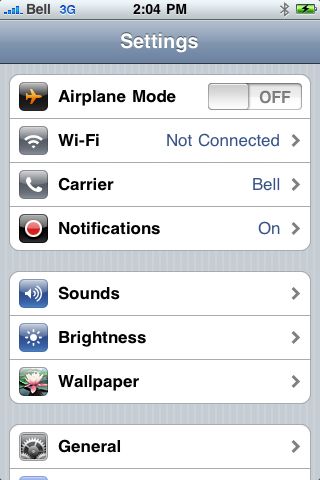
Step 1: open the settings menu

Step 2: select ‘general‘ from the settings menu

Step 3: Select ‘network‘ from the general menu

Step 4: Select ‘Internet Tethering‘ from the Network menu.

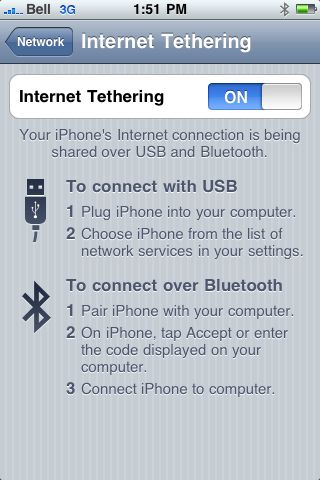
Step 5: Slide the ‘Internet Tethering‘ button to ‘on’

Now you are ready to connect your iPhone with ‘modem mode’ enabled. You have options to connect with USB or bluetooth.

USB  connection mode: The first time you connect the iPhone in this mode, iTunes will load the necessary drivers and you are ready to go.

Bluetooth connection mode: Before you can connect in bluetooth mode, bluetooth must on active (on) and the iPhone must be paired with the computer in the same manner as you would pair a bluetooth headset. (refer to system documentation for this step)

I have found tethering to work great. If fact, this blog post was written using a tethered internet connection via my iPhone.

Note: Please review your data plan limits and applicable data charge rates before actively using this connection method. You certainly don’t want any surprises on your monthly bill.

Stay connected 🙂

~ Mark

The X100e – first impressions

Last fall, I wrote a blog post titled Are Netbooks Ready for Primetime. At the time of writing, it seemed to me that the answer was yes, no and maybe depending on needs and environment.

Certainly, in the time frame of 4 to 6 months ago, many netbooks were running XP home for their OS and consequently were challenging to use in a managed domain based environment. I spend some time testing the Lenovo Ideapad. In many respects this was a great machine, and it showed me the potential of a netbook sized machine for travel and web 2.0 uses. I did not like the keyboard layout and found the keyboard a little to small. The Ideapad also used XP home.

This week I have had an opportunity to try out the new ThinkPad X100e model. This unit is clearly a step up from a true netbook in that it is a smaller ThinkPad with many of the solid design features you would expect from the ThinkPad model line. The clunky keyboard design of the IdeaPad was gone. The keys are nicely sized and shaped, and the overall keyboard layout is very clean from my perspective. The unit I tried came with Windows 7, and worked like a charm – easy to use, no setup issues and the wireless connected easily and worked without issue. I also understand that the X100e unit can be configured to use XP pro, so this gives some options within the managed enterprise environment.

IdeaPad (left) and X100e (right)

IdeaPad keyboard layout

X100e keyboard layout

The unit comes with a number of options including:

  • Windows 7 home/pro (Eng/Fr)
  • 1/2/3/4 GB RAM
  • Eng/Fr keyboard
  • 160/250/320 GB hard drive
  • bluetooth
  • Microsoft software bundles.

Given the Windows 7/XP options, improved keyboard layout and price point, I think the X100e unit could find a real niche in the K-12 education environment – a little more than a traditional netbook, a little less than an expensive laptop. I will look forward to hear what others think about this exciting product.

~ Mark

K-12: Entrepreneurship 2.0

Further to my last blog post, Valuing Online Communities in the K-12 educational arena, I have been reflecting on the many possibilities of using social media tools to an advantage.

Mitch Joel discusses the five C’s of Entrepreneurship 2.0 in his book Six Pixels of Separation, and identifies them as follows:

  • Connecting
    • Connecting to Consumers
    • Building loyalty
    • Nurturing those connections to make more connections
    • Making money and growing
  • Creating
  • Conversations
  • Community
  • Commerce

He goes on to discuss strategies to use social media tools to achieve specific business goal(s). These tools have certainly leveled the playing field in terms of the potential to connect and get your message out.

What happens if we take out ‘business’ and replace it with ‘education’?

The goals of building strong connections between members like groups (administrators, teachers, support staff etc.) is key within an organization. Building a strong culture of learning and sharing is also important for the long term success of the organization. Furthermore, I believe building a community between these strategic groups to maximize learning and sharing with a focus on the ‘big picture collective goal(s)’ is also important.

It seems to me, the strategy of using the five C’s of Entrepreneurship 2.0 should be just as effective in the educational environment. Perhaps with the exception of making money, in my opinion, the other points are in strong alignment. If you were going to promote some new resource for example, I wonder what the impact would be of using social media tools as part of the promotion and marketing strategies would be?

After all, don’ t we want to

  • connect to our customers (internal, e.g. teachers)
  • build loyalty (return customers to continually use provided resources)
  • nurture these connections, and make new connections (connect more teachers & share)
  • grow (and engage)

I would say yes to all four points. This is, after all, part of the culture of a successful education organization too. IN addition to system announcements, posters etc., why not use social media tools to enhance these strategies?

Now, all that I need is a great project to give this a try!

~ Mark

K-12: Valuing online communities

I recently had an opportunity to present to our senior admin group to examine new directions concerning access to online resources. As part of the preliminary discussion, I outlined a frame of reference that included:

  • the value of online communities as an extension of school communities and classrooms, and
  • aligning internet resource selection processes with existing resource selection processes to form a basis of comparison as a starting point.

During the presentation, I made the following points to frame the discussion:

A growing body of evidence validates the importance of the sense of community within the learning environment for administrators, teachers and students alike. Benefits include:

  • promote life long learning
  • engaged learners
  • a sense of belonging and support
  • a culture of learning and sharing
  • communities are built on trust
  • embrace Character Development and Digital Citizenship ideals

In his book, Grown Up Digital, Don Tapscott promotes 7 strategies that support a ‘School 2.0’ environment. The strategies are summarized as follows:

  • Focus on the change in pedagogy, not the technology itself. Use technology for a student-focused, customized and collaborative learning environment
  • Reduce lecturing, broadcast learning does not work as effectively for this generation of learners. Allow the students to co-create a learning experience
  • Empower students to collaborate
  • Focus on life long learning
  • Use technology to get to know each student
  • Design programs that leverage the strengths of the Net Generation in project based learning
  • Reinvent your as an educator

Further to this presentation, I have been reading Six Pixels of Separation by Mitch Joel.  Mitch also documents some important characteristics of communities. Although some of these statistics are more business oriented, I feel there is a strong connection to educational based online communities. Mitch notes that community users:

  • spend more money that non community users
  • remain customers 50% longer than non community members
  • visit 9 times more often than non community members
  • login one or more times per day (56%)

Additionally, 43% of Internet user who are members of online communities say they feel ‘as srtongly connected’ to their virtual communities as their real world communities.

To my way of thinking, these are impressive statistics. Online communities are here stay, are highly valued by users and provide valuable professional learning and sharing opportunities. It seems to me that it is equally important to establish online communities as a natural extension to school communities and classrooms. It is time to charge ahead and embrace social media tools within the curricula, not as an option, but as a planned strategy of curriculum delivery and learning opportunties.

~ Mark

Sliding into 2010/2011

I always find this time of year interesting. On one hand you feel firmly entrenched in this year, focused on major projects and making sure things get completed before June is upon us. On the other hand, I find some of my attention starts to drift towards next school year – yikes! Our budget process has just been nudged into action. In many ways, this is viewed as a time to be thinking about priorities for the upcoming months.

More and more though, I am beginning to view multiple school years as a continuum. On the assumption that strategic planning and the Board and department levels have been done well, then projects and strategies still need to be executed in the right order, with the right priority level(s) and resourced appropriately. From my point of view, the bottom line is Stay the Course. If you had the right big picture priorities in the first place, then they should still be priorities. In our case, it will take another 3 years for some of our technology environment changes to be fully completed and implemented in a sustainable way – well worth it, is just takes time to do correctly.

Some of the ongoing massaging of supporting the big picture plan going forward is what captivates my interest:

  • maintaining the energy behind new processes
  • meeting the challenge of keeping staff trained and aligned with the true needs of the system
  • keeping the learning and IT agendas well aligned, stepping ahead in a strong partnership
  • determining the role of new technologies within the curriculum (netbooks, iPads, eBook readers etc.)
  • ongoing support for mobile learning
  • embracing new tools in a systemic way

I enjoy the time to reflect, and the opportunity to tweak the necessary components in an effort to maximize the achievement of our system goals.  More reflecting, analyzing and learning on the horizon.

~ Mark