I have 36 years experience in K-12 education. I have been fortunate to work in many different roles including teacher, department head, ICT consultant, IT Manager and CIO.
Personal interests include performing in the Venturi Winds woodwind quintet, the Cambridge Symphony and the KW Community Orchestra as well as composing and arranging music.
Connect, Learn, Reflect & Share - make a difference today!
I have traveled from Canada to the USA several times in the last few months. Wanting to be connected via 3G in a cost effective manner, I ordered an AT&T sim card for my iPad with the understanding that I could activate the sim once I was in the USA with a wifi connection.
Attempt 1 – I was unable to activate the card due to lack of wifi in the location I was at.
Attempt 2 – I was unable to activate the card since the sim account activation process would not validate a Canadian credit card & address against the USA based template using a local hotel address.
Attempt 3 – I was unable to activate the card since the sim account activation process would not validate a plain vanilla no address credit/cash card as the name field cannot be left blank.
Adventure 2 – excursion to Austria to perform with the KWCO orchestra.
Our hotel was located in downtown Saltzburg Austria conveniently next to a small shopping mall which contained a T-Mobile store. They had iPad compatible sims for Austria in 1GB or 3GB packages ($15 and $22 respectively) which are active for 30 days. There are options to top up the data if required and/or reuse the chip again on a future trip.
I popped in the sim card, entered the sim card password and the T-mobile network was detected in about 5 seconds. All as it should be – easy, convenient, affordable and hastle free for the end user.
Kudos to T-Mobile. I think the North American TelCo.’s could take a few pointers from the European approach re service levels and customer satisfaction.
Now to research a better travel to USA from Canada solution — starting with T-Mobile.
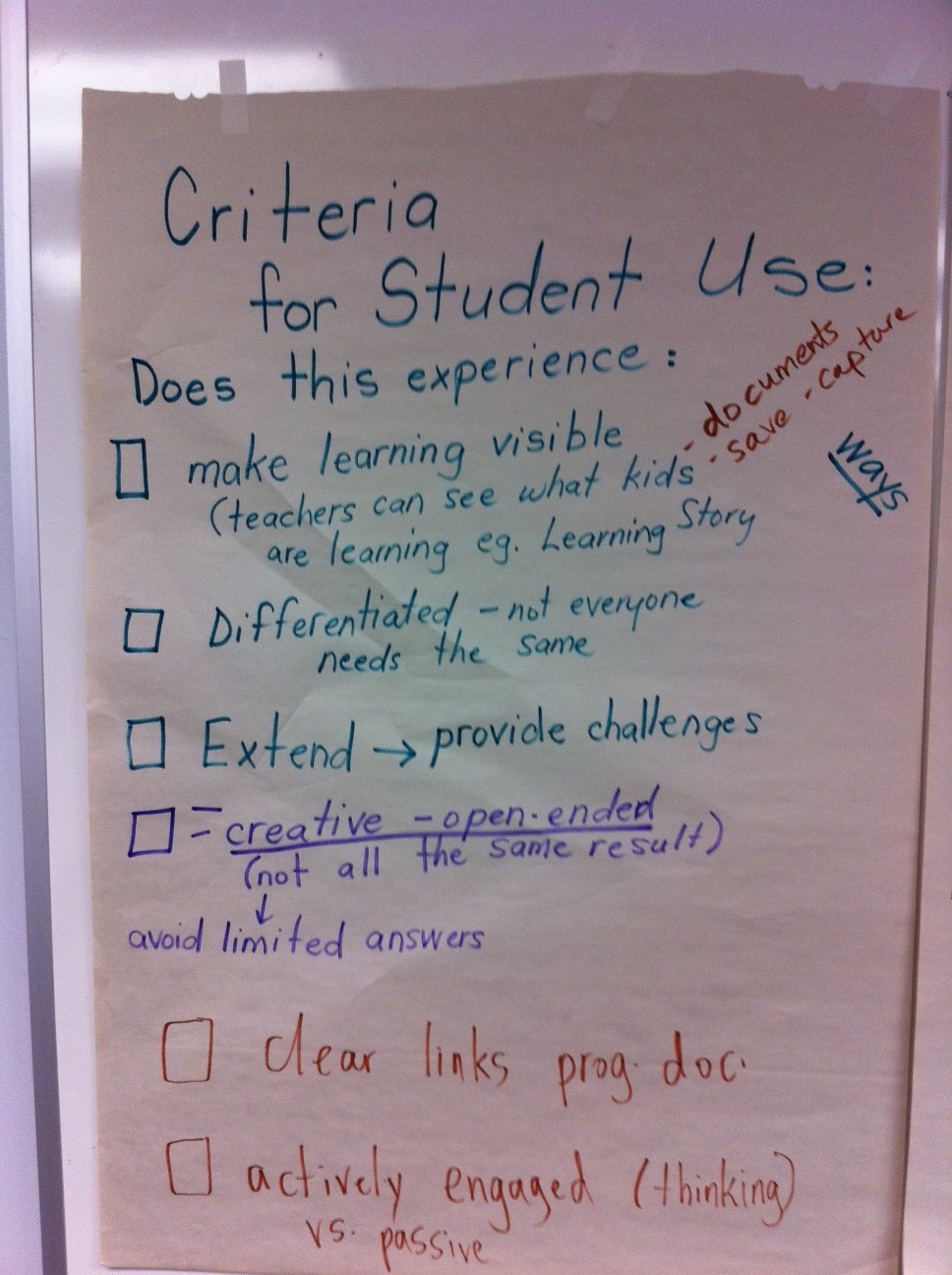
Just prior to the end of the school year, we held a meeting of the group the teachers involved in our JK/SK iPad project. The meeting was a great sharing of learnings to date. Much of the discussion centred around criteria for choosing apps for students of this age/grade level. Here is what they had to say.
Earlier this month I had a chance to visit Central Public School (website) with Rebecca Rouse (@rebrouse) to have a first hand experience observing our JK/SK students using iPads. Central P. S. is one of 5 Waterloo Region District School Board sites participating in a focused study on the impact of the use of iPads to support early reading and early literacy development in our students.
Upon arriving at the classroom, we initially stayed off to the side to observe without interupting the natural flow of the classroom. A kindergarten classroom is a busy space, and I was immediately struck by my initial observations. There was certainly an air of energy and excitement in the classroom. Students were checking with staff to see when it was their turn to move to the iPad station. Clearly, they were motivated and did not want to miss their turn. I was very impressed with preparation and organization of teachers Brenda Fowler Mandy Serpa. They had really thought through the physical logistics of managing the iPads within this busy environment. iPads were numbered via the screen background for easy tracking. Cases were used for protection during storage and transportation from room to room. A picture book of app (application) icons was created to assist the students in locating the correct software. Screens were cleaned regularly to maintain the sharp image and reduce germs. I also noted how careful the students handled the technology – impressive! With guidance from the staff, students used a variety of apps (applications) for word recognition, spelling, personal exploration and story creation.
Eventually we joined the student table and sat next to the students. I asked one student what he thought about using the iPads. Without a pause, he enthusiastically stated that iPads were ‘fun and creative’. All of the students were eager to share their work and successes with us.
Teacher Observations: After watching the students in action with the iPads at the learning centre in the classroom, teachers shared their observations from the first month of the project.
lesson preparation time had become more streamlined (less paper based)
time spent on learning activities increased
students spent more time on task during guided reading sessions
there has been a significant increase in student engagement levels
reading skills are developing more rapidly compared to a more traditional approach
the built in audio support enhances student learning
a notable increase in student confidence
students are eager to demonstrate something new they have learned
5 iPads is a good number of devices for managing the student group
students were keen to assist each other with problem solving
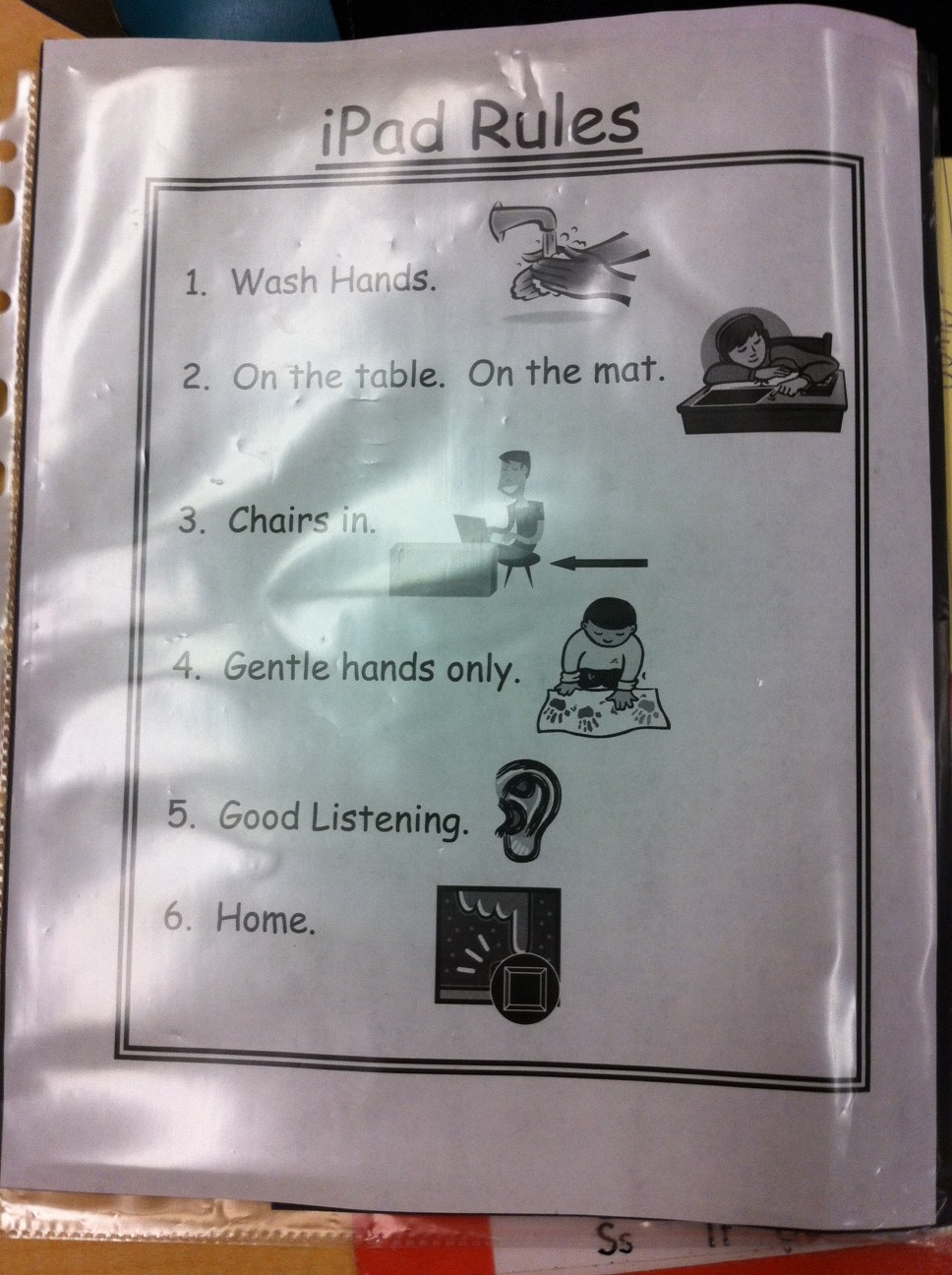
iPad Rules
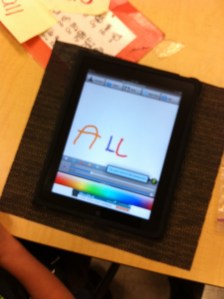
Spelling words
Sample App Icon Card
iPad Centre
This project has certainly had a positive start. Thank you to Principal Jennifer Crits and teachers Brenda Fowler and Mandy Serpa for sharing their experiences to date.
If the results of this proof of concept project show a strong correlation to improved early reading and early literacy then we revise how we allocate technology for all JK/SK programs.
On Monday June 13th, I had the pleasure of attend Ron Millar’s retirement celebration. It was a great event and I appreciated the opportunity to provide some remarks about Ron and his career. Having worked with Ron for most of my career, I also wanted to share my comments here in a more public way.
Ron Millar
Ron, the Millar family and guests,
I thought it was fitting for this event, that I have my speaking notes on an iPad. This year I celebrated my 30th year in education with the WRDSB. I have known Ron and had the pleasure and honour of working with him in a variety of capacities for almost my entire career.
For those of you that know me, you are aware that it seems things always work out in threes. Fittingly, there are 3 sections to my remarks tonight: Things in Common/stats, Memories and Going Forward.
Things in common & stats:
Ron and I have many things in common, and I thought I would highlight a few of those things today:
– glasses & beards: we delighted in saying if you can’t tell us apart, Ron has a beard and I wear glasses
– an appreciation for black: the dress code is embedded, no memos or phone calls 🙂
– curiosity
– passion for learning
– and one additional point that I would bet most of you don’t know.
Ron and I both taught mathematics at Glenveiw Park Secondary School. On the theme of numbers, I wanted to share a few of Ron’s statistics from his amazing 44 year career.
– he has worked 2332 weeks or 11660 days, factoring his continued summer work
– he has been granted 880 sick days, and being blessed with good health, most have not been used
– since the beginning of email, Ron has received approximately 544, 000 messages in his WaterWorks (work) account. I know he often teased about declaring email bankruptcy and deleting them all, but I know if fact that they were answered.
– Ron bought the first instructional computer for the Board, a TRS 80 I believe. Since that day, he has piled up some impressive stats:
– $44 million spent on computer hardware – about 47,000 computers
– $4.5 million spent on software
– $4 million spent on staff development activities – this year is CATC camp #20
– oh yes, and the number 15 is important. In the days when WaterWorks (our email system) was just starting, Frank & I were assured that it would take about 15 minutes per day to manage the WaterWorks project needs. I think in reality, it took all of our daily time except for 15 minutes – but well worth it when you look at what is has become today.
Memories
– the days of the modem workshops, stringing phone line cables in the Education Centre on Saturday mornings as part of workshop prep
– thank you for starting my passion for iDevices
– ITS events always have a picture of Ron taking of picture of Mark who is taking a picture of Ron (tradition)
– Our ‘water cooler’ time – starting everyday talking about some new thing that one of us learned
– Ron teaching my daughter Charlotte her first Latin pun – sempre ooby sub ooby – always wear under wear
– Listening to Ron talk enthusiastically about a new technology
– Zipping to Buffalo to get those first precious iPads into Canada
– Arranging amazing system events for the Computer Contacts with speakers such as David Warlick and Alan November
– Joking that if Ron got up a little earlier and I stayed up a bit later, we would offer 24 hour coverage for ITS
– Dilbert – in one of my favourite cartoons, the IT department raids Dilbert of his desktop, laptop, disks and USB key. After they leave, Dilbert points out they missed the wireless pen!
Hats: Most of you, like me, have never seen Ron physically wear a hat — but he does wear them. I think of them as the hats of the master learner. Ron has excellent people skills and has a wonderful ability to pop on the right hat at the right time. He might wear:
– a question hat and ask a probing question at just the right time
– a support hat, sensing when you need help
– a friend hat when you need a listener
– an energy hat to get some new project going
– an experience hat to guide a process or project along in the right direction
– a research hat to validate our work
– a mentor hat to share knowledge or help you see a new insight
– an R&D hat to look into the future
– a smile hat – time for a little humour or practical joke to keep the mood light or
– a passion hat to keep the learning and energy high
Going forward
When I thought about how to wrap up my comments, of course I came back to the theme of 3 buckets. Ron, each bucket has a wish for you.
Bucket #1: a wish that you will enjoy a happy retirement for as many years as your career
Bucket #2: a wish that you will continue to be as passionate about your retirement activities as you have been with your work
Bucket #3: a wish that you will stay connected – don’t be a stranger.
Thanks for bringing your ‘A game’ everyday to learn, facilitate, problem solve and make WRDSB a great place to be.
Today I had the pleasure of tuning in to a webcast presentation by Alan Levine about digital story telling resources. I ideas were great and the chat window was action packed with comments, ideas and positive feedback. I wanted to share a list of a few of the resources that were highlighted.
This is a great set of tools to support digital story telling. Visit Alan’s blog and wiki to get the full story and lots of good ideas. Everyone has a story to tell. Give one of these great tools a spin today then do something fun. innovative and engaging with your students!
Thank you to Sheryl and the PLP Network team for setting up this learning opportunity with Alan.
On Friday May 20th we held our culminating day for this year’s PLP and Futures Forum session. From my point of view, the day was a wonderful success — an opportunity to passionately share about our learnings, celebrate our collective successes and begin the scaling process by introducing next year’s Futures Forum teachers to the process. I captured much of the morning presentations with my Livescribe pen. I have uploaded many of the recordings and linked to the sections by topic as per the list below.
It has been a while since I posted a set of links. Over the last couple of weeks, I have come across a number of interesting articles, and thought I would share the links.
On Monday April 11th, the long awaited press release of the Ontario College of Teachers (OCT) electronic communication and social media advisory was released. I was attending the OCT live presentation on Tuesday in Toronto, and viewed the advisory print document and watched the video to be well informed for the session.
My initial impression of the print document was that it was a well written, solid framework to guide educators into this new territory. I was very impressed with the video production as it captured a positive spirit for leveraging these new tools within our education system. I did feel that some additional clarification was required in the area of Facebook use, and planned my comments and questions for the live session.
It was interesting to watch the press and media take on the documents and follow the reactions via Twitter. As one would expect, reaction varied widely, tending towards the ‘too cautious’ end of the scale. Tuesday morning, I was able to have a conversation with Chris Vollum, an excellent speaker who has significant experience presenting social media sessions to school and parent audiences across the province and at many WRDSB schools. Chris, who was interviewed as part of the video, had a positive reaction and felt the overall message was positive. I also had a good phone discussion with Jane Mitchinson who has provided extensive leadership in technology and social media use within our Board.
The session was well organized, with the agenda organized as: presentation, table discussion and Q&A. I captured some of the important highlights and shared them on Twitter:
Opening remarks: OK to use social media in responsibly and ethically — key factors: care, trust, integrity and respect
The intent of the advisory is to clarify responsibilities while capitalizing on the potential of these tools
Social media tools can be appropriate, useful and powerful
OCT: ‘off duty’ use of social media tools matters – what does appropriate use look like?
Online behavior by teachers should reflect the same professional ethics as used in the school setting
Private vs. Professional: onus on members, off duty conduct matters, exercise caution, act professionally at all times
The internet is part of a teacher’s off duty realm
Any online presence should respect professional integrity, even in the somewhat less formal social media environment
Reviewing some examples of professional misconduct -I note that these examples would be inappropriate online or offline
Teachers: model good behavior, advocate proper use (digital citizenship) be courteous and professional at all times
Facebook – caution re ‘friending’ – but no distinguishing of friend=contact, it is all about the security and privacy settings – education!!
My comment: follow the Grandma rule— if you don’t want your Grandma to find out, don’t put it on Facebook
You can’t judge social media from outside
Board hosted email should be used for communications with parents (not personal email addresses)
The table discussions were interesting. We were given 4 scenario questions to consider. All were great questions with pros and cons and certainly generated excellent discussion around the different viewpoints — risk factor(s), legal implications, empathy, professional approach.
In some ways, I enjoyed the Q&A best. Many good questions were asked, and gave further indication that there are multiple factors to consider in almost all situations. I did take the opportunity to raise a few points during the discussion:
Digital citizenship and character development programs are essential for teachers and students
Staff and students need authentic experiences with social media tools in a real world context
Your digital footprint represents your online presence – how google-able are you?
Your digital legacy is your digital reputation – how will other perceive you and remember you?
Social media tools offer many opportunities for connecting, collaborating and sharing – embrace & capitalize
I did ask specific clarification around the ‘teachers should not friend students’ point. In the Facebook environment, a ‘friend’ is a contact. How any 2 contacts interact is dependent on security and privacy settings, and the relationship — a professional context suitable to the educational environment. I sited examples where teachers might ‘friend’ students, but have suitably locked down profiles and interact with students in a Facebook group setting. Panel members who addressed my question indicated that there is no issue with this if it is done properly with appropriate settings and professional conduct. We all recognized and acknowledged the need for people to know, understand and use appropriate settings (Digital Citizenship).
I took the time to meet the panel members after the session. I appreciate the work done on this document, and the importance of the framework established and congratulate the team that worked on the preparation of this document.
What if I could change one thing? – The one thing that I wish could be changed is the manner in which this was handled by the media. They really grabbed a couple of small pieces of information and cast a giant negative spin on things — so much for fact finding and balanced reporting. Unfortunately, this is all some people will remember.
Next steps: Embrace change! Given the great potential of these tools, it is important that those comfortable in leading, continue to learn and share best practices and experiences. Boards and federations need to make sure Digital Citizenship and Character Development programs and other training supports are in place. Pre-service teacher programs should provide a good grounding in Web 2.0 and social media tools. Teachers need to be familiar and comfortable with these tools before using them with students.
You never know when an interesting social media conversation will break out.
Last Sunday, our woodwind quintet, the Venturi Winds, performed a concert at the Wellington County Museum & Archives building. Following the program we decided to go out for a light dinner along with a few family members who attended the event.
Seated at the table and previewing menus, the unsuspecting conversation started. One person, who operates their own business, begins to tell the story of needing to terminate an employee for continually spending company time on their personal cell phone. They turn to me and ask “What you you do in the schools? Do you allow cell phones in the classroom?”
I provide some background on our digital citizenship program indicating that it is important to:
recognize that value of mobile devices to support certain aspects of curriculum delivery
teach appropriate, ethical and safe use for a particular situation
and teach self regulation
Many of our schools have designated some ‘cell phone safe’ zones where students may use their phones. Classroom use is generally at the discretion of the teacher. Everyone could see the value in our approach, and that providing some real world context to these experiences was of value.
The conversation deepens. “What about laptops? What about Facebook? (etc.)? Are these allowed in the classroom? These are distractions.”
I provide some additional information about our program and approach. True enough, these could be distractions, but mobile technology and social media tools provide:
ways to interact with the world in real time
access to information
collaboration opportunities
authentic audience opportunities and experiences to students
I went on to explain the use of blogs, wikis, ning, Google docs, Facebook etc. and how the use of these tools can support important curriculum goals such as non fiction writing (e.g. journals, poetry, peer review of projects …). The conversation went on to talk about the role of the teacher shifting from the ‘sage on the stage’ to the learning coach who facilitates inquiry and project based learning.
All in all, a great conversation that stretched out over most of the meal time. The conversation did eventually drift to other topics. Finally a question came up about time zones and daylight savings time.
My solution: “If you had a smart phone, you could look that up right now.” – and I did. What a great segue to the power of access to information via mobile devices. Our time together concluded with a good laugh from the group.



 ~ Mark's Musings ~ blog.markwcarbone.ca