Tag Archives: Facebook

Creating a Facebook group for your K12 class

In my previous blog post, I made reference to a number of strategies to embrace the use of Facebook within the K12 classroom to support learning. One of the most powerful features of Facebook for use in the classroom, is the groups feature.

The process used to setup a Facebook group is straight forward and can be completed in just a minute or two. The steps are:

1. Select the Groups link on the left side of your Facebook ‘Home’ page.
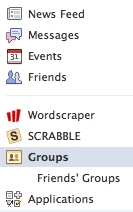
2. Click the ‘Create a Group’ button

3. Complete the basic group information.

4. including the category and type information.

5. Click the create groups button to proceed to the group property settings page. I would recommend unchecking the ‘Non-admins can write on the wall’ setting. Unchecking this parameter prevents wall posts leaking out side of the group to Facebook friends of group members.

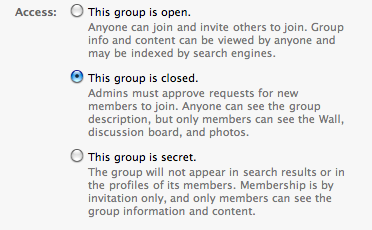
6. The bottom section of the group property settings page governs the visibility and privacy settings for the group.  For K12 purposes, I recommend the closed group setting. This allows the group name to be searched, but keeps the content of the group private to the group membership. With this setup, the group owner can invite members via email addresses and NOT be friends with the members. From the K12 perspective, this allows a teacher to create (own) a group and invite student membership without becoming Facebook friends with the students. In our case, this can be done easily by using our Board generated student email addresses.

Note (20101012): Since researching and experimenting for this blog post, the new groups feature was introduced within the Facebook environment. This feature may impact the functionality described here in terms of the groups members are, or are not, friend relationships. Until this is more clearly understood, I recommend that privacy and security settings are implemented accordingly.
7. Click the ‘Save’ button to activate your settings.

8. Select the ‘invite people to join’ link to send group invites.

Once people accept your group invitation, the collaborating will begin.  Enjoy your Facebook Learning space.

~ Mark
Facebook in K12 – Resources

Links: 2010-09-18  — Facebook in the Classroom


Synthesize the Concepts

Iowa city are now using the social media website inside the classroom

The Science Behind Feeling Good While Social Networking

Ideas for Social Media Guidelines

Social Media Guidelines – More Thoughts

Suggestions: Facebook guidelines for students, parents and schools

ST. CHARLES Community College Facebook Guidelines

Use Facebook to Support School Homework

Note: These resources have also been posted in my ‘Facebook in the Classroom’ user group on Facebook.

~ Mark

Kicking off the 2010-2011 School Year

I enter the 2010-2011 school year with great anticipation and excitement.  Many of the projects that were in major planning stages last year will ‘go live’ this year.

  • Effective today, we have wifi hot spots in each secondary school. These hot spots will allow staff and students to use their own equipment for Internet access.
  • Expanded use of web 2.0 and social media tools to support curriculum delivery. Staff and students now have access to Facebook. Facebook and Twitter, along with other resources will be used to extend school community and support curriculum delivery.
  • By mid month, we will role out email for elementary students. In addition to the secondary role out last April, all students fill have a Board assigned email address to support curriculum and communication needs, and identification in other online environments.  All students will be part of our FirstClass system.
  • Launching our Future Forum project (semester 2), developed as our 2009/2010 PLP project
  • Automated processes now reduce manual work to support account management
  • Redesigned and significantly improved drupal based web sites for our secondary schools
  • Moodle hosted setup to deliver Health and Safety content (launched Sept. 2nd)

Significant projects for this year include:

  • expanded development of our Library Learning Commons (LLC) project
  • a complete rewrite of our Technology Acceptable Use procedure to align with Digital Code of Conduct, Digital Citizenship, and Character Development programs
  • iPads & netbooks in the classroom
  • continued involvement in the PLP program
  • a look at e-book strategies
  • expanding our wireless project
  • building on our Digital Citizenship program

Day one went well. We hit our startup targets and hit the road running. It is going to be a great year!

~ Mark

New Facebook Privacy Settings Get Mixed Reaction

There has been a fair bit of hype around the promised improvements to Facebook privacy settings. The release of the new privacy settings format this week has come with a mixed reaction from users and privacy advocates. Many users claim some settings are in fact more open than they were before and that it is easier for users to give out details they may not wish to share.

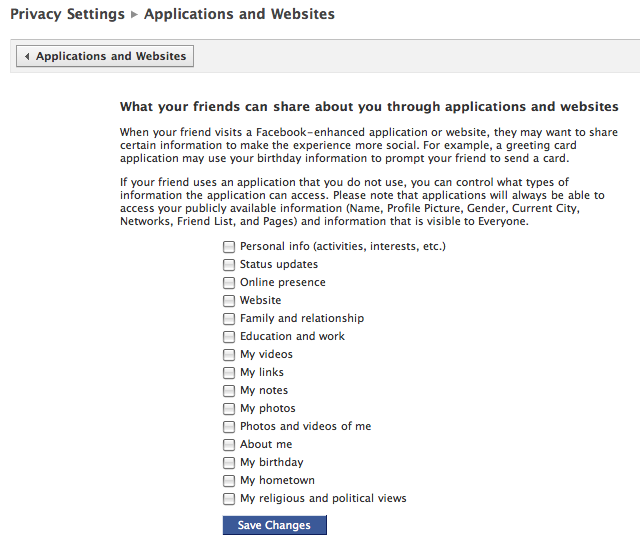
The first time you log in since the new settings were put in place, you are prompted to review and update your settings. As you can see from the screen capture below, there is a long list of things impacting your privacy options to work through and check.

Personally, I was disappointed to see that some of the settings default to friends of friends. I was certainly hoping for default settings to be more locked down with the onus on the user to open up the settings to their liking. In working through this new setup, I noticed that not all settings seemed to adhere to the way I set them the first time through.

Be aware, and be safe online. Take the time to complete a thorough review of your settings. I would recommend the following actions:

  • a detailed review of ALL of your settings with appropriate changes saved
  • logout
  • login
  • recheck the settings for verification

I believe there continues to be more work for privacy and online safety advocates to do.

Related Reading

From the Facebook blog: new privacy tools
ABC News: 5 things to know about the new Facebook privacy settings.
Yahoo News: Privacy Advocates slamFacebook change

~ Mark

Facebook screen effect

Very curious!

Step 1: Log into Facebook

Step 2: press the following key sequence (one at a time):

up arrow, up arrow, down arrow down arrow, left arrow, right arrow, left arrow, right arrow, b, a, <Enter>

Step 3:

In Windows, right click on the screen to open the options window, then click away from the options window to close it

In OSX, control click on the screen to open the options window, then click away from the options window to close it

Step 4: Now when you press up or down arrow, or click the pointer a set of coloured circles will appear on the screen – weird.

Step 5: Simply log out of Facebook to cancel this effect.

Thanks to my daughter for sharing this strange find with me. You never know what you will learn.

~ Mark


A Victory for Process: Facebook Privacy Policy to Change

My July 18th blog post referenced issues with Facebook not meeting Canadian privacy laws. This week, announcements were made indicating that following the consultation process with the Canadian Privacy Commission, Facebook would indeed make changes to bring their practices in line with Canadian privacy requirements.

During the upcoming months, Facebook will make several changes to its privacy policy. This will include clarifying messages on the site that inform users about their control over their personal information when they join, deactivate or delete an account or sign up to use an application.

Specific changes Facebook will be making:

• Updating the Privacy Policy to better describe a number of practices, including the reasons for the collection of date of birth, account memorialization for deceased users, the distinction between account deactivation and deletion, and how its advertising programs work.

• Encouraging users to review their privacy settings to make sure the defaults and selections reflect the user’s preferences.

• Increasing the understanding and control a user has over the information accessed by third-party applications. Specifically, Facebook will introduce a new permissions model that will require applications to specify the categories of information they wish to access and obtain express consent from the user before any data is shared. In addition, the user will also have to specifically approve any access to their friends’ information, which would still be subject to the friend’s privacy and application settings.

My View:  To me, this represents more than a victory for privacy. It is a vote of confidence that the process works – and it worked through the identification of issues, consultation, collaboration and resolution. This is powerful and more effective than some ugly court case. The efforts of those involved in this entire process will positively impact the current 200 million Facebook users and all future Facebook users. Three cheers for a great process!!!

Related Reading:

Original complaint by the Canadian Internet Policy and Public Interest Clinic

Original Findings and Recommendations

Facebook Press Release

Globe and Mail perspective

New York Times perspective


~ Mark

Social Networking in Education: Friend or Foe

Last night I read Joe Corbett’s post on ISTE Connects: Is Facebook the Enemy of Education? While looking for Facebook applications for education, he came across research indicating that Facebook could negatively impact studying. The general indication from the research was that Facebook is a distractor – Facebook users typically spend less time studying which in turn negatively impacts grades. Now, hold this thought!

Like Joe, this got me thinking and I decided to review some of my recent readings on the topic. The links below encompass a good selection of views on the subject.


Viewpoints

Social Network Access: available or blocked/content filtered
Classroom learning vs. socializing
Supported by teachers, not supported by administration
Social Networks are just tooks – can we use them in educationally effective ways?
Keep the issues separate
Social Networking is part of web 2.0 literacy and digital citizenship


Reference Articles/Blog Posts

Classroom 2.0: The Value of Social Networking

Sue Water’s Blog: Educational Networking and Staying Out of My Face

Cool Cat Teacher’s Blog: It Is About Educational Networking NOT Social Networking

Fran Smith, Edutopia: How to Use Social Networking Technology for Learning

Harold Rheingold: Attention Literacy

Mark Carbone: recent blog post re school content filtering and social network access


OK, you have been holding that thought …. I believe you will find Joe’s article interesting, and it includes a reader survey. His post and survey are at: Is Facebook the Enemy of Education by Joe Corbett, ISTE. Have you voted yet?

~ Mark

Facebook and Canadian Privacy Laws

One of the eye catching news items this week from my point of view was the release of the report on Facebook and Canadian Privacy Laws. As I cruised through a variety of related news releases and postings, I thought I would share some of the links that I thought were worthwhile in today’s blog post.

Office of the Privacy Commissioner of Canada view website

Overview: Facebook needs to improve privacy practices see overview

          Related links on the site:
          – findings
          – backgrounder
          – Remarks by Jennifer Stoddart, Privacy Commissioner of Canada
          – Remarks by Elizabeth Denham, Assistant Privacy Commissioner of Canada

Facebook’s offical response to the report: response

From CBC: There are some great links on the CBC site to related news stories, perspectives and videos.  view reports

From The Globe and Mail: (Video reports)

Privacy commissioner raises Facebook concerns: CP video report

BNN speaks with Elizabeth Denham, Assistant Privacy Commissioner: BNN report

How to deactivate your facebook account: click for instructions

~ Mark

Upcoming changes to Facebook privacy rules

I was cruising through email notifications this afternoon and noted a new posting re upcoming changes to privacy settings in the Facebook environment. For interested readers, the article may be found at:

http://www.cio.com/article/496742/Facebook_s_Upcoming_Privacy_Changes_What_You_Need_to_Know?source=CIONLE_nlt_leader_2009-07-09

I hope this helps keep you up to date with your online safety and security knowledge – all part of Digital Citizenship development!

~ Mark

Facebook vs. Face-to-Face

Can Facebook replace face-to-face?  This interesting question was recently posed in the ISTE forum hosted at

 http://www.iste-community.org/group/landl/forum/topics/pointcounterpoint-can-facebook

ISTE will be selecting two responses from submissions to publish in the Sept/Oct. Leading & Learning with Technology journal. The response I decided to submit to ISTE is included below.

:::

Can Facebook replace face-to-face?  

Given the revolutionary change in the internet since its inception and the current capabilities of web 2.0 tools, this is certainly an interesting question to pose. As an avid technology user and life long learner this question has prompted a lot of pondering on my part.

In my view, life is fundamentally about people and relationships. Relationships provide the foundational connection between people as they foster many emotions: love, trust, comfort, sense of well being, caring and personal value. Relationships contain a core ingredient of real time interaction as one of many important components. I do not believe the essence of human interaction can exist in complete isolation. Social networking applications such as Facebook function in an asynchronous communication patterns. I do not believe fully functional relationships can exist with this interactive pattern only.

Based on this thinking, I would have to cast my vote as ‘no’. Facebook can not fully replace face-to-face interactions.

However, I do see an exciting future where people will have more and more opportunities to live in a blended world that maximizes one’s experiences that embrace face to face interactions and relationships, effectively use Facebook, other social networking tools, and other web 2.0 tools, as a way to connect with people, learn and work in a rich and collaborative manner.

As we continue to develop and refine our notions of the meaning of digital citizenship and learn how to embed these fundamental values in each of us, I believe we will have impacted human communication in a truly positive and global way.

~ Mark