Category Archives: Web20

Social Media Map

As educators we are always on the look out for a new and clean way to explain concepts to other people. I came across this diagram a little while ago and thought it was an interesting way to explain the relationships of Social Media Tools.

The diagram, as you can see from the thumbnail thumbnail below, is laid out somewhat like a railway track system with colour coding used to represent categories of social media tools by function.

SocialMediaMap

The key in the lower left explains the function categories as:

  • syndication
  • collaboration
  • communication
  • interaction

Each function area shows a number of application types, which correspond to entries on the map. The original map, by Jay Ball,  is posted in an online slide show.  Click here to view the original B2B Social Media Map. I thought this was a fresh approach to explaining social media and the relationships between some of the applications. This is well worth a look in my view – another teaching trick in the back pocket.

~ Mark

A Victory for Process: Facebook Privacy Policy to Change

My July 18th blog post referenced issues with Facebook not meeting Canadian privacy laws. This week, announcements were made indicating that following the consultation process with the Canadian Privacy Commission, Facebook would indeed make changes to bring their practices in line with Canadian privacy requirements.

During the upcoming months, Facebook will make several changes to its privacy policy. This will include clarifying messages on the site that inform users about their control over their personal information when they join, deactivate or delete an account or sign up to use an application.

Specific changes Facebook will be making:

• Updating the Privacy Policy to better describe a number of practices, including the reasons for the collection of date of birth, account memorialization for deceased users, the distinction between account deactivation and deletion, and how its advertising programs work.

• Encouraging users to review their privacy settings to make sure the defaults and selections reflect the user’s preferences.

• Increasing the understanding and control a user has over the information accessed by third-party applications. Specifically, Facebook will introduce a new permissions model that will require applications to specify the categories of information they wish to access and obtain express consent from the user before any data is shared. In addition, the user will also have to specifically approve any access to their friends’ information, which would still be subject to the friend’s privacy and application settings.

My View:  To me, this represents more than a victory for privacy. It is a vote of confidence that the process works – and it worked through the identification of issues, consultation, collaboration and resolution. This is powerful and more effective than some ugly court case. The efforts of those involved in this entire process will positively impact the current 200 million Facebook users and all future Facebook users. Three cheers for a great process!!!

Related Reading:

Original complaint by the Canadian Internet Policy and Public Interest Clinic

Original Findings and Recommendations

Facebook Press Release

Globe and Mail perspective

New York Times perspective


~ Mark

Digital Citizenship in the Classroom

Digital Citizenship is an important theme in today’s online world. Educational systems are actively developing strategies to weave this concept into the curriculum. Mike Ribble describes Digital Citizenship as the norms of appropriate, responsible behavior with regard to technology use.  He believes Digital Citizenship is characterized by 9 elements.

1. Digital Etiquette: electronic standards of conduct or procedure.

2.   Digital Communication: electronic exchange of information.

3.   Digital Literacy: process of teaching and learning about technology and the use of technology.

4.   Digital Access: full electronic participation in society.

5.   Digital Commerce: electronic buying and selling of goods.

6.   Digital Law: electronic responsibility for actions and deeds (ethical use)

7.   Digital Rights and Responsibilities: those freedoms extended to everyone in a digital world.

8.   Digital Health and Wellness: physical and psychological well-being in a digital technology world.

9.   Digital Security (self-protection): electronic precautions to guarantee safety.

The full details of the 9 elements are online at DigitalCitizenship.net.

In our Board, Digital Citizenship will handled as part of our Character Development initiative. While this is certainly a topic for most grades, we feel the greatest impact will be achieved working with students grade 4 through 9. We are in the midst of preparing classroom resources to assist with the delivery of this initiative.

To date, we have purchased reference books for each school library, shared some resources and teaching strategies with our Technology Steering Committee and designed a poster which will be distributed to all schools and also used for electronic media. Elements of the electronic media will be used as the background for the computer desktop display image.

The books we purchased for school libraries are:

Digital Citizenship in Schools by Mike Ribble and Gerald Bailey (ISTE) and

Raising a Digital Child by Mike Ribble (ISTE)

Links:

Digital Citizenship and Creative Content

Cyber Smart Curriculum

Safe Social Networking

Brain Pop: Spotlight on Digital Citizenship

Wired Safety

Safe Surfing, An Introduction to the Internet

Doug Johnson’s technology ethics

Stop Cyber Bullying

Web Awareness Workshop Series Note: This series is licensed for use in Ontario publicly funded schools by OSAPAC. OSAPAC priorities for 2009/2010 will include Digital Citizenship and Online Safety through online delivery.

Thank you for teaching, promoting and role modeling Digital Citizenship.

~ Mark

What’s in a Digital Footprint

As we spend more and more time online, one leaves a digital footprint – digital connections to our name which are part of your online presence. 

Personas is a component of the metropathologies, currently on display at the MIT museum by the Social Media Group. It uses sophisticated natural language processing and the Internet to create a data portrait of one’s aggregated online personaliy. In effect, Personas shows you how the Internet sees you.

Here’s how it works:  You enter your name, first and last only, no middle initials, titles etc. and Personas will dig through the Internet to search for information and attempts to characterize the person by fitting the information against a predetermined set of categories that an algorithmic process created from the total data set found. Each step of the multi-stage process is visualized. The final result is the representation of the seemingly authoritative personal ‘online’ profile (based on the data set).

Personas is a great example of data mining to build profiles from extensive quantities of information. As amazing as this process is, it is also an example showing inconsistencies and inadvertent errors that occur, mainly due to the lack of ability to separate data from multiple owners of the same name. In other words, if I run the process using ‘Mark Carbone’ the final profile presented will be based on the collective data for all of the  people with the name ‘Mark Carbone’, not just me. 

The algorithm fits the collected data against 23 categories, so it’s fairly comprehensive.  The categories include one called ‘illegal’ and I would bet that this would make many of us squirm a little …  I road tested a few names, including my own and this category exists for all the names I tested. None the less, this is a great example a powerful data mining tool.

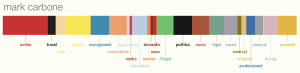
As an example the representation of ‘Mark Carbone’ looks like

 personas_example


This is a very interesting technology. Click here to try  your name.  I am sure you will enjoy checking out Personas.  Have fun with the profiler.

~ Mark