Category Archives: Leadership Perspective

K-12: Entrepreneurship 2.0

Further to my last blog post, Valuing Online Communities in the K-12 educational arena, I have been reflecting on the many possibilities of using social media tools to an advantage.

Mitch Joel discusses the five C’s of Entrepreneurship 2.0 in his book Six Pixels of Separation, and identifies them as follows:

  • Connecting
    • Connecting to Consumers
    • Building loyalty
    • Nurturing those connections to make more connections
    • Making money and growing
  • Creating
  • Conversations
  • Community
  • Commerce

He goes on to discuss strategies to use social media tools to achieve specific business goal(s). These tools have certainly leveled the playing field in terms of the potential to connect and get your message out.

What happens if we take out ‘business’ and replace it with ‘education’?

The goals of building strong connections between members like groups (administrators, teachers, support staff etc.) is key within an organization. Building a strong culture of learning and sharing is also important for the long term success of the organization. Furthermore, I believe building a community between these strategic groups to maximize learning and sharing with a focus on the ‘big picture collective goal(s)’ is also important.

It seems to me, the strategy of using the five C’s of Entrepreneurship 2.0 should be just as effective in the educational environment. Perhaps with the exception of making money, in my opinion, the other points are in strong alignment. If you were going to promote some new resource for example, I wonder what the impact would be of using social media tools as part of the promotion and marketing strategies would be?

After all, don’ t we want to

  • connect to our customers (internal, e.g. teachers)
  • build loyalty (return customers to continually use provided resources)
  • nurture these connections, and make new connections (connect more teachers & share)
  • grow (and engage)

I would say yes to all four points. This is, after all, part of the culture of a successful education organization too. IN addition to system announcements, posters etc., why not use social media tools to enhance these strategies?

Now, all that I need is a great project to give this a try!

~ Mark

K-12: Valuing online communities

I recently had an opportunity to present to our senior admin group to examine new directions concerning access to online resources. As part of the preliminary discussion, I outlined a frame of reference that included:

  • the value of online communities as an extension of school communities and classrooms, and
  • aligning internet resource selection processes with existing resource selection processes to form a basis of comparison as a starting point.

During the presentation, I made the following points to frame the discussion:

A growing body of evidence validates the importance of the sense of community within the learning environment for administrators, teachers and students alike. Benefits include:

  • promote life long learning
  • engaged learners
  • a sense of belonging and support
  • a culture of learning and sharing
  • communities are built on trust
  • embrace Character Development and Digital Citizenship ideals

In his book, Grown Up Digital, Don Tapscott promotes 7 strategies that support a ‘School 2.0’ environment. The strategies are summarized as follows:

  • Focus on the change in pedagogy, not the technology itself. Use technology for a student-focused, customized and collaborative learning environment
  • Reduce lecturing, broadcast learning does not work as effectively for this generation of learners. Allow the students to co-create a learning experience
  • Empower students to collaborate
  • Focus on life long learning
  • Use technology to get to know each student
  • Design programs that leverage the strengths of the Net Generation in project based learning
  • Reinvent your as an educator

Further to this presentation, I have been reading Six Pixels of Separation by Mitch Joel.  Mitch also documents some important characteristics of communities. Although some of these statistics are more business oriented, I feel there is a strong connection to educational based online communities. Mitch notes that community users:

  • spend more money that non community users
  • remain customers 50% longer than non community members
  • visit 9 times more often than non community members
  • login one or more times per day (56%)

Additionally, 43% of Internet user who are members of online communities say they feel ‘as srtongly connected’ to their virtual communities as their real world communities.

To my way of thinking, these are impressive statistics. Online communities are here stay, are highly valued by users and provide valuable professional learning and sharing opportunities. It seems to me that it is equally important to establish online communities as a natural extension to school communities and classrooms. It is time to charge ahead and embrace social media tools within the curricula, not as an option, but as a planned strategy of curriculum delivery and learning opportunties.

~ Mark

Sliding into 2010/2011

I always find this time of year interesting. On one hand you feel firmly entrenched in this year, focused on major projects and making sure things get completed before June is upon us. On the other hand, I find some of my attention starts to drift towards next school year – yikes! Our budget process has just been nudged into action. In many ways, this is viewed as a time to be thinking about priorities for the upcoming months.

More and more though, I am beginning to view multiple school years as a continuum. On the assumption that strategic planning and the Board and department levels have been done well, then projects and strategies still need to be executed in the right order, with the right priority level(s) and resourced appropriately. From my point of view, the bottom line is Stay the Course. If you had the right big picture priorities in the first place, then they should still be priorities. In our case, it will take another 3 years for some of our technology environment changes to be fully completed and implemented in a sustainable way – well worth it, is just takes time to do correctly.

Some of the ongoing massaging of supporting the big picture plan going forward is what captivates my interest:

  • maintaining the energy behind new processes
  • meeting the challenge of keeping staff trained and aligned with the true needs of the system
  • keeping the learning and IT agendas well aligned, stepping ahead in a strong partnership
  • determining the role of new technologies within the curriculum (netbooks, iPads, eBook readers etc.)
  • ongoing support for mobile learning
  • embracing new tools in a systemic way

I enjoy the time to reflect, and the opportunity to tweak the necessary components in an effort to maximize the achievement of our system goals.  More reflecting, analyzing and learning on the horizon.

~ Mark

School Blogging: A New Twist

Today I had the opportunity to attend a technology planning meeting at one of our elementary schools. As I anticipated, the conversation was engaging and the work session productive.

The Principal, Mr. James Bond, is certainly providing excellent curriculum leadership with well thought out technology integration plans which align with our system goals.  I was really impressed with the blogging initiative that has been started at the school and wanted to share a few highlights. In addition to the dedicated class blogs being run by some of the staff, Mr. Bond has also taken a unique approach to setting up a school blog.

The school blog project is designed to promote building an online school community. Accordingly, the blog is set up to allow everyone in the building to participate. Within the blog, a number of categories have been set up to organize the posts by topic. Teachers are assigned blog categories to monitor and be responsible for moderating. Each student is registered on the blog as a contributing author, which allows them to add posts or comments to any of the areas that interest them.  Mr. Bond indicated this strategy has guaranteed each student in the school has class time with at least one, but usually more than one, teacher who is active in the project at this point in time.

Blog post categories cover a wide range of topics and teachers are encouraged to try new ideas too. Some of the topics include math journals, book reviews, as well as many other areas of curriculum and general interest. The project has been underway for just one month, and steady growth in participation is already being observed. Teachers have observed that students are engaged in the writing process during school hours, and many contribute from home outside of school time too.

Our session finished with some discussion around strategies to share this exciting approach to build community and increase capacity within our Board and beyond. I look forward to watching this project grow, and my next visit to the school!

Related Resources

Mr. Bond’s Blog
Follow Mr. Bond on Twitter

~ Mark

2009: What’s Changed?

Last week, while waiting at Starbucks to meet my wife for a coffee, I fired up Tweetdeck on my iPhone and flipped through the recent list of Twitter updates. One that caught my interest was from Will Richardson asking “What changed in 2009?”. I read his reflective blog post at Weblogg-ed.com. Great question, great time to reflect and time to jump in with a blog post to respond.

Will specifically asks “So, as a way of taking stock, I’m asking, what’s changed?

I mean really changed in your school? What stories are there of moving wholesale to an inquiry-based curriculum, of real reinvention of assessments, of students participating in global learning networks, learning how to create their own personal networks around their own passions? Or even moving off of paper into a digital reading and writing space? Or moving from a teaching community to a learning community? Or other changes? My sense is that once again, there’s not all that much different today than a year ago.”

I will comment from two perspectives: personally, and from a K-12 system point of view. For me personally, 2009 was an amazing year filled with many projects, a lot of learning and many opportunities. Upon reflection, I consider all of the following to be successes for me:

  • began blogging mid year, still doing it, writing regularly, and having fun doing it
  • embraced Twitter and other social networking tools
  • actively participating in a number of online forums (ISTE, Ning, Classroom 2.0, Ontario Meetup etc.)
  • participating in the Ontario PLP cohort
  • developed a solid personal learning network (PLN)
  • completed a leadership course at the Queens University Business Executive Development Centre
  • continued participation with education committees/organizations including: OSAPAC, COCA, RCAC, OASBO

In the broader K-12 context in my Board, things ARE different than a year ago – maybe not in the ‘wholesale’ way quite yet, but they are in fact different. Specific targets that were set 12-18 months ago are being realized or are at least under way. Some of these successes include:

  • implementing our new shorter technology replacement cycle
  • roll out of wireless with network access control (NAC) is under way
  • convert 40 elementary schools to a new dual boot Mac environment (starting Jan. 2010)
  • mobile learning projects with iPod Touches in the classroom are underway
  • implementing our Library Learning Commons model for better system support
  • significantly improved alignment between Learning Services and IT departments
  • provided greater access to online resources (less content filtering) including access to some social media tools
  • planning new staff development strategies for Sept. 2010 to include social media component
  • more people are ‘involved’ than a year ago, and the thinkers and changers are better connected
  • more teachers and students are using blogs, wikis, media, inquiry based research/learning

What have I learned?

  • I can make a difference
  • I can participate
  • I can help to keep these important conversations going
  • I can initiate
  • educational change takes time
  • maybe we (the big picture we) are not ready (yet) for chaotic change given the variance of teacher understanding and readiness in the areas of technology use and embedding in the curriculum
  • there are indeed systematic approaches that can be taken to engage people and move the agenda forward – and we need to actively keep working on them

A Context for Continuing the Journey

At the end of the day, or school year, or graduation day for our students, I think we fundamentally will arrive in a similar place – we want to graduate students with:

  • certain experiences and character traits in place
  • well developed critical thinking and problem solving skills
  • strong skills in writing and a variety of literacies
  • developed emotional intelligences
  • creativity
  • etc. ( I am not attempting to generate the perfect list here, just make a point)

Maybe we don’t need to revisit/review/change every classroom, teacher and instructional practice. What we can change, in a broader strategic manner with impact, is the journey that happens between enrollment and graduation.We do need to systematically put things in place so that each child that journeys through a system has some guaranteed experiences. These experiences should also include:

  • readiness to live and work in a technology oriented world
  • embedded technology supported learning
  • collaborative online experiences
  • social media use and awareness
  • participate in a culture of sharing
  • digital literacies and digital citizenship

Count me in! This is doable. The question is how do we achieve greater invovlement, provide the right ‘enablers’, keep costs down, change things at the systemic level at a greater rate of change, keep the energy behind sustained change and yet without ‘upending the apple cart’? Personally, I am looking forward to 2010 to keep working on this agenda. When 2011 arrives, I want to look back at 2010 and say that more change has occurred and that I made a difference.

~ Mark
Edu chit chat at ground level

We kicked today off with a lovely brunch hosted by very close friends – a perfect way to start the day! Many of the people in attendance are connected to the education scene in one way or another. Collectively we covered the range of parents, secondary teachers and department heads, vice principal, recently retired principal, university profs, soon to be teachers and me.

Of course, there was a healthy round of catching up on what is happening with the various families, plans for the festive season and, teachers being teachers, some ‘shop talk’ about what everyone was doing. So …. when it was my turn, I dived into the Ontario PLP experience I was enjoying and chatted about the potential powerful uses of social media tools in our system. Well, talk about start a multi dimensional conversation. I think we could have had a 2 day symposium with the brunch gang to explore the pros and cons all of the various options.

As a group, we represented decades of solid teaching experience. As a group, we represented an extremely diverse experiences in the areas of using, adopting (and embedding) technology in the way we teach, work and live.  We hit the whole range (minimum to maximum) of personal comfort levels, willingness to embrace new technologies, student engagement, the powerful potential of the tools available today and how the use of these tools would/could impact education in positive ways — a fascinating discussion to say the least.

We did cover one last point, and I saved it to last so it could stand on its own for emphasis — and it really struck a chord with me. The general consensus was that the typical teacher of today is not ready to embrace social media tools at this point in time for a number of reasons. At ‘ground level’

  • only a small percentage actually use social media tools
  • most teachers are not comfortable with the tools themselves, let alone embrace them in teaching
  • most teachers have not thought about embracing the power of social media in useful ways to support curriculum delivery
  • many teachers are not sure about the level of engagement the use of these tools may bring
  • some are curious about this ‘new world’

So, in yet another setting, we end up back at some of my favourite pondering points:

  • building communities and cultures of sharing
  • getting more teachers involved
  • etc., you can read my ‘list’ in an earlier blog post from this week

The important aspect of arriving at my favourite pondering points (again) is that I really trust the observations, opinions and insights that this group has about where things are at ‘in the field’. In some ways, this conversation was a reality check. Is the gap getting wider? In general, are we ‘preaching to the choir’?  More thinking and planning about systemic change, impacting the educational front etc. In some ways this is a nice lead into Will Richardson’s question, “what changed in 2009?”  Watch for an upcoming blog post where I will share my views on what changed.

~ Mark

Ontario Meetup: Are We Asking the Right Questions?

The recent Ontario Meetup online session provided the anticipated engaging discussion of educational directions. This particular session was led by @courosa. The discussion centred around the intersecting tensions in the K-12 educational environment between building online communities, embracing the value and power of social media tools and content filtering.

@dougpete captured the key points in his recent blog post  Getting Priorities Straight.  I have had the pleasure of having many engaging discussions with Doug around this very topic. I think he hit the nail on the head with his statement “From what we can see, there’s a real tightrope to be walked to reach the other side and keep the organization’s needs and the needs of the end user in balance”.

As I listened and participated in the online session, which wandered between the benefits and challenges with each of these areas, and since reflected on the nature of the discussion, it struck me that there may be a ‘new lens’ in the midst of this discussion. I am beginning to wonder if we are focusing on the right questions. It is my observation that there is a trend developing in these discussions:

  • building learning communities is the right thing to do in an educational environment
  • building a culture of sharing is important
  • content filtering policies can get in the way of reaching these goals

What I find troubling in these discussions, is that they often narrow to a focus on YouTube and Facebook, almost implying that the only way to achieve these goals is with the specific use of these tools.  I think the ‘new lens’ or focus on this topic needs to look at this from a different point of view. I am thinking more about change at the system level to embrace this in a more holistic way. Certainly, simply unblocking a site or two does not mean an education system of several thousand staff and students is ready to change and be instantly successful.

Assuming that building learning communities and establishing this culture of sharing are important, and fundamentally the right place to ‘get to’, perhaps the questions that need addressing are:

  • How do we get more people involved?
  • How do we make them comfortable in their journey to ‘jump in’ to this new world?
  • How do we best teach, practice and embed character development and digital citizenship for both students and staff?
  • How do we keep training costs to a minimum so that this does not become a barrier?
  • How do we move this agenda forward with or without the specific use of  ‘magnet’ sites such as YouTube and/or  Facebook?
  • How do we select some free/low cost tools so that
    • cost is not a barrier
    • there is some elements of consistency as teachers change grades and/or schools
    • the integrity of the environment (the ‘network’ = internal + internet) is reliable for all to use for both learning and business functions
  • Should there be some thought put into the ‘gradual release of responsibility’ concept being applied to social media use as there is in other curriculum areas?
  • As things change, and opportunities present themselves, we are promoting and celebrating the change(s)

These are the questions whirring though my mind. I want to extend a thank you to my PLP group and the participants of the Ontario Meetup group for continuing this important dialogue and keeping the discussion going. More thinking and planning to do!

~ Mark

New Facebook Privacy Settings Get Mixed Reaction

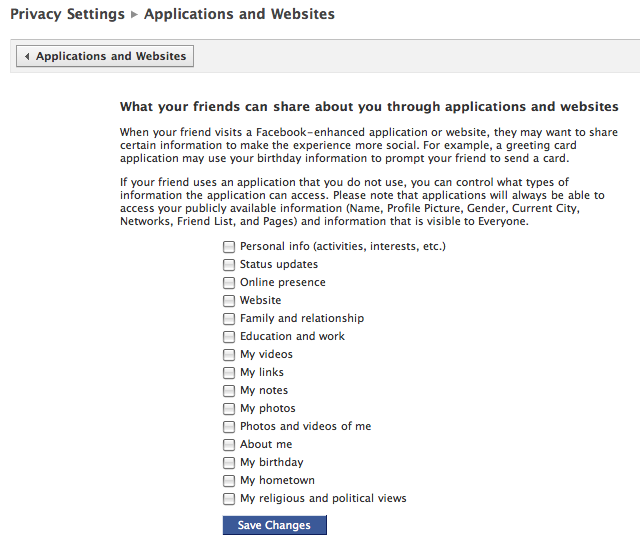
There has been a fair bit of hype around the promised improvements to Facebook privacy settings. The release of the new privacy settings format this week has come with a mixed reaction from users and privacy advocates. Many users claim some settings are in fact more open than they were before and that it is easier for users to give out details they may not wish to share.

The first time you log in since the new settings were put in place, you are prompted to review and update your settings. As you can see from the screen capture below, there is a long list of things impacting your privacy options to work through and check.

Personally, I was disappointed to see that some of the settings default to friends of friends. I was certainly hoping for default settings to be more locked down with the onus on the user to open up the settings to their liking. In working through this new setup, I noticed that not all settings seemed to adhere to the way I set them the first time through.

Be aware, and be safe online. Take the time to complete a thorough review of your settings. I would recommend the following actions:

  • a detailed review of ALL of your settings with appropriate changes saved
  • logout
  • login
  • recheck the settings for verification

I believe there continues to be more work for privacy and online safety advocates to do.

Related Reading

From the Facebook blog: new privacy tools
ABC News: 5 things to know about the new Facebook privacy settings.
Yahoo News: Privacy Advocates slamFacebook change

~ Mark

RCAC: Managing the Gap

One of the things I really enjoyed about the RCAC event this week was meeting people for the first time that I have only known though online interactions. It was truly a pleasure to meet @thecleversheep, @peterskillen and @aforgrave.

The format of the RCAC day is keynote, break out sessions, lunch, keynote and another round of break out sessions. This formula works well, and there is always a good selection of presenters and topics for the break out sessions. This year, I had registered for a presentation about the Creative Commons. What a pleasant surprise to discover that the session was being presented by @thecleversheep, who I had been following for some time on Twitter.  How wonderful to meet a kindred spirit who shares the same passion about copyright, licensing, managing content in appropriate ways in the web 2.0 world and spreading the word about digital citizenship!

I really liked the framework used to discuss content from a cradle to grave perspective: creation, ownership and rights of use through to public domain. You own the rights to content you create (original or using legal sources), all rights reserved and 50 years after your death, it becomes part of the public domain. The ‘gap’, defines the timeframe between creation and public domain. The Creative Commons provides a great way for you to formally indicate a specific type of copyright licensing and use of your work(s) while you are alive. Licensing typically fall into the  areas of:

  • attribution
  • share alike
  • non commercial
  • non derivative
  • and combination of these principles

Detailed license descriptions are available at the Creative Commons website. Excellent examples were given to illustrate music, videos, written content and remix/mashups. I had to smile when audience questions were taken at the end of the session and the answers to some scenarios were ‘that’s illegal’ and ‘that breaks copyright’. Just because something is easy to do with technology does not mean it is legal to to it.  The Clever Sheep knows his stuff !

I would encourage you to visit the Clever Sheep website and view the Creative Commons for RCAC article. Thanks for a great session, being a creative teacher and promoting digital citizenship.

Thank you to @dougpete and his organizing team for a great learning opportunity.

~ Mark

Social Media ID Probe

Question of the day: How willingly do social network users give up personal data?

This very question has been explored by Sophos UK. Sophos conducted testing in 2007 and 2009. The results may surprise you.

Given the efforts put into promoting and raising the awareness levels of Digital Citizenship, online safety and privacy, I would have anticipated a trend of improvement to be reflected in the results. However, this was not the case. I wonder if a big factor in this result stems from the continuing growth in the numbers of social network users. The Facebook blog currently reports over 300 million users. Just a few months ago the number was in the 250 million range. TwitDir, a Twitter directory currently shows 5.3 million users with an aggressive growth rate. Some estimates place the Twitter growth rate at 1382%. The reality is that this means there are high numbers of relatively inexperienced social networkers in the mix at any given point in time who may not be as savvy as more experienced online users.

Some highlights from the testing showed that:

  • 41 – 46% of users probed blindly accepted a friend request
  • one of the ‘blind friends’ was in fact a plastic duck
  • younger users tend to give out information more freely

Actual results of the probe are summarized in the chart below.


I would encourage you to read the report and recommendations for online safety at Sophos.com. From my point of view, the results indicate that there is considerable work to do in the area of Digital Citizenship and online safety.

~ Mark